
Free Safe Operating Procedure (Impact Driver) Template
Establish clear, safe work methods for using impact drivers with our free template. Download this customisable Safe Operating Procedure to improve workplace safety.
Free Safe Operating Procedure (Impact Driver) Template
DOCX • 126 KB + PDF
Updated Oct 2026
No signup required
Purpose of the Free Safe Operating Procedure (Impact Driver) Template
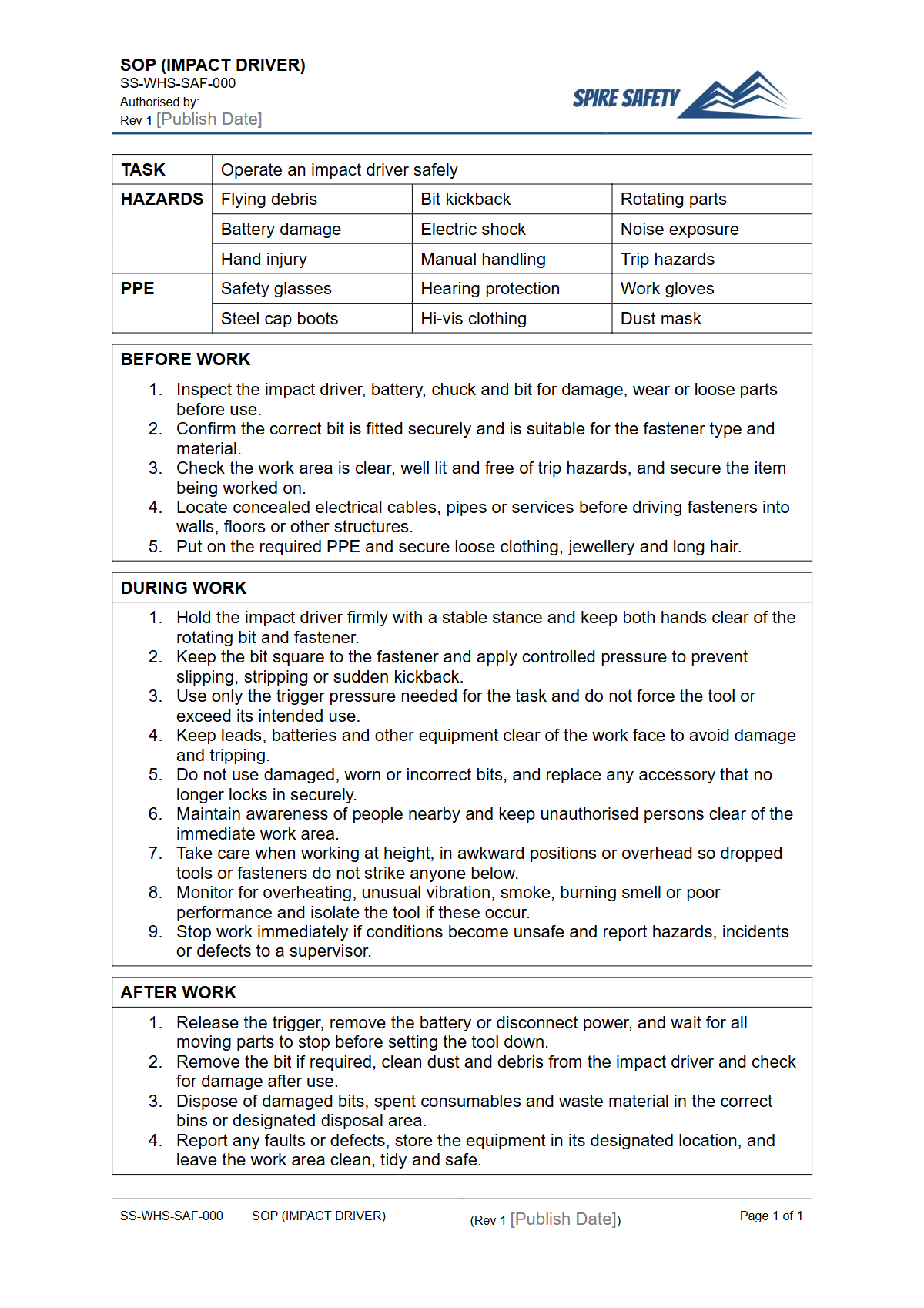
This Free Safe Operating Procedure (Impact Driver) Template provides a structured framework for documenting the required steps to safely operate an impact driver. An SOP is a critical tool for any workplace, ensuring tasks are performed consistently and safely by all personnel.
For high-torque power tools like impact drivers, a clear SOP helps minimise risks such as injuries from kickback, flying debris, and ergonomic strain. It serves as a fundamental component of your overall WHS management systems, demonstrating a commitment to proactive risk control and worker training.
Using this template helps a Person Conducting a Business or Undertaking (PCBU) meet their primary duty of care under Australian WHS legislation. It provides a documented process for training, hazard identification, and risk control measures specific to impact driver use.
The procedure outlines pre-start checks, operational steps, and post-use maintenance, creating a comprehensive guide for operators.
Video walkthrough
How to use the Free Safe Operating Procedure (Impact Driver) Template
Our template is available for immediate download in both DOCX and PDF formats. The DOCX version is fully editable, allowing you to tailor the content to the specific models of impact drivers, tasks, and environmental conditions found in your workplace.
Simply download the file and open it in Microsoft Word or a compatible program to begin customisation.
Important: This document is a template only. For it to be effective, you must customise it to reflect the specific hazards and control measures relevant to your workplace.
We recommend a competent person conducts a risk assessment on the use of your impact driver(s) and incorporates the findings into the final SOP. If you require assistance with this process, our WHS consulting services can provide expert guidance.
When to use an Impact Driver SOP
A Safe Operating Procedure for an impact driver should be a living document, integrated into your daily operations. It is essential during several key activities:
- Worker Induction and Training: Use the SOP as a primary training tool for new employees or workers unfamiliar with the specific model of impact driver.
- Pre-Start Checks: Operators should reference the SOP's checklist before each use to ensure the tool is in safe working order.
- Refresher Training: Periodically review the SOP with all authorised operators to reinforce safe work practices and communicate any updates.
- Incident Investigations: Following a near-miss or incident, the SOP should be reviewed to determine if procedures were followed and if any amendments are necessary.
- Audits and Inspections: The SOP serves as evidence of a formalised safety process during internal or external safety audits.
Just as you would maintain a free Circular Saw SOP for cutting tasks, this procedure should be readily accessible wherever impact drivers are used.
Who should use it
The responsibility for using and maintaining the Impact Driver SOP extends across multiple roles within an organisation:
- Workers/Operators: Must read, understand, and follow the procedure every time they use an impact driver. They are responsible for conducting pre-start checks and reporting any faults or hazards.
- Supervisors and Team Leaders: Are responsible for ensuring that workers are trained on the SOP and adhere to it. They must also enforce its use and monitor for compliance.
- Health and Safety Representatives (HSRs): May use the SOP during workplace inspections and consultations to verify that adequate safety controls are in place.
- Managers/PCBUs: Hold the ultimate responsibility for ensuring that an effective SOP is developed, implemented, and regularly reviewed as part of the broader safety management system. A comprehensive Air Compressor SOP template should also be in place if pneumatic tools are used.
Key Elements of an Impact Driver SOP
A robust SOP for an impact driver should cover several critical areas. This template provides sections for pre-operational checks, including inspecting the battery, housing, chuck, and ensuring the correct impact-rated bit is selected.
The operational section details the sequence of work, focusing on maintaining a firm grip, correct posture, and awareness of surroundings. Post-operational steps include cleaning the tool, proper storage, and battery charging protocols. Documenting these elements is not just good practice; it's a key part of the evidence reviewed during formal WHS compliance audits. For a wider selection of safety documents, explore our complete free WHS resources library.
Common mistakes
Common mistakes to avoid
- Using standard screwdriver bits or sockets, which are not impact-rated and can shatter under force.
- Failing to wear mandatory PPE, especially safety glasses to protect from flying debris.
- Applying excessive force or poor posture, leading to stripped fasteners, damaged work surfaces, or ergonomic injury.
- Neglecting pre-start checks, such as inspecting the bit holder, battery connection, and housing for damage.
Legal references
Legal considerations
The following legal requirements may be relevant to this type of work.
- Work Health and Safety Act (Harmonised) — Provides the primary duties for protecting workers and other people from work health and safety risks.
- Work Health and Safety Regulations (Harmonised) — Sets out requirements supporting the management of workplace hazards and risks.
The following codes may be relevant to this type of work.
- Managing WHS Risks Code of Practice — Provides practical guidance on identifying hazards, assessing risks and applying effective controls.
- Work Health and Safety Consultation, Cooperation and Coordination Code of Practice — Provides practical guidance on consulting workers and coordinating with other duty holders.
- Managing the Work Environment and Facilities Code of Practice — Provides practical guidance on safe work environments, workplace facilities and related controls.
Did you know
Torque vs. Speed
Impact drivers generate significantly more torque than standard drills, but often have a lower rotational speed (RPM). This high torque is what makes them so effective at driving fasteners but also introduces risks like kickback and fastener shearing if not controlled.
Hearing Protection is Key
The rapid impacts that give the tool its name can produce noise levels well over 85 dB(A). The model Code of Practice for Managing Noise recommends hearing protection for any exposure above this level to prevent permanent hearing damage.
FAQ
Frequently asked questions
01Is an SOP mandatory for an impact driver in Australia?
02What's the difference between an impact driver and a standard drill driver?
03How often should an impact driver SOP be reviewed?
04Can I use this template for both battery-powered and pneumatic impact drivers?
Share this resource
Free Safe Operating Procedure (Impact Driver) Template
Browse Categories
How To Use It
- 1Download and open in Word or PDF.
- 2Replace the placeholders with your business details.
- 3Get it reviewed by a WHS specialist before rollout.
Need it customised?
Our WHS consultants can adapt this template to your site, run a gap analysis, or audit what you already have in place.
Book a Free Consultation WHS consulting servicesor call 1300 156 382
Related templates
- Free Safe Operating Procedure (Impact Wrench) Template
- Free Safe Operating Procedure (Inboard Motor) Template
- Free Safe Operating Procedure (Inbound Freight Check) Template
- Free Safe Operating Procedure (Inbound Load Staging) Template
- Free Safe Operating Procedure (Incontinence Linen Bag) Template
- Free Safe Operating Procedure (Incubator) Template