
Free Safe Operating Procedure (Incubator) Template
Formalise the safe use of laboratory or agricultural incubators with our structured Safe Operating Procedure. Download this free, customisable template today.
Free Safe Operating Procedure (Incubator) Template
DOCX • 126 KB + PDF
Updated Oct 2026
No signup required
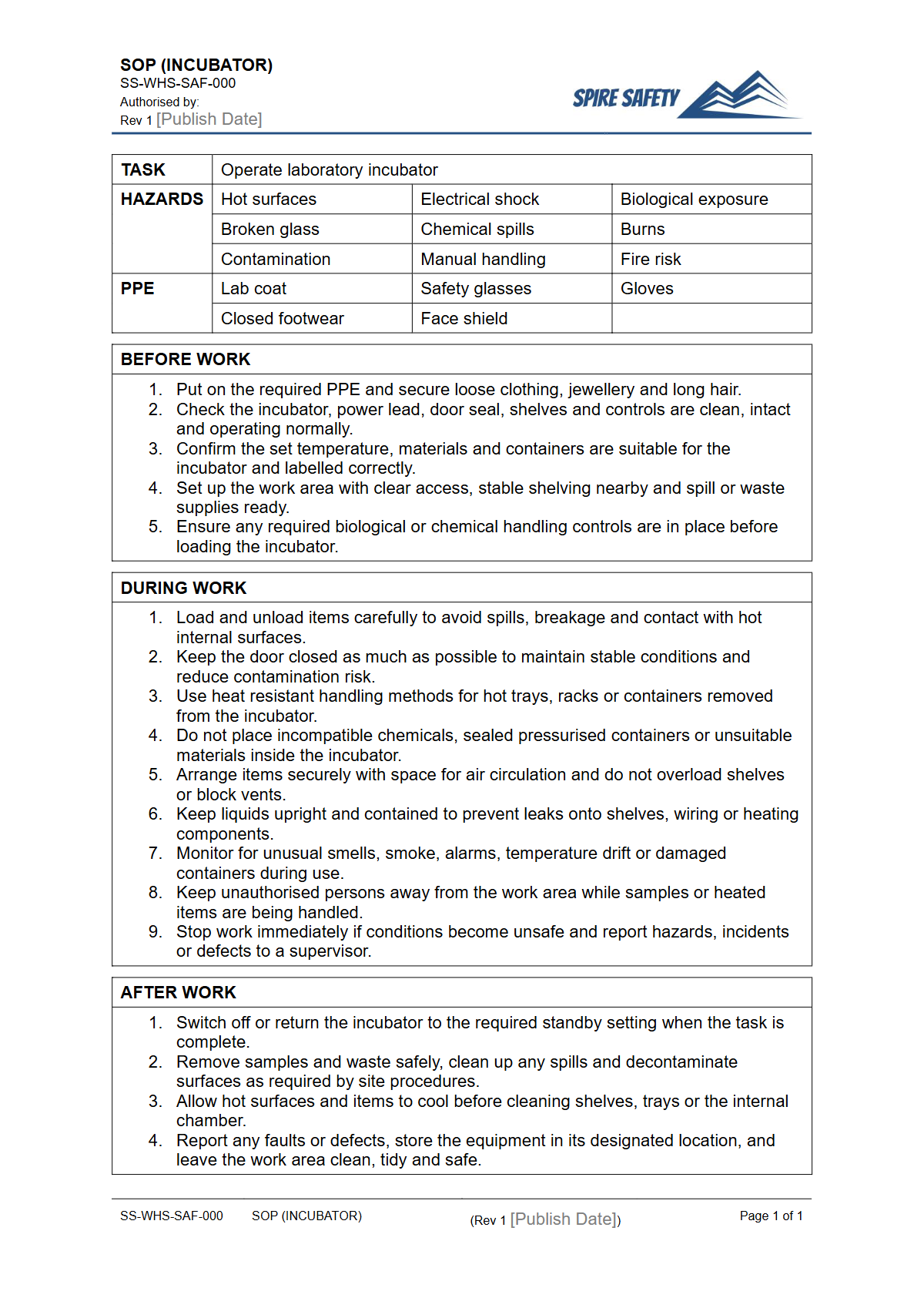
Purpose of the Free Safe Operating Procedure (Incubator) Template
Operating laboratory or agricultural incubators involves specific risks, including electrical hazards, exposure to biological agents, thermal burns, and potential for cross-contamination. This Free Safe Operating Procedure (Incubator) Template provides a structured framework for documenting the required steps to operate this equipment safely.
A well-developed SOP is a critical tool for mitigating these risks, ensuring consistent operational practices, and providing a reliable basis for worker training and competency assessment.
By clearly outlining pre-operational checks, step-by-step operating instructions, and shutdown procedures, this document helps create a safer work environment. It serves as a key component within broader WHS management systems, demonstrating a commitment to proactive risk management.
Implementing a formal SOP reduces the likelihood of incidents, protects valuable samples or cultures, and ensures the equipment is maintained and used as intended by the manufacturer.
Video walkthrough
How to use the Free Safe Operating Procedure (Incubator) Template
This document is provided in both DOCX and PDF formats for your convenience. The DOCX version is fully editable, allowing you to adapt the content to your specific workplace requirements.
To effectively use this Free Safe Operating Procedure (Incubator) Template, you should methodically work through each section, replacing the placeholder text with information relevant to your site's equipment, materials, and environment.
IMPORTANT: This document is a template and must be customised to reflect the specific incubator models, substances, processes, and control measures in your workplace. We recommend a competent person, such as a lab manager or WHS advisor, reviews and approves the final document before it is implemented.
The final SOP should be used as a primary training document for all personnel who will operate the incubator.
Key Elements to Customise
- Plant & Equipment Details: List the specific make, model, and location of the incubator(s) covered by the SOP.
- Potential Hazards: Identify all credible hazards associated with your specific incubator and the materials used within it (e.g., specific biohazards, chemical exposure, electrical faults, ergonomic strains from loading/unloading).
- Control Measures: Detail the specific controls you have in place, including required Personal Protective Equipment (PPE), ventilation, and emergency shutdown procedures.
- Training & Competency: Define the training requirements for operators and how their competency will be verified and recorded.
- Emergency Procedures: Outline the steps to take in case of a spill, power failure, fire, or other foreseeable emergency.
When Should an Incubator SOP Be Used?
A Safe Operating Procedure for an incubator should be a living document that is integrated into daily operations. It is not a file-and-forget compliance document.
It should be readily accessible to all relevant workers, ideally located near the equipment itself for easy reference. Prime usage occasions include during the induction and training of new employees, as a reference for refresher training, and as a guide for supervisors monitoring safe work practices.
Furthermore, the SOP should be formally reviewed and updated whenever there is a change to the equipment, the process, or the substances being used. It is also essential to review the SOP following any incident or near miss involving the incubator to incorporate any learnings and prevent recurrence. Regular reviews are also a key part of maintaining safety standards, often verified during WHS compliance auditing.
What Hazards Should an Incubator SOP Address?
While often seen as simple equipment, incubators present a range of hazards that must be managed. Your SOP should clearly identify and provide controls for these risks. Common hazards include:
- Biological Hazards: The primary function of many incubators is to grow microorganisms. The SOP must detail procedures for handling pathogenic or genetically modified organisms, preventing spills, and effective decontamination to protect workers and prevent cross-contamination.
- Thermal Hazards: Incubators operate at elevated temperatures, creating a risk of contact burns on hot surfaces. Similar to other heated equipment, documented procedures are key, just as they are in our Safe Operating Procedure for deep fryers.
- Electrical Hazards: Like all mains-powered equipment, incubators pose risks of electric shock, especially if damaged or used in wet environments. Procedures for inspection of cords and plugs are essential.
- Chemical Hazards: If volatile or hazardous chemicals are used within the incubator or for cleaning, the SOP must reference the relevant Safety Data Sheets (SDS) and outline safe handling procedures.
- Ergonomic Hazards: For large, floor-standing incubators, the SOP should address manual handling risks associated with loading and unloading heavy racks or samples.
Your organisation may use a wide array of specialised equipment, each requiring its own SOP. For example, processes in a workshop setting would be covered by documents like our free Air Compressor SOP template, demonstrating how procedures are tailored to specific machinery.
You can find more examples in the Spire Safety's free WHS resources library to build out your documentation.
Common mistakes
Common mistakes to avoid
- Using the template without customising it for the specific incubator model and tasks.
- Failing to include detailed cleaning, disinfection, and decontamination procedures.
- Neglecting to train workers on the finalised SOP and verify their understanding.
- Not making the SOP easily accessible to operators near the equipment.
Legal references
Legal considerations
The following legal requirements may be relevant to this type of work.
- Work Health and Safety Act (Harmonised) — Provides the primary duties for protecting workers and other people from work health and safety risks.
- Work Health and Safety Regulations (Harmonised) — Sets out requirements supporting the management of workplace hazards and risks.
The following codes may be relevant to this type of work.
- Managing WHS Risks Code of Practice — Provides practical guidance on identifying hazards, assessing risks and applying effective controls.
- Work Health and Safety Consultation, Cooperation and Coordination Code of Practice — Provides practical guidance on consulting workers and coordinating with other duty holders.
- Managing the Work Environment and Facilities Code of Practice — Provides practical guidance on safe work environments, workplace facilities and related controls.
Did you know
Inspired by Chickens
The modern medical infant incubator was developed in the 1880s by Dr. Stéphane Tarnier in Paris after he saw chicken incubators at a local zoo and adapted the principle for premature babies, dramatically reducing infant mortality.
FAQ
Frequently asked questions
01What is the purpose of a Safe Operating Procedure for an incubator?
02Are incubators a workplace hazard?
03How often should an incubator SOP be reviewed?
04Who is responsible for writing an SOP for an incubator?
Share this resource
Free Safe Operating Procedure (Incubator) Template
Browse Categories
How To Use It
- 1Download and open in Word or PDF.
- 2Replace the placeholders with your business details.
- 3Get it reviewed by a WHS specialist before rollout.
Need it customised?
Our WHS consultants can adapt this template to your site, run a gap analysis, or audit what you already have in place.
Book a Free Consultation WHS consulting servicesor call 1300 156 382
Related templates
- Free Safe Operating Procedure (Induction Cooktop) Template
- Free Safe Operating Procedure (Induction Heater) Template
- Free Safe Operating Procedure (Industrial Fan) Template
- Free Safe Operating Procedure (Industrial Robot) Template
- Free Safe Operating Procedure (Industrial Sewing Machine) Template
- Free Safe Operating Procedure (Industrial Vacuum) Template