
Free Safe Operating Procedure (Industrial Robot) Template
Download our free Safe Operating Procedure for industrial robots. This template provides a starting point for creating your own site-specific safety document.
Free Safe Operating Procedure (Industrial Robot) Template
DOCX • 126 KB + PDF
Updated Oct 2026
No signup required
Purpose of the Free Safe Operating Procedure (Industrial Robot) Template
This free Safe Operating Procedure (Industrial Robot) template provides a structured starting point for organisations to document the safe use of industrial robots in the workplace. The primary purpose of a Safe Operating Procedure (SOP) is to provide clear, step-by-step instructions that guide workers, ensuring tasks are performed consistently and safely every time.
Using this template helps to manage high-risk activities associated with robotic systems, such as automated welding, materials handling, assembly, or painting.
Industrial robots introduce significant hazards, including impact and crushing from moving parts, entanglement, and electrical or pneumatic energy risks. A documented procedure is a critical control measure that helps mitigate these risks.
By formalising the process, you create a vital training tool for new operators and a reference for experienced staff. Implementing robust SOPs is a cornerstone of effective WHS management systems, demonstrating a commitment to proactive risk management and workplace safety.
What's included in the template?
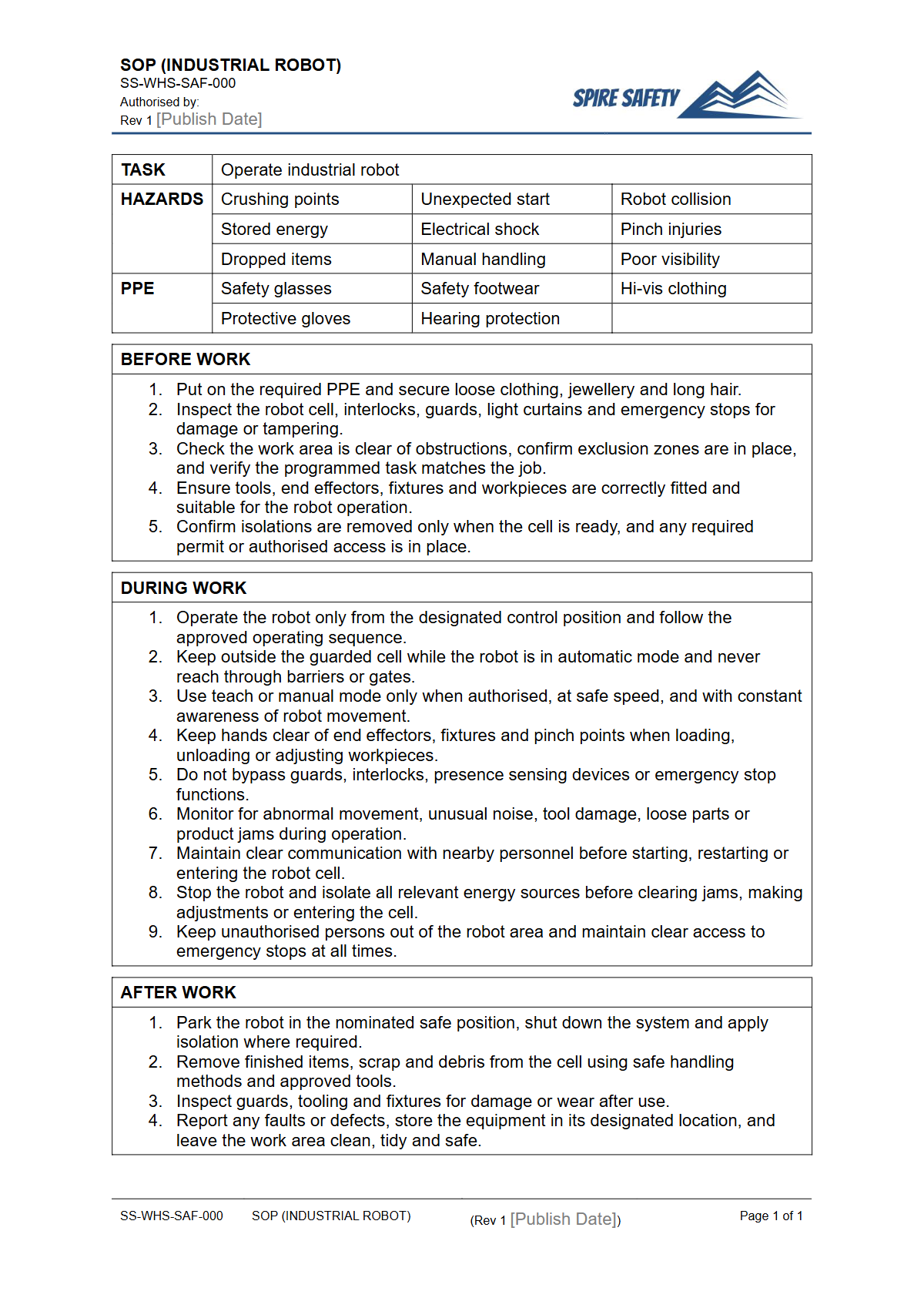
This downloadable document includes sections for:
- Required Personal Protective Equipment (PPE)
- Hazard identification and risk controls
- Pre-operational safety checks
- Step-by-step operating instructions
- Shutdown and cleaning procedures
- Emergency procedures and contacts
Video walkthrough
How to use the Free Safe Operating Procedure (Industrial Robot) Template
This template is provided in both DOCX and PDF formats. The DOCX file is fully editable, allowing you to tailor the content to your specific operational needs.
The PDF version can be used as a quick reference or for static distribution. To effectively use this resource, you must conduct a thorough risk assessment of your specific robotic equipment and the tasks it performs.
The findings of this assessment should be used to populate and refine the sections of the template.
Important: This document is a template, not a completed procedure. We have provided a framework, but it is your responsibility to customise the content to reflect the unique models, configurations, guarding, software, and work environment of your site.
Ensure a competent person reviews and approves the final document before it is implemented. The effectiveness of this SOP relies entirely on its accurate customisation for your workplace.
Many industrial automation cells combine robots with other machinery. If your system includes automated transport, you may also benefit from reviewing our Conveyer System SOP template to ensure all components are managed safely.
When to use it
A Safe Operating Procedure for an industrial robot should be developed and in place before the equipment is first used. It serves as a foundational document for operator training and competency verification.
The SOP should be readily accessible in the work area and used as a day-to-day reference guide. It is also critical to review and update the SOP regularly.
A review should be triggered whenever there is a change to the machinery, process, or control measures; after an incident or near miss; or as part of scheduled WHS compliance auditing to ensure its continued relevance.
Who should use it
This document is intended for use by Persons Conducting a Business or Undertaking (PCBUs), managers, and supervisors responsible for the safety of automated workplaces. They should use the template to develop and implement a site-specific procedure.
Operators and maintenance personnel are the primary end-users of the finalised SOP. They must be trained on its contents and follow the prescribed steps to ensure their own safety and the safety of others.
WHS representatives and committee members should also be involved in the review and consultation process to ensure the procedure is practical and addresses all identified hazards.
Ancillary equipment required to support the robot, such as pneumatic systems, must also be operated and maintained safely. Your risk assessment may identify the need for separate procedures, such as our Air Compressor SOP, to cover associated plant.
Developing effective SOPs for complex machinery can be challenging. If you require assistance with risk assessments or procedure development, Spire Safety offers expert WHS consulting services to help you meet your obligations.
Explore our complete free WHS resources library for more templates, checklists, and guides to support your safety management system.
Common mistakes
Common mistakes to avoid
- Using a generic template without customising it for the specific robot model, application, and workplace layout.
- Failing to develop procedures for non-routine tasks like maintenance, cleaning, programming, or fault recovery.
- Assuming operators understand all robot fault codes and error messages without specific training.
- Becoming complacent and entering the robot's work envelope while it is still powered or not properly isolated.
Legal references
Legal considerations
The following legal requirements may be relevant to this type of work.
- Work Health and Safety Act (Harmonised) — Provides the primary duties for protecting workers and other people from work health and safety risks.
- Work Health and Safety Regulations (Harmonised) — Sets out requirements supporting the management of workplace hazards and risks.
The following codes may be relevant to this type of work.
- Managing WHS Risks Code of Practice — Provides practical guidance on identifying hazards, assessing risks and applying effective controls.
- Work Health and Safety Consultation, Cooperation and Coordination Code of Practice — Provides practical guidance on consulting workers and coordinating with other duty holders.
- Managing the Work Environment and Facilities Code of Practice — Provides practical guidance on safe work environments, workplace facilities and related controls.
Did you know
Non-Routine Risks
The majority of accidents and fatalities involving industrial robots occur during non-routine tasks like maintenance, programming, testing, and troubleshooting when personnel are required to enter the robot's normally-guarded work cell.
FAQ
Frequently asked questions
01What are the main hazards of working with industrial robots?
02Is a Safe Operating Procedure legally required for industrial robots in Australia?
03How often should an industrial robot SOP be reviewed?
04Can this template be used for collaborative robots (cobots)?
Share this resource
Free Safe Operating Procedure (Industrial Robot) Template
Browse Categories
How To Use It
- 1Download and open in Word or PDF.
- 2Replace the placeholders with your business details.
- 3Get it reviewed by a WHS specialist before rollout.
Need it customised?
Our WHS consultants can adapt this template to your site, run a gap analysis, or audit what you already have in place.
Book a Free Consultation WHS consulting servicesor call 1300 156 382
Related templates
- Free Safe Operating Procedure (Industrial Sewing Machine) Template
- Free Safe Operating Procedure (Industrial Vacuum) Template
- Free Safe Operating Procedure (Infrared Thermometer) Template
- Free Safe Operating Procedure (Ingredient Decanting) Template
- Free Safe Operating Procedure (Injector Cleaning) Template
- Free Safe Operating Procedure (Inkjet Coder) Template