
Free Safe Operating Procedure (Ingredient Decanting) Template
Manage risks from ingredient decanting with our free Safe Operating Procedure. This customisable template helps formalise safety steps for your workplace.
Free Safe Operating Procedure (Ingredient Decanting) Template
DOCX • 126 KB + PDF
Updated Oct 2026
No signup required
Purpose of the Free Safe Operating Procedure (Ingredient Decanting) Template
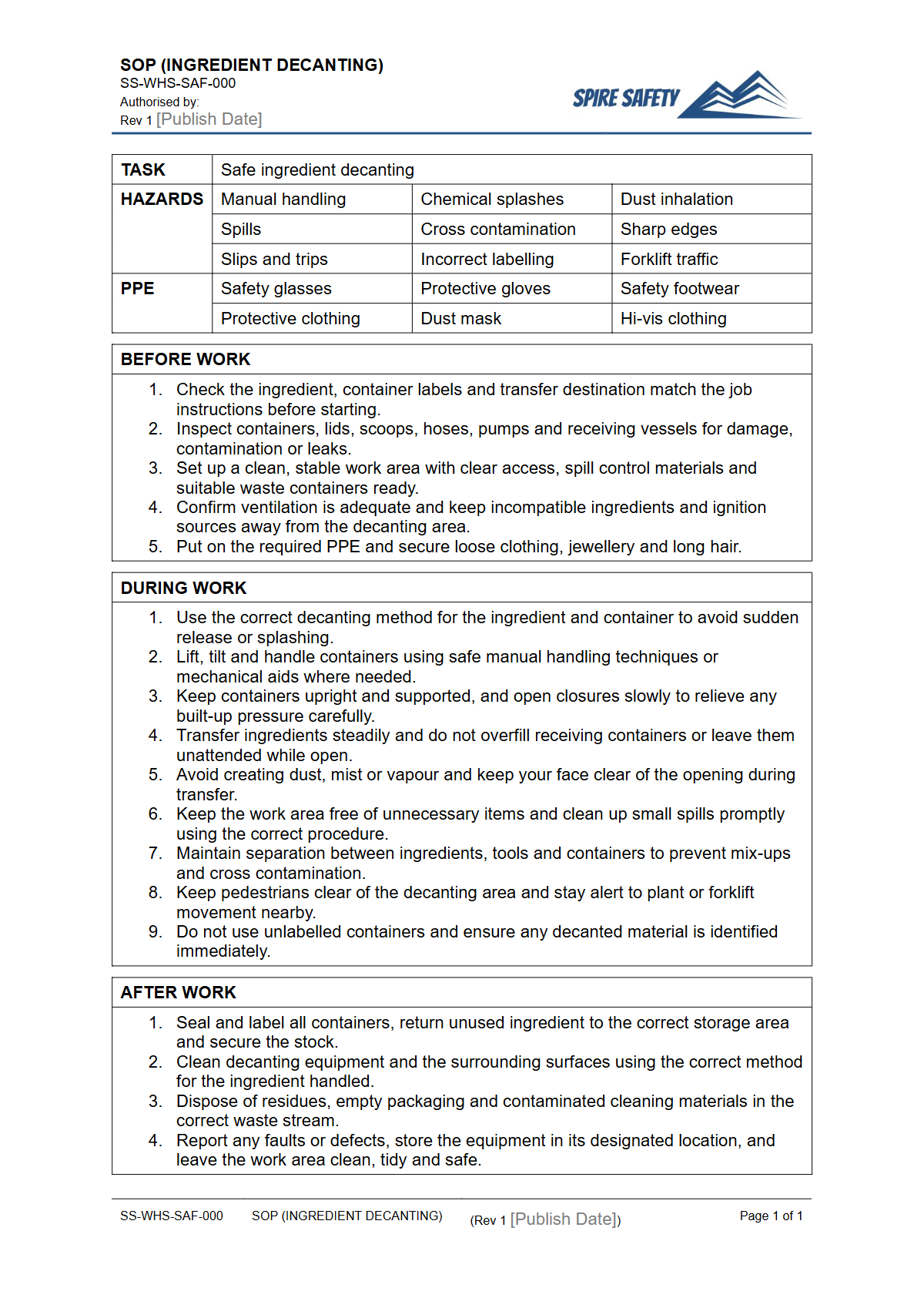
A Safe Operating Procedure (SOP) is a critical tool for ensuring tasks are performed safely and consistently. This free Safe Operating Procedure (Ingredient Decanting) Template provides a structured starting point for your business to document the process of transferring ingredients from one container to another.
It helps manage risks associated with hazardous substances, manual handling, and potential contamination, aligning your processes with Australian WHS best practice. By formalising the steps, you create a safer working environment and provide clear instructions for all personnel involved in handling ingredients.
Ingredient decanting, while seemingly simple, carries inherent risks such as chemical splashes, inhalation of powders or vapours, spills creating slip hazards, and ergonomic strains from lifting heavy containers. A documented SOP ensures that every worker follows the same safety-checked process, using the correct Personal Protective Equipment (PPE) and handling techniques every time. This procedure is a fundamental component of a robust safety framework and demonstrates a commitment to proactive risk management within your organisation's WHS management systems.
Video walkthrough
How to use the Free Safe Operating Procedure (Ingredient Decanting) Template
This template is provided as a fully editable DOCX file, allowing you to tailor it precisely to your operational needs. A PDF version is also available for easy distribution and viewing.
To use the template effectively, you must replace the placeholder text with information specific to your workplace, including the types of ingredients being decanted, the equipment used, the specific PPE required, and your emergency procedures.
Important: This document is a template and must be customised to suit the specific ingredients, equipment, and environment of your workplace. We recommend a competent person, in consultation with workers who perform the task, completes this customisation process.
A generic procedure is not sufficient to meet your duty of care. For example, the controls for decanting flammable liquids will differ significantly from those for decanting food-grade powders, just as procedures for using workshop equipment require their own specific instructions, like in our free Air Compressor SOP template.
When to use this Safe Operating Procedure
An SOP for ingredient decanting should be an active, living document within your safety system. It is not a 'set and forget' policy.
It should be used in several key situations to maximise its effectiveness and ensure ongoing safety.
- Training and Induction: Use the SOP as a primary training document for new employees or for workers newly assigned to decanting tasks.
- Pre-Task Reference: Encourage workers to review the SOP as a refresher before commencing the task, especially if it is not performed frequently.
- Refresher Training: Incorporate the SOP into regular refresher training sessions to reinforce safe work practices and communicate any updates.
- Incident Investigation: Following an incident or near miss related to decanting, the SOP should be reviewed to identify if the procedure was followed and if it needs revision.
- Audits and Inspections: The SOP serves as a benchmark during internal or external safety audits, demonstrating that a formal process is in place. Our team can assist with WHS compliance auditing to verify the effectiveness of your procedures.
Who should use this Safe Operating Procedure
This SOP is designed for use by various personnel within an organisation to ensure a cohesive approach to safety. The primary users are the workers who directly perform the decanting tasks, as it provides them with clear, step-by-step instructions to do their job safely.
Supervisors and team leaders should also use the SOP to oversee work, conduct informal checks, and ensure their team members are competent and compliant.
WHS managers and personnel will use this document as part of the broader risk management framework, using it for training program development and as evidence of implemented control measures. It's a key document that helps a Person Conducting a Business or Undertaking (PCBU) fulfil their primary duty of care.
Similar specific procedures are vital across all business operations, such as those detailed in our deep fryer SOP for commercial kitchens. For businesses with a wide range of procedures, our free WHS resources library offers many other templates.
Ultimately, a well-drafted and properly implemented SOP fosters a positive safety culture where everyone understands their responsibilities. If you require specialised guidance on developing or integrating complex procedures, Spire Safety offers expert WHS consulting to help build and refine your safety systems.
Common mistakes
Common mistakes to avoid
- Using unlabelled or incorrectly labelled secondary containers.
- Failing to use or maintain the specified Personal Protective Equipment (PPE).
- Performing decanting in a poorly ventilated area or near ignition sources.
- Not having appropriate spill kits or emergency equipment readily accessible.
Legal references
Legal considerations
The following legal requirements may be relevant to this type of work.
- Work Health and Safety Act (Harmonised) — Provides the primary duties for protecting workers and other people from work health and safety risks.
- Work Health and Safety Regulations (Harmonised) — Sets out requirements supporting the management of workplace hazards and risks.
The following codes may be relevant to this type of work.
- Managing WHS Risks Code of Practice — Provides practical guidance on identifying hazards, assessing risks and applying effective controls.
- Work Health and Safety Consultation, Cooperation and Coordination Code of Practice — Provides practical guidance on consulting workers and coordinating with other duty holders.
- Managing the Work Environment and Facilities Code of Practice — Provides practical guidance on safe work environments, workplace facilities and related controls.
Did you know
Labelling is Critical
According to Safe Work Australia, using unlabelled containers for decanted chemicals is a frequent cause of workplace poisoning and chemical injury incidents.
Ventilation Matters
Poor ventilation can cause airborne concentrations of hazardous substances to build up to dangerous levels, even during brief decanting tasks.
FAQ
Frequently asked questions
01What hazards are associated with ingredient decanting?
02Is an SOP a legal requirement for decanting ingredients in Australia?
03How often should a Safe Operating Procedure for decanting be reviewed?
04What is the difference between an SOP and a SWMS?
Share this resource
Free Safe Operating Procedure (Ingredient Decanting) Template
Browse Categories
How To Use It
- 1Download and open in Word or PDF.
- 2Replace the placeholders with your business details.
- 3Get it reviewed by a WHS specialist before rollout.
Need it customised?
Our WHS consultants can adapt this template to your site, run a gap analysis, or audit what you already have in place.
Book a Free Consultation WHS consulting servicesor call 1300 156 382
Related templates
- Free Safe Operating Procedure (Injector Cleaning) Template
- Free Safe Operating Procedure (Inkjet Coder) Template
- Free Safe Operating Procedure (Inspection Camera) Template
- Free Safe Operating Procedure (Instrument Washer) Template
- Free Safe Operating Procedure (Insulation Tester) Template
- Free Safe Operating Procedure (Intercom Panel Cleaning) Template