
Free Safe Operating Procedure (Intercom Panel Cleaning) Template
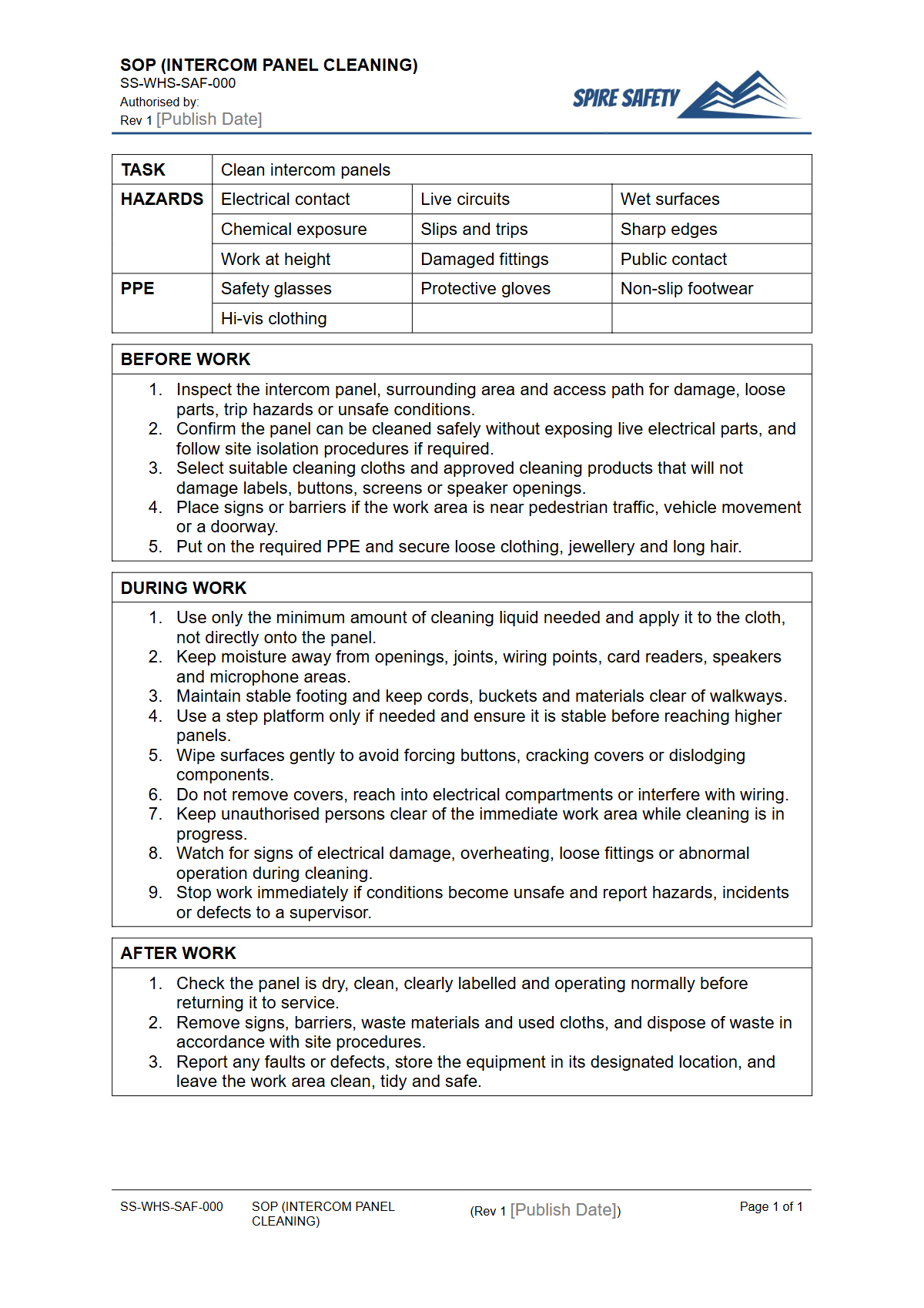
Download our free Safe Operating Procedure (Intercom Panel Cleaning) Template to manage risks. This customisable DOCX helps formalise your safety processes.
Free Safe Operating Procedure (Intercom Panel Cleaning) Template
DOCX • 126 KB + PDF
Updated Oct 2026
No signup required
Purpose of the Free Safe Operating Procedure (Intercom Panel Cleaning) Template
Cleaning tasks, while often routine, can present significant workplace hazards if not managed correctly. This is particularly true for cleaning electronic equipment like intercom panels.
Our Free Safe Operating Procedure (Intercom Panel Cleaning) Template provides a structured framework for outlining the required steps to perform this task safely. The primary purpose is to help Persons Conducting a Business or Undertaking (PCBUs) identify and control risks such as electrical shock, exposure to hazardous cleaning chemicals, and ergonomic injuries from awkward postures.
By documenting a standardised process, you create a clear, consistent, and safe method for all workers to follow. This reduces the likelihood of incidents, equipment damage, and injuries.
Implementing robust SOPs is a fundamental part of building and maintaining effective WHS management systems, demonstrating a commitment to proactive safety management and due diligence.
Video walkthrough
How to use the Free Safe Operating Procedure (Intercom Panel Cleaning) Template
This template is designed for ease of use and customisation. After downloading the DOCX file, you should review each section and adapt it to the specific context of your workplace.
This involves consulting with workers who perform the task, reviewing the Safety Data Sheets (SDS) for your chosen cleaning products, and considering the specific models of intercoms being serviced. Key areas for customisation include listing the correct Personal Protective Equipment (PPE), detailing the exact steps for power isolation, and specifying the approved cleaning agents and tools.
Crucially, this document is a template, not a finished product. We have developed it as a starting point, but you must customise it to reflect the specific intercom models, cleaning chemicals, equipment, and environmental conditions at your workplace.
Just as you would tailor instructions for different machinery, such as with our deep fryer SOP template, this procedure must be made site-specific to be effective.
Applying the Hierarchy of Controls
When customising the SOP, apply the hierarchy of risk controls. Consider if you can eliminate the hazard or substitute it with a safer alternative.
For example, can you use a non-hazardous, pH-neutral cleaning agent instead of a harsh solvent? Can the work area be organised to prevent awkward reaching or bending (engineering controls)?
Administrative controls, like this SOP and worker training, are essential, as is the final control: providing and ensuring the use of appropriate PPE, such as insulating gloves and safety glasses.
When to use this Safe Operating Procedure
A Safe Operating Procedure for intercom panel cleaning should be a living document integrated into your daily operations. It must be used as a primary training tool for new employees or any worker assigned to the task for the first time.
It also serves as a critical reference document before work commences, ensuring all safety checks and procedures are fresh in the operator's mind. Furthermore, the SOP should be a key document reviewed during safety meetings, incident investigations, and routine workplace inspections.
Regularly reviewing your SOPs ensures they remain current with any changes in equipment, chemicals, or work practices. This proactive review process is a core component of regular WHS compliance audits and helps maintain a continuously improving safety culture within the organisation.
Who should use this document
This SOP is intended for a range of personnel within an organisation. Primarily, it is for the workers who directly perform the cleaning task, providing them with clear, step-by-step instructions to ensure their safety.
Supervisors and managers should use it to induct and train workers, as well as to supervise the task and confirm that the established safe work methods are being followed. WHS managers and safety officers will use the document as part of the broader safety management system, using it to facilitate risk assessments and demonstrate compliance.
For organisations without dedicated internal safety resources, implementing new procedures can be a challenge. If you require assistance in adapting this template or developing a suite of SOPs for your operations, engaging expert WHS consulting services can provide the necessary guidance and support.
You can also explore our complete free WHS resources library for other useful templates and guides.
Common mistakes
Common mistakes to avoid
- Failing to electrically isolate the intercom unit before cleaning begins.
- Using an overly wet cloth or spraying cleaning solution directly onto the panel.
- Not checking the Safety Data Sheet (SDS) for the chosen cleaning chemical.
- Using a generic SOP without customising it for the specific equipment and chemicals at the workplace.
Legal references
Legal considerations
The following legal requirements may be relevant to this type of work.
- Work Health and Safety Act (Harmonised) — Provides the primary duties for protecting workers and other people from work health and safety risks.
- Work Health and Safety Regulations (Harmonised) — Sets out requirements supporting the management of workplace hazards and risks.
The following codes may be relevant to this type of work.
- Managing WHS Risks Code of Practice — Provides practical guidance on identifying hazards, assessing risks and applying effective controls.
- Work Health and Safety Consultation, Cooperation and Coordination Code of Practice — Provides practical guidance on consulting workers and coordinating with other duty holders.
- Managing the Work Environment and Facilities Code of Practice — Provides practical guidance on safe work environments, workplace facilities and related controls.
Did you know
Hidden Dangers
Even extra-low voltage systems (under 50V AC or 120V DC) can pose an electric shock risk, especially when liquids are introduced, as they can bridge circuits and components.
Aerosol Risk
Spraying cleaning fluids directly onto electronic devices is a common cause of failure. The liquid can seep behind buttons and into casings, causing short circuits long after the cleaning is complete.
FAQ
Frequently asked questions
01What are the main hazards when cleaning intercom panels?
02Do I need a separate SOP for every cleaning task in my business?
03How often should an SOP for intercom panel cleaning be reviewed?
04Can I use any household cleaner on an intercom panel?
Share this resource
Free Safe Operating Procedure (Intercom Panel Cleaning) Template
Browse Categories
How To Use It
- 1Download and open in Word or PDF.
- 2Replace the placeholders with your business details.
- 3Get it reviewed by a WHS specialist before rollout.
Need it customised?
Our WHS consultants can adapt this template to your site, run a gap analysis, or audit what you already have in place.
Book a Free Consultation WHS consulting servicesor call 1300 156 382
Related templates
- Free Safe Operating Procedure (Irrigation Filter Clean) Template
- Free Safe Operating Procedure (Irrigation Head Check) Template
- Free Safe Operating Procedure (Irrigation Leak Repair) Template
- Free Safe Operating Procedure (Irrigation Line Flush) Template
- Free Safe Operating Procedure (Irrigation Valve Check) Template
- Free Safe Operating Procedure (Irrigation Zone Test) Template