
Free Safe Operating Procedure (Irrigation Zone Test) Template
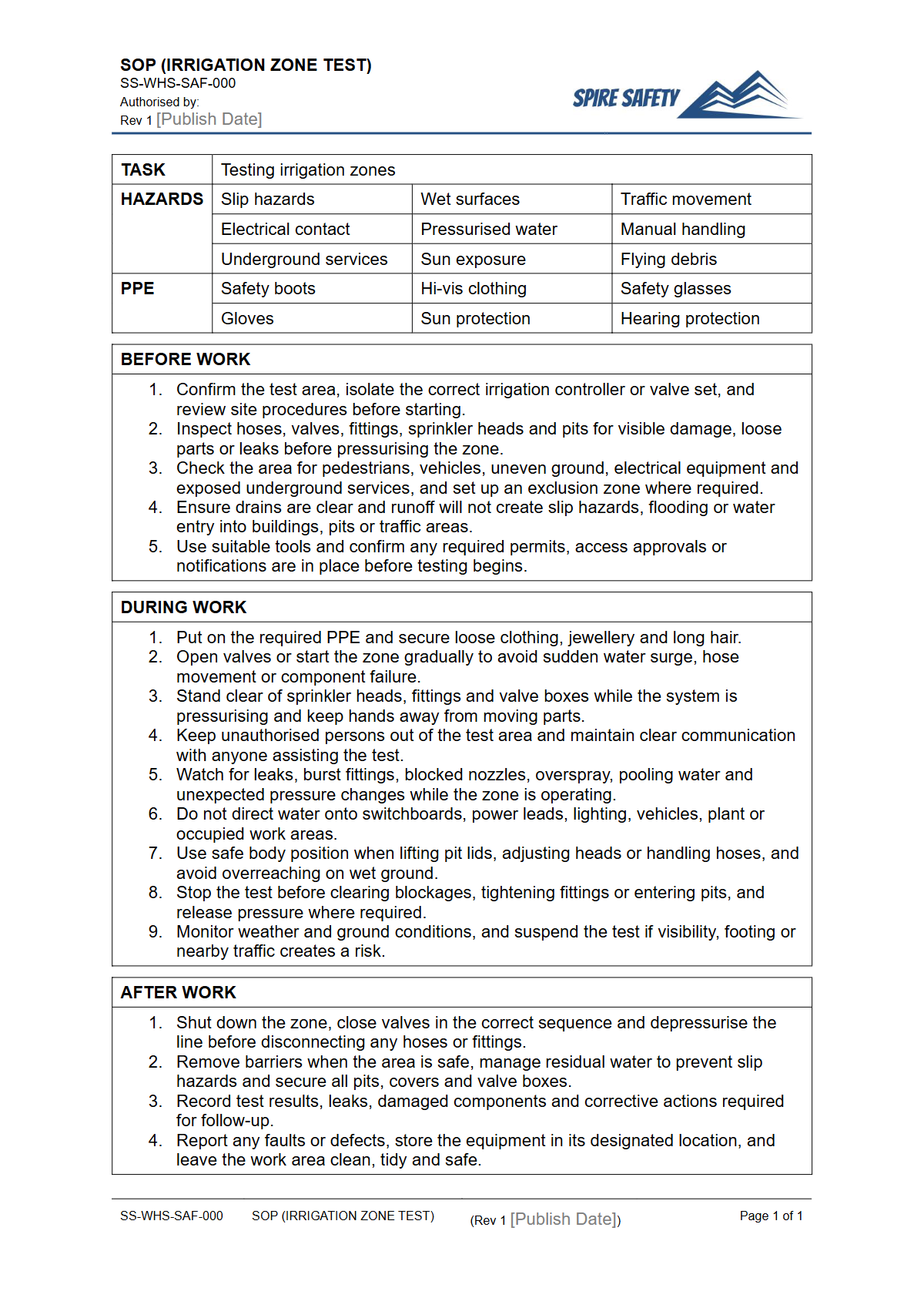
Download our free Safe Operating Procedure (Irrigation Zone Test) template. This document provides a framework for outlining safe work steps.
Free Safe Operating Procedure (Irrigation Zone Test) Template
DOCX • 126 KB + PDF
Updated Oct 2026
No signup required
Purpose of the Free Safe Operating Procedure (Irrigation Zone Test) Template
Effectively managing safety during routine maintenance is a cornerstone of any robust safety system. Our Free Safe Operating Procedure (Irrigation Zone Test) Template provides a structured starting point for organisations in landscaping, agriculture, and facilities management.
This document is designed to help you formally outline the step-by-step process for safely testing individual irrigation zones, helping to minimise risks for your personnel. An SOP ensures that tasks are performed consistently and safely every time, regardless of who is performing the work.
The primary purpose is to control hazards associated with irrigation systems. These can include slips, trips, and falls on wet surfaces, manual handling injuries from lifting valve box lids or equipment, exposure to treated or non-potable water, and potential electrical shock from controllers or solenoids.
By documenting a clear procedure, you provide workers with essential information, training instructions, and a clear sequence of work that has been assessed for risks.
Video walkthrough
How to use the Free Safe Operating Procedure (Irrigation Zone Test) Template
This template is provided in both DOCX and PDF formats for your convenience. The DOCX file is fully editable, allowing you to tailor it to your specific operational needs.
A comprehensive SOP is a vital part of your broader safety framework. For those looking to manage the entire asset lifecycle, our FREE Irrigation System SOP (Safe Operating Procedure) Template provides a higher-level view that complements this zone-specific procedure.
It is crucial to understand that this is a guide, not a finished, universally applicable document. We strongly advise that you customise the content to reflect the specific types of irrigation controllers, valves, sprinklers, and site-specific hazards unique to your workplace.
You must conduct a site-specific risk assessment and incorporate your findings into the final SOP. Integrating such procedures into your overarching safety framework is a key part of developing effective WHS management systems.
Key considerations for customisation include:
- Site Layout: Including maps or diagrams of irrigation zones, controller locations, and isolation points.
- Equipment Specifics: Referencing the manufacturer’s instructions for the specific controllers and components in use.
- Water Source: Noting if the water is recycled, treated, or potable, and outlining any specific PPE requirements.
- Emergency Procedures: Detailings steps for managing uncontrolled water release, electric shock, or personal injury.
When to use this Safe Operating Procedure
An SOP for irrigation zone testing should be used consistently during several key operational phases. Its application ensures a standardised, safe approach every time the task is performed. It should be the primary reference document during:
- Routine Maintenance: Regular scheduled checks to ensure all zones are functioning correctly, heads are properly aligned, and there are no leaks.
- Pre-Season Start-Up: The comprehensive process of recommissioning an irrigation system after a period of dormancy, typically before spring or a growing season.
- System Audits: When performing water efficiency audits or checks on system performance.
- Troubleshooting and Repairs: When diagnosing faults such as a zone not activating, low pressure, or constant running. Using the SOP ensures even diagnostic work is done safely. This may also involve tasks covered by a Trencher SOP Template if underground line repairs are needed.
Who should use this document
This Safe Operating Procedure is intended for use by trained and competent personnel responsible for the maintenance, operation, and repair of irrigation systems. This typically includes roles such as:
- Groundskeepers and Greenkeepers
- Landscape Maintenance Technicians
- Irrigation Specialists and Technicians
- Farm Workers and Agricultural Managers
- Facilities Maintenance Staff
Before any worker undertakes this task, the Person Conducting a Business or Undertaking (PCBU) must ensure they have received adequate information, training, and instruction. This includes specific training on the contents of the finalised SOP, the hazards involved, and the operation of the specific equipment on site.
Competency should be verified and recorded. If you require assistance in developing competency frameworks, seeking professional WHS consulting can provide valuable guidance and support.
Verifying the Procedure's Effectiveness
A documented SOP is only effective if it is understood, followed, and regularly reviewed. Supervisors should conduct periodic observations to ensure workers are adhering to the outlined steps.
Furthermore, the procedure should be a living document, subject to review and improvement. Regular reviews should occur whenever there is a change in equipment or process, or after an incident or near-miss.
Scheduled WHS compliance auditing can help verify that this and other procedures are being implemented correctly across your organisation.
This template is one of many tools available to help you build a safer workplace. We encourage you to explore our complete free WHS resources library for other templates and guides to support your safety management efforts.
Common mistakes
Common mistakes to avoid
- Forgetting to electrically isolate the irrigation controller before working on solenoids or wiring.
- Failing to notify other site users or cordon off test areas, creating slip and trip hazards.
- Neglecting to wear appropriate PPE, such as gloves and eye protection, when working with valve boxes or non-potable water.
- Using the template as-is without customising it for site-specific hazards, equipment, and procedures.
Legal references
Legal considerations
The following legal requirements may be relevant to this type of work.
- Work Health and Safety Act (Harmonised) — Provides the primary duties for protecting workers and other people from work health and safety risks.
- Work Health and Safety Regulations (Harmonised) — Sets out requirements supporting the management of workplace hazards and risks.
The following codes may be relevant to this type of work.
- Managing WHS Risks Code of Practice — Provides practical guidance on identifying hazards, assessing risks and applying effective controls.
- Work Health and Safety Consultation, Cooperation and Coordination Code of Practice — Provides practical guidance on consulting workers and coordinating with other duty holders.
- Managing the Work Environment and Facilities Code of Practice — Provides practical guidance on safe work environments, workplace facilities and related controls.
Did you know
Water Waste
A single broken sprinkler head can waste over 900 litres of water per hour. Regular zone testing helps identify such issues early, conserving water and reducing operational costs.
Dial Before You Dig
Before any excavation to repair underground lines—a common task following zone test fault-finding—it is a legal requirement in Australia to contact Dial Before You Dig to obtain plans for underground utilities.
FAQ
Frequently asked questions
01What is the difference between an SOP and a Safe Work Method Statement (SWMS)?
02Does this SOP template cover electrical isolation procedures?
03How often should irrigation zones be tested using this SOP?
04Can I use this template for both commercial and residential irrigation systems?
Share this resource
Free Safe Operating Procedure (Irrigation Zone Test) Template
Browse Categories
How To Use It
- 1Download and open in Word or PDF.
- 2Replace the placeholders with your business details.
- 3Get it reviewed by a WHS specialist before rollout.
Need it customised?
Our WHS consultants can adapt this template to your site, run a gap analysis, or audit what you already have in place.
Book a Free Consultation WHS consulting servicesor call 1300 156 382
Related templates
- Free Safe Operating Procedure (Isolation Signage Setup) Template
- Free Safe Operating Procedure (Jackhammer) Template
- Free Safe Operating Procedure (Jaw Crusher Clearing) Template
- Free Safe Operating Procedure (Jet Blast Area Entry) Template
- Free Safe Operating Procedure (Jet Bridge Cleaning) Template
- Free Safe Operating Procedure (Jet Ski Operation) Template