
Free Safe Operating Procedure (Jet Blast Area Entry) Template
Effectively manage the significant risks associated with jet blast areas in aviation and industrial settings. Download our free template to get started.
Free Safe Operating Procedure (Jet Blast Area Entry) Template
DOCX • 126 KB + PDF
Updated Oct 2026
No signup required
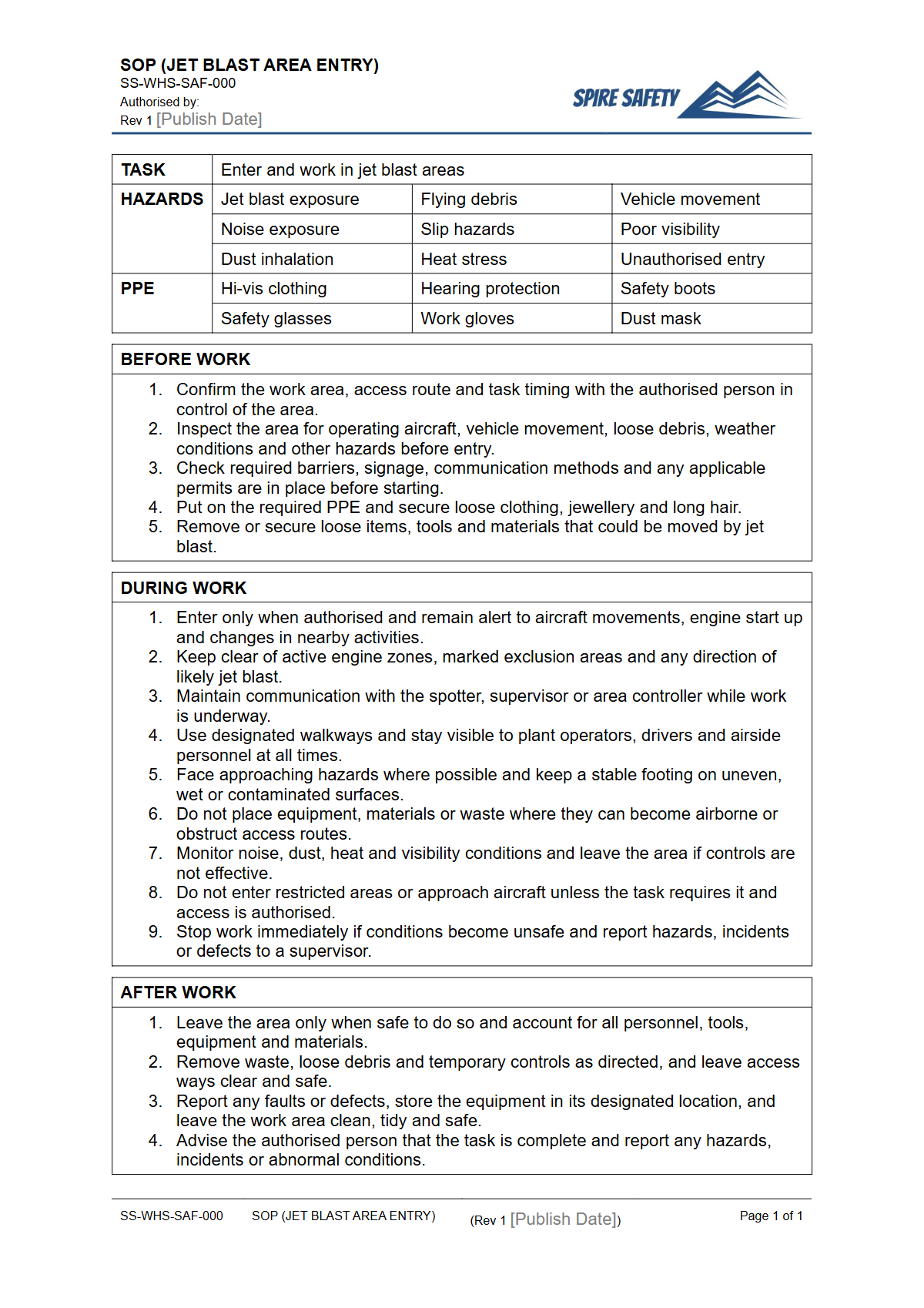
Purpose of the Free Safe Operating Procedure (Jet Blast Area Entry) Template
Jet blast from aircraft engines poses a severe risk to personnel, vehicles, and equipment on an aerodrome or in maintenance areas. This Free Safe Operating Procedure (Jet Blast Area Entry) Template provides a structured framework for establishing and documenting the safety protocols required to enter and work within these high-risk zones.
Its primary purpose is to minimise the risk of injury or damage from high-velocity exhaust gases by defining clear rules, exclusion zones, and communication procedures. Formalising these steps helps ensure every person, from ground crew to visitors, understands the hazards and their responsibilities.
Using a standardised SOP ensures consistent application of safety measures across all shifts and teams. It serves as a vital training tool for new employees and a reference for experienced staff.
Like managing the risks of high-pressure systems detailed in our Free Air Compressor SOP, controlling access to jet blast zones is a critical component of a safe system of work in aviation environments. This document provides a clear, auditable record of the control measures your organisation has implemented to manage these specific and significant hazards.
Video walkthrough
How to use the Free Safe Operating Procedure (Jet Blast Area Entry) Template
This template is provided in both DOCX and PDF formats for your convenience. The DOCX file is fully editable, allowing you to adapt the procedure to the specific aircraft, layout, and operational context of your workplace.
To effectively use this document, you should conduct a thorough risk assessment of your jet blast areas, identifying specific hazards related to different aircraft types, taxiway configurations, and ground support equipment.
Important: This is a template, not a finished document. You must customise it with your site-specific details, including aircraft types, minimum safe distances, personnel roles, and emergency contacts.
We are not responsible for the outcomes of the final document you create. Integrating this procedure into your broader WHS management systems ensures it aligns with your overall safety objectives and is regularly reviewed and updated.
Once customised, the SOP should be used to induct and train all relevant personnel. It's crucial that everyone understands the defined exclusion zones, communication protocols with flight crews, and the procedures for securing loose items or equipment.
The process is similar to how you would tailor our FREE Telehandler SOP Template for your specific machine; the core principles are sound, but the operational details must match your unique environment to be effective.
When to use this Safe Operating Procedure
A Safe Operating Procedure for jet blast area entry should be in constant use at any facility where aircraft engines are operated, including airports, maintenance bases, and military airfields. It is not a document for occasional reference but a foundational guide for daily operations.
Specifically, it must be consulted and followed whenever personnel or vehicles need to operate in areas potentially affected by jet blast or prop wash.
It becomes particularly critical during non-routine operations, such as engine testing, aircraft repositioning, or when unfamiliar aircraft types are present. The SOP should also be a key document referenced during incident investigations, near-miss reporting, and regular safety drills.
Scheduling reviews of the SOP as part of your WHS compliance auditing activities ensures it remains current with changing fleet compositions or aerodrome layouts.
Who should use this Safe Operating Procedure
This SOP is intended for a wide range of personnel working in and around aircraft movement areas. The primary users are ground staff who perform their duties on the apron, including:
- Aircraft Marshallers / Ramp Agents
- Baggage Handlers
- Aircraft Maintenance Engineers
- Refuelling Technicians
- Catering and Cleaning Staff
- Drivers of all Ground Support Equipment (GSE)
Furthermore, pilots and flight crew must be familiar with the procedures to ensure effective communication and coordination with ground teams. The responsibility for adherence is shared among all individuals operating in the area, much like how operators of heavy machinery must follow a FREE Grader SOP to ensure safety.
Airport operations managers and WHS officers should use this document to oversee implementation, conduct training, and supports your compliance efforts across the organisation.
Key Components of the SOP Template
Our template provides a logical structure to build your procedure. It includes sections for outlining the scope and purpose, defining key responsibilities, and listing the required Personal Protective Equipment (PPE).
The core of the document focuses on the step-by-step procedure for entry, work, and exit from the blast area, including pre-start checks for loose debris and communication protocols. It also includes prompts for you to insert diagrams of your specific jet blast danger zones for different aircraft. For more examples of safety documentation across various industries, you can browse our complete free WHS resources library.
Finally, the template includes sections for emergency procedures, training requirements, and a review log. This comprehensive approach helps ensure you don't miss critical elements when developing your site-specific SOP.
For expert guidance on adapting this template or tackling other complex WHS challenges, Spire Safety's WHS consulting services can provide tailored support.
Common mistakes
Common mistakes to avoid
- Underestimating the danger zone and using generic, non-aircraft-specific safe distances.
- Failing to conduct a thorough pre-start check of the area for foreign object debris (FOD) that can become projectiles.
- Poor or non-existent communication between flight crew and ground staff before engine start-up or power increase.
- Treating all aircraft the same, without recognising the vast difference in blast intensity between a regional jet and a wide-body airliner.
Legal references
Legal considerations
The following legal requirements may be relevant to this type of work.
- Work Health and Safety Act (Harmonised) — Provides the primary duties for protecting workers and other people from work health and safety risks.
- Work Health and Safety Regulations (Harmonised) — Sets out requirements supporting the management of workplace hazards and risks.
The following codes may be relevant to this type of work.
- Managing WHS Risks Code of Practice — Provides practical guidance on identifying hazards, assessing risks and applying effective controls.
- Work Health and Safety Consultation, Cooperation and Coordination Code of Practice — Provides practical guidance on consulting workers and coordinating with other duty holders.
- Managing the Work Environment and Facilities Code of Practice — Provides practical guidance on safe work environments, workplace facilities and related controls.
Did you know
Incredible Force
The jet blast from a large aircraft like a Boeing 777 or Airbus A380 on takeoff power can reach speeds over 300 km/h. This is strong enough to flip trucks, shatter windows, and propel debris with lethal force over hundreds of metres.
Idle is Not Safe
Even at idle thrust, the jet blast from many commercial aircraft can generate winds of over 100 km/h in the immediate vicinity of the engines, posing a significant hazard to any person or unsecured object.
FAQ
Frequently asked questions
01What is a jet blast area?
02Why is a specific SOP needed for jet blast area entry?
03Who is responsible for enforcing a jet blast area SOP?
04Can this template be used for helicopter rotor wash areas?
Share this resource
Free Safe Operating Procedure (Jet Blast Area Entry) Template
Browse Categories
How To Use It
- 1Download and open in Word or PDF.
- 2Replace the placeholders with your business details.
- 3Get it reviewed by a WHS specialist before rollout.
Need it customised?
Our WHS consultants can adapt this template to your site, run a gap analysis, or audit what you already have in place.
Book a Free Consultation WHS consulting servicesor call 1300 156 382
Related templates
- Free Safe Operating Procedure (Jet Bridge Cleaning) Template
- Free Safe Operating Procedure (Jet Ski Operation) Template
- Free Safe Operating Procedure (Jib Crane) Template
- Free Safe Operating Procedure (Jigsaw) Template
- Free Safe Operating Procedure (Juice Extractor) Template
- Free Safe Operating Procedure (Jump Starting Vehicles) Template