
Free Safe Operating Procedure (Jib Crane) Template
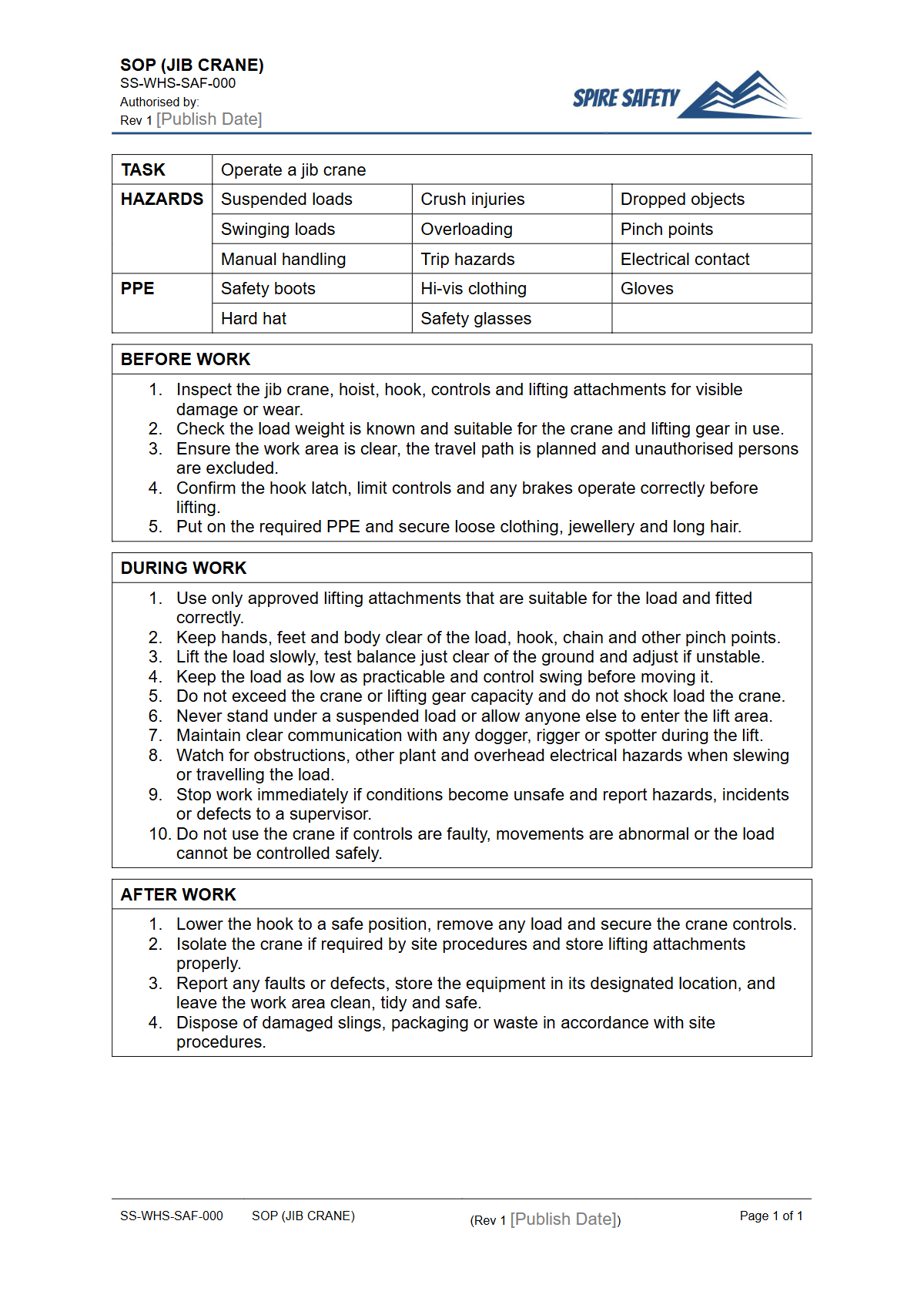
Download our free Safe Operating Procedure (Jib Crane) Template to formalise crane operations. This customisable guide helps you document key safety steps.
Free Safe Operating Procedure (Jib Crane) Template
DOCX • 126 KB + PDF
Updated Oct 2026
No signup required
Purpose of the Free Safe Operating Procedure (Jib Crane) Template
A Safe Operating Procedure (SOP) is a foundational document for managing workplace risks. This Free Safe Operating Procedure (Jib Crane) Template provides a structured framework for documenting the step-by-step process required to operate a jib crane safely.
Its primary purpose is to minimise the risk of injury to operators and other personnel by standardising tasks and highlighting critical safety controls. By clearly outlining pre-operational checks, shutdown procedures, and emergency responses, an effective SOP helps ensure consistent, safe behaviour across all shifts and operators.
Formalising your processes with an SOP demonstrates a commitment to health and safety, forming a key part of your risk management strategy. It serves as a vital training tool for new employees and a reference point for experienced staff, ensuring everyone understands the expected safety standards. A well-developed SOP for plant and equipment is a core component of a robust safety management system, similar in principle to procedures for other machinery like our Telehandler SOP.
Video walkthrough
How to use the Free Safe Operating Procedure (Jib Crane) Template
This template is available in both DOCX and PDF formats for your convenience. The DOCX file is fully editable, allowing you to tailor the content to the specific jib cranes and tasks in your workplace.
Consultation is a critical step; you must involve your crane operators and supervisors in the drafting and review process to ensure the procedure is practical, accurate, and reflects how work is actually performed.
To use the template effectively:
- Download the DOCX file.
- Consult with workers who operate or work near jib cranes.
- Fill in the specific details for your site, including crane model numbers, load limits, designated operating zones, and site-specific hazards.
- Add company details, approval dates, and review schedules.
- Use the finalised SOP to train workers and induct new employees.
- Display the SOP in a visible location near the jib crane.
Important Note: To be effective, this document must be customised to your specific workplace. We've provided a structured starting point aligned with Australian WHS practice, but you must add details about your specific jib crane models, site layout, loads, and emergency procedures.
Integrating these documents into your broader WHS management systems ensures they are properly controlled, reviewed, and implemented.
Key Sections in the Jib Crane SOP
A comprehensive Safe Operating Procedure for a jib crane should cover several key areas to be effective. Our template prompts you to consider and document the following critical information:
- Required Personal Protective Equipment (PPE): Specify the mandatory PPE for operators and any personnel in the lifting area, such as hard hats, steel-capped boots, and high-visibility clothing.
- Pre-Operational Checks: Detail the visual and functional inspections that must be performed before any lift. This includes checking the hoist, trolley, wire rope or chain, hooks, safety latches, and control pendants.
- Step-by-Step Operating Instructions: Outline the sequence for safely attaching, lifting, moving, and lowering a load. This section should cover confirming load weight, checking the load path is clear, and avoiding shock loading.
- Post-Operational Procedures: Describe the correct shutdown process, including parking the hook in a designated location, turning off the power, and reporting any faults or defects.
- Emergency Procedures: Detail the immediate actions to take in case of power failure, equipment malfunction, or other emergencies.
You can find many other document templates to support your safety framework in our free WHS resources library.
When to use it
The Jib Crane SOP should be a living document, used consistently throughout day-to-day operations. It is not a 'set and forget' policy.
It should be directly referenced during worker training and competency assessments to verify their understanding of safe work methods. Supervisors should use it as a benchmark for observing work practices and providing feedback.
The SOP must also be reviewed periodically as part of your safety management processes, after any incident or near miss involving the crane, or when a new jib crane model is introduced to the workplace. Regular reviews can be integrated into your schedule of WHS compliance audits to ensure ongoing relevance.
Who should use it
This SOP is intended for a range of personnel within an organisation. Primary users are the crane operators themselves, who must follow the procedure for every task.
Supervisors and managers are responsible for implementing the SOP, providing training, and ensuring compliance. WHS and safety representatives should use the document to assist with risk assessments and workplace inspections.
Maintenance personnel can also refer to the SOP to understand operational hazards and lockout/tagout requirements before commencing repair work. The principles of documenting safe procedures apply to all types of machinery, from cranes to items covered by an Air Compressor SOP.
Common mistakes
Common mistakes to avoid
- Failing to confirm the load weight against the crane's load chart before lifting.
- Using damaged, uncertified, or inappropriate lifting gear like slings and shackles.
- Swinging or travelling with a load over personnel or through occupied areas.
- Side-pulling or 'snatching' loads, which places undue stress on the crane structure.
Legal references
Legal considerations
The following legal requirements may be relevant to this type of work.
- Work Health and Safety Act (Harmonised) — Provides the primary duties for protecting workers and other people from work health and safety risks.
- Work Health and Safety Regulations (Harmonised) — Sets out requirements supporting the management of workplace hazards and risks.
The following codes may be relevant to this type of work.
- Managing WHS Risks Code of Practice — Provides practical guidance on identifying hazards, assessing risks and applying effective controls.
- Work Health and Safety Consultation, Cooperation and Coordination Code of Practice — Provides practical guidance on consulting workers and coordinating with other duty holders.
- Managing the Work Environment and Facilities Code of Practice — Provides practical guidance on safe work environments, workplace facilities and related controls.
Did you know
Design Determines Capacity
The 'jib' or 'boom' is the horizontal arm that supports the hoist. Its structural design is the primary factor in determining the crane's Safe Working Load (SWL) and operating radius.
Human Error is a Major Factor
A significant percentage of crane incidents are not caused by catastrophic mechanical failure, but by human factors like improper rigging, swinging loads over personnel, or attempting to lift loads beyond the crane's rated capacity.
FAQ
Frequently asked questions
01What should be included in pre-operational checks for a jib crane?
02Is a Safe Operating Procedure a legal requirement for jib cranes in Australia?
03How often should a jib crane SOP be reviewed?
04Who is qualified to operate a jib crane?
Share this resource
Free Safe Operating Procedure (Jib Crane) Template
Browse Categories
How To Use It
- 1Download and open in Word or PDF.
- 2Replace the placeholders with your business details.
- 3Get it reviewed by a WHS specialist before rollout.
Need it customised?
Our WHS consultants can adapt this template to your site, run a gap analysis, or audit what you already have in place.
Book a Free Consultation WHS consulting servicesor call 1300 156 382
Related templates
- Free Safe Operating Procedure (Jigsaw) Template
- Free Safe Operating Procedure (Juice Extractor) Template
- Free Safe Operating Procedure (Jump Starting Vehicles) Template
- Free Safe Operating Procedure (Kayak Operation) Template
- Free Safe Operating Procedure (Keg Coupler Change) Template
- Free Safe Operating Procedure (Keg Handling) Template