
Free Safe Operating Procedure (Keg Handling) Template
Handling kegs involves significant manual handling risks. This free template helps you document safe work practices to protect your team. Download it now.
Free Safe Operating Procedure (Keg Handling) Template
DOCX • 126 KB + PDF
Updated Oct 2026
No signup required
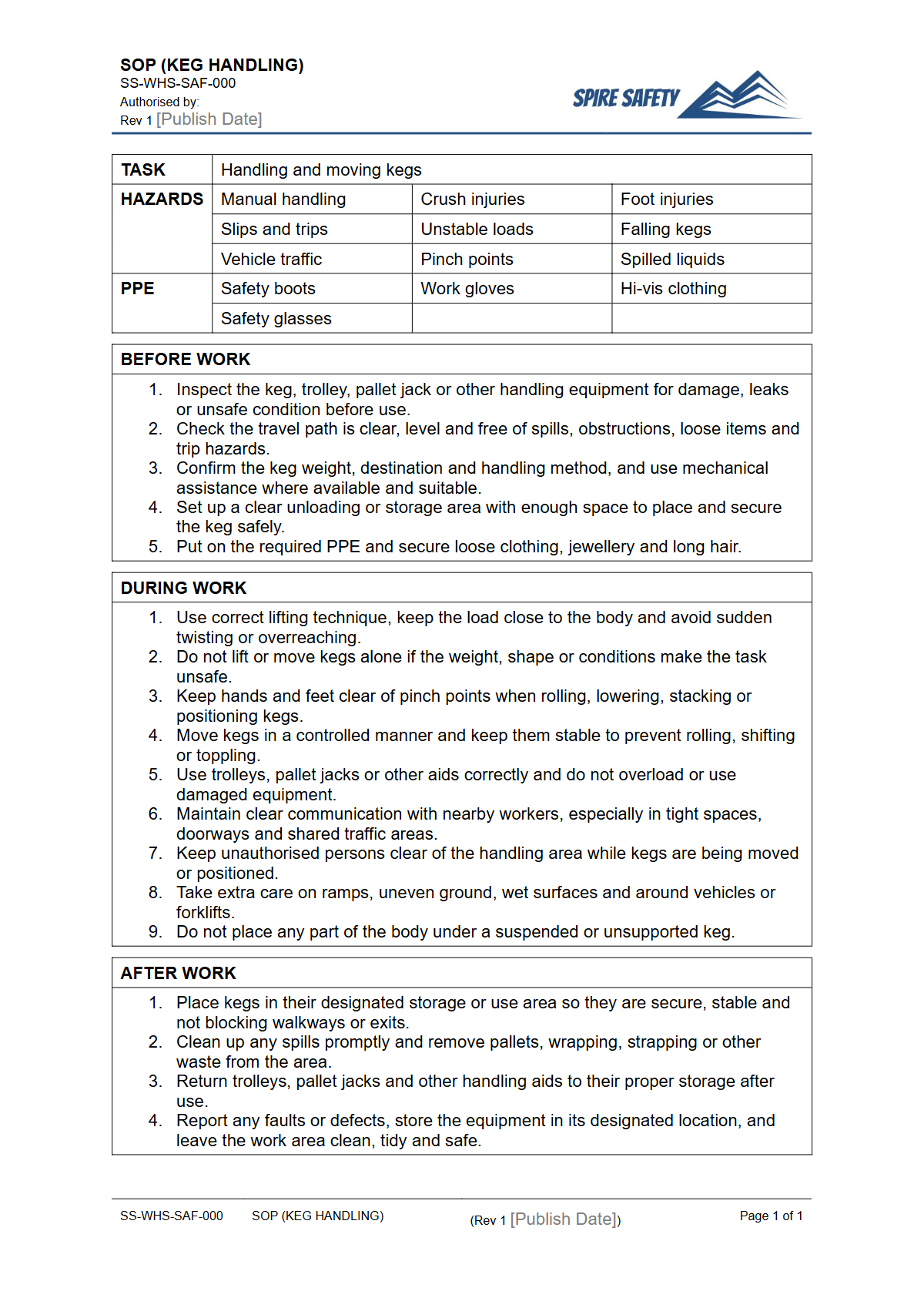
Purpose of the Free Safe Operating Procedure (Keg Handling) Template
Handling full or empty kegs presents significant workplace health and safety risks, primarily related to hazardous manual tasks. This Free Safe Operating Procedure (Keg Handling) Template provides a structured starting point for businesses in the hospitality, brewing, and logistics industries to document a safe system of work.
It is designed to help you outline the required steps, identify potential hazards, and implement control measures to minimise the risk of musculoskeletal injuries, slips, trips, falls, and crushing incidents associated with moving, stacking, and connecting kegs.
A documented SOP serves as a critical training tool and a reference for workers, ensuring that everyone understands the recognised safe method for performing the task. Developing and implementing this procedure is a key part of an effective safety framework, demonstrating a commitment to managing risks as part of your broader WHS management systems. This template, available in both DOCX and PDF, helps formalise your process and align your operations with Australian WHS best practices.
Hazards Addressed
- Musculoskeletal Disorders: Strains and sprains from lifting, carrying, pushing, or pulling heavy and awkward loads.
- Crushing and Pinching: Injuries to hands and feet from dropped kegs or during stacking.
- Slips, Trips, and Falls: Caused by wet floors in cellars or cool rooms, or poor housekeeping around storage areas.
- Pressurised Systems: Risks associated with incorrect tapping or connection of gas lines to the keg coupler.
Video walkthrough
How to use the Free Safe Operating Procedure (Keg Handling) Template
This document is a template and not a complete Safe Operating Procedure. To be effective, you must customise it to reflect the specific environment, equipment, and processes at your workplace.
Download the DOCX file and update it with your company name, logo, and site-specific details. Walk through the task of handling a keg from delivery to connection, and update the steps to match your process.
Be sure to identify the specific mechanical aids available (e.g., hand trolleys, keg lifts, dollies) and mandate their use. Include details relevant to your cool room layout, storage heights, and emergency procedures.
Many hospitality venues manage multiple risks beyond manual handling. For related high-risk tasks, you may also find our Free Safe Operating Procedure (Deep Fryer - Standard Operation) template useful for standardising kitchen safety.
When to use it
A Keg Handling SOP should be used as a primary document for managing this specific task. It is essential for:
- Worker Training: Use the SOP as the basis for practical, hands-on training for all new and existing employees who handle kegs.
- Inductions: Integrate the SOP into your induction process for all cellar, bar, and delivery staff.
- Risk Management: Use the SOP as a control measure identified in your risk assessments for hazardous manual tasks.
- Incident Investigation: Refer to the SOP when investigating a near-miss or incident to determine if procedures were followed and if they need revision.
For larger breweries or distribution centres, keg movement may be integrated with automated systems. In such cases, consider adapting this procedure alongside a FREE Conveyer System SOP (Safe Operating Procedure) Template to cover all aspects of the process.
Who should use it
This SOP is intended for any Person Conducting a Business or Undertaking (PCBU) where kegs are handled. This includes, but is not limited to:
- Pubs, Bars, and Clubs
- Restaurants and Hotels
- Breweries and Distilleries
- Bottle Shops and Liquor Retailers
- Event and Catering Companies
- Logistics and Freight Providers
Managers, supervisors, and WHS representatives are responsible for ensuring the SOP is customised, implemented, and reviewed regularly. Conducting periodic checks of your safety documents is crucial, and a formal WHS compliance auditing service can help identify gaps in your overall system.
Breweries also rely on other pressurised equipment. To manage related risks, you may need procedures for other machinery, such as our Free Air Compressor SOP (Safe operating Procedure) Template, to ensure comprehensive safety coverage.
By establishing clear, documented procedures for all high-risk tasks, you build a stronger safety culture and a more resilient organisation. Explore our complete free WHS resources library for more templates to support your business.
Common mistakes
Common mistakes to avoid
- Using the template without customising it for specific workplace equipment and layouts.
- Failing to provide practical, hands-on training on the SOP, assuming workers will just read it.
- Neglecting to provide or maintain appropriate mechanical aids like trolleys or keg lifts.
- Not reviewing the SOP after a near-miss or incident involving keg handling.
Legal references
Legal considerations
The following legal requirements may be relevant to this type of work.
- Work Health and Safety Act (Harmonised) — Provides the primary duties for protecting workers and other people from work health and safety risks.
- Work Health and Safety Regulations (Harmonised) — Sets out requirements supporting the management of workplace hazards and risks.
The following codes may be relevant to this type of work.
- Managing WHS Risks Code of Practice — Provides practical guidance on identifying hazards, assessing risks and applying effective controls.
- Work Health and Safety Consultation, Cooperation and Coordination Code of Practice — Provides practical guidance on consulting workers and coordinating with other duty holders.
- Managing the Work Environment and Facilities Code of Practice — Provides practical guidance on safe work environments, workplace facilities and related controls.
Did you know
Keg Weight
A standard 50-litre (13.2-gallon) keg weighs over 60 kilograms when full. This is well above the weight threshold where mechanical aids are recommended to prevent musculoskeletal injuries.
Manual Tasks
According to Safe Work Australia, hazardous manual tasks are the leading cause of work-related injuries in Australia, accounting for a significant percentage of all serious workers' compensation claims each year.
FAQ
Frequently asked questions
01Is a Safe Operating Procedure for keg handling legally required in Australia?
02What are the main hazards of manual keg handling?
03What mechanical aids are best for handling kegs?
04How often should we review our Keg Handling SOP?
Share this resource
Free Safe Operating Procedure (Keg Handling) Template
Browse Categories
How To Use It
- 1Download and open in Word or PDF.
- 2Replace the placeholders with your business details.
- 3Get it reviewed by a WHS specialist before rollout.
Need it customised?
Our WHS consultants can adapt this template to your site, run a gap analysis, or audit what you already have in place.
Book a Free Consultation WHS consulting servicesor call 1300 156 382
Related templates
- Free Safe Operating Procedure (Keg Trolley Use) Template
- Free Safe Operating Procedure (Kennel Waste Cleanup) Template
- Free Safe Operating Procedure (Kerb Saw) Template
- Free Safe Operating Procedure (Kerbside Cleanup) Template
- Free Safe Operating Procedure (Key Safe Access) Template
- Free Safe Operating Procedure (Kitchen Bench Cleaning) Template