
Free Safe Operating Procedure (Kerbside Cleanup) Template
Manage the risks of council or private kerbside collections with our free Safe Operating Procedure for Kerbside Cleanup.
Free Safe Operating Procedure (Kerbside Cleanup) Template
DOCX • 126 KB + PDF
Updated Oct 2026
No signup required
Purpose of the Free Safe Operating Procedure (Kerbside Cleanup) Template
Kerbside cleanup and hard rubbish collection present a unique and varied set of workplace hazards. From manual handling of awkward and heavy objects to unexpected encounters with hazardous materials, sharps, and pests, a structured approach to safety is essential.
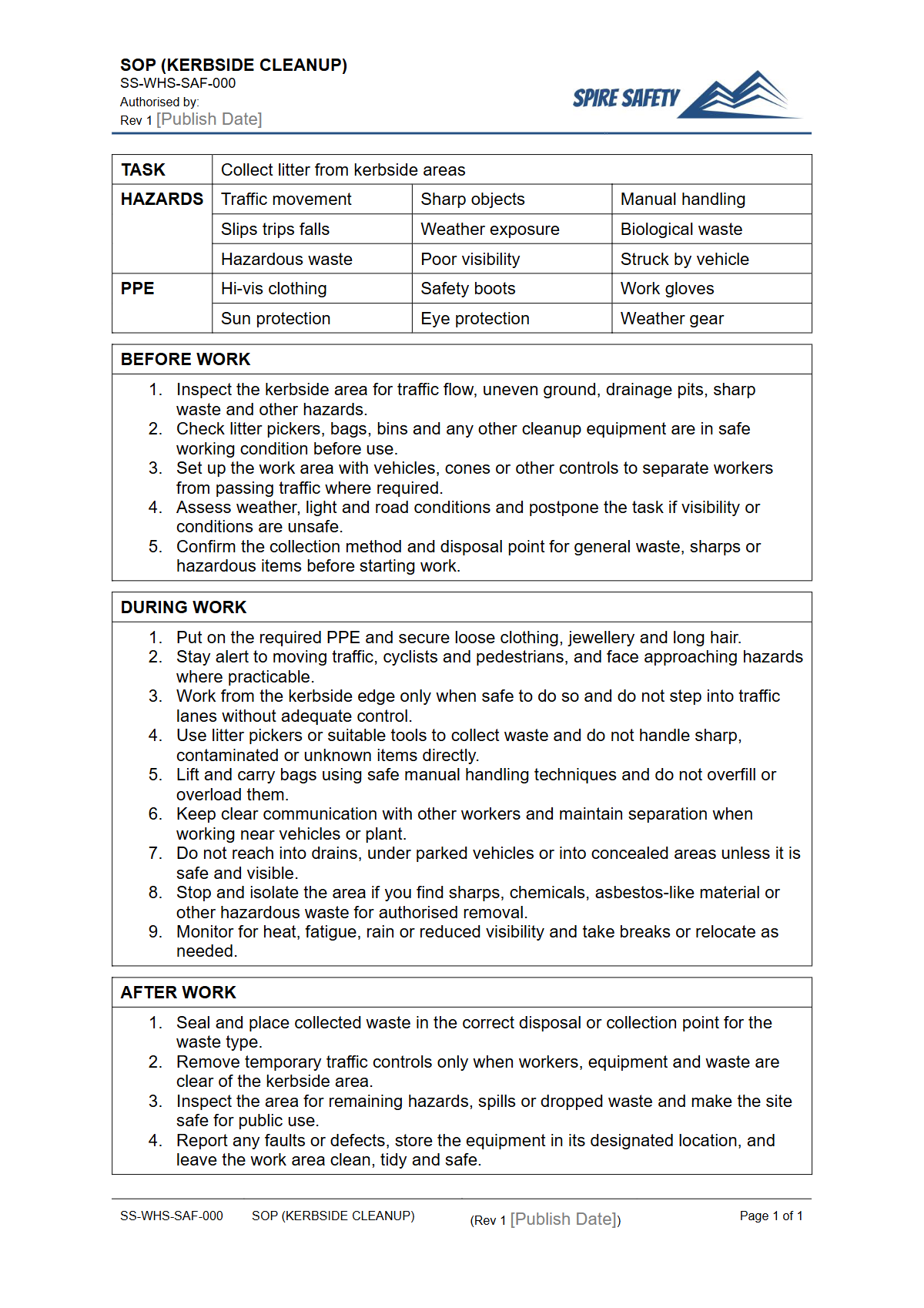
This Free Safe Operating Procedure (Kerbside Cleanup) Template provides a framework for documenting safe work methods to control these risks and protect workers.
The template guides you in outlining step-by-step instructions for tasks associated with kerbside collection. This includes pre-start checks, hazard identification, safe lifting techniques, vehicle operation, traffic interaction, and procedures for dealing with unexpected finds like chemicals or asbestos-containing materials.
A documented SOP ensures that safety processes are communicated clearly and consistently across your team, forming a key part of your safety management system. Just as you would document procedures for specific machinery using a FREE Telehandler SOP Template, kerbside collection requires its own documented process to manage its specific risks.
Video walkthrough
How to use the Free Safe Operating Procedure (Kerbside Cleanup) Template
This template is provided in both DOCX and PDF formats for your convenience. The DOCX file is fully editable, allowing you to tailor the content to the specific equipment, environment, and scale of your operations.
It is crucial to adapt the document to reflect the actual risks and control measures relevant to your workplace. Generic procedures are not effective and may not meet your legal obligations.
To use the template effectively:
- Consult your workers: Involve the team members who perform the task. Their direct experience is invaluable for identifying practical hazards and effective controls.
- Conduct a risk assessment: Before finalising the SOP, perform a thorough WHS consulting-supported risk assessment for all aspects of the kerbside cleanup process. Use the findings to inform the content of your SOP.
- Customise the details: Replace the placeholder text with specific information about your site, the types of waste collected, the vehicles and tools used, and your emergency procedures. For example, if workers may need to break down large items, the process must be detailed; this differs greatly from using a FREE Circular Saw SOP Template but follows the same principle of task-specific instruction.
- Train your team: Once finalised, all relevant workers must be trained on the SOP. Ensure they understand the procedures and have an opportunity to ask questions. Keep training records.
- Review and update: The SOP should be a living document, reviewed regularly and updated whenever there is a change to the task, equipment, or after any incident.
Note: We have developed this template as a starting point. It is your responsibility to ensure the final document is customised to your business and its specific risks to be considered a compliant safe work document.
When to use a Safe Operating Procedure for Kerbside Cleanup
An SOP for kerbside cleanup should be used whenever workers are tasked with collecting hard rubbish, bulky goods, or other non-standard waste from public roadsides or properties. This applies to council collection services, private waste management contractors, and property maintenance companies.
It should be readily available at the worksite and used as a reference for pre-start briefings and for training new employees. The principles within also contribute to your overall WHS management systems, demonstrating a systematic approach to hazard management.
Who should use this template
This template is designed for use by Persons Conducting a Business or Undertaking (PCBUs), managers, supervisors, and safety officers in the waste management, local government, and property services industries. It provides the structure needed to formally document procedures and meet WHS duties.
Workers can also use the final, customised document as a practical guide to perform their duties safely. For a comprehensive review of your implemented procedures, you might consider periodic WHS compliance auditing to verify their effectiveness and identify areas for improvement.
You can explore more procedural documents in our free WHS resources library to support your operations.
Common mistakes
Common mistakes to avoid
- Failing to adequately customise the template for the specific workplace and tasks.
- Not providing practical training to all workers on the finalised SOP.
- Omitting crucial traffic management controls for workers operating near live traffic.
- Neglecting to include procedures for identifying and safely managing unexpected hazardous materials.
Legal references
Legal considerations
The following legal requirements may be relevant to this type of work.
- Work Health and Safety Act (Harmonised) — Provides the primary duties for protecting workers and other people from work health and safety risks.
- Work Health and Safety Regulations (Harmonised) — Sets out requirements supporting the management of workplace hazards and risks.
The following codes may be relevant to this type of work.
- Managing WHS Risks Code of Practice — Provides practical guidance on identifying hazards, assessing risks and applying effective controls.
- Work Health and Safety Consultation, Cooperation and Coordination Code of Practice — Provides practical guidance on consulting workers and coordinating with other duty holders.
- Managing the Work Environment and Facilities Code of Practice — Provides practical guidance on safe work environments, workplace facilities and related controls.
Did you know
Manual Handling Risk
According to Safe Work Australia, the waste collection industry has one of the highest rates of serious workers' compensation claims, with body stressing and manual handling being a leading cause of injury.
Hidden Dangers
Discarded household items can contain hidden hazardous materials. Unmarked containers may hold corrosive chemicals, and older building materials can contain asbestos, posing a serious health risk if disturbed.
FAQ
Frequently asked questions
01What are the main hazards in kerbside cleanup work?
02Who is responsible for creating a Safe Operating Procedure?
03How often should an SOP for kerbside cleanup be reviewed?
04Is this template suitable for both council and commercial waste collectors?
Share this resource
Free Safe Operating Procedure (Kerbside Cleanup) Template
Browse Categories
How To Use It
- 1Download and open in Word or PDF.
- 2Replace the placeholders with your business details.
- 3Get it reviewed by a WHS specialist before rollout.
Need it customised?
Our WHS consultants can adapt this template to your site, run a gap analysis, or audit what you already have in place.
Book a Free Consultation WHS consulting servicesor call 1300 156 382
Related templates
- Free Safe Operating Procedure (Key Safe Access) Template
- Free Safe Operating Procedure (Kitchen Bench Cleaning) Template
- Free Safe Operating Procedure (Kitchen Exhaust Clean) Template
- Free Safe Operating Procedure (Kitchen Floor Cleaning) Template
- Free Safe Operating Procedure (Kitchen Trolley Use) Template
- Free Safe Operating Procedure (Knife Handling) Template