
Free Safe Operating Procedure (Kitchen Bench Cleaning) Template
Document the safe method for cleaning kitchen benches to maintain hygiene and prevent injuries.
Free Safe Operating Procedure (Kitchen Bench Cleaning) Template
DOCX • 126 KB + PDF
Updated Oct 2026
No signup required
Purpose of the Free Safe Operating Procedure (Kitchen Bench Cleaning) Template
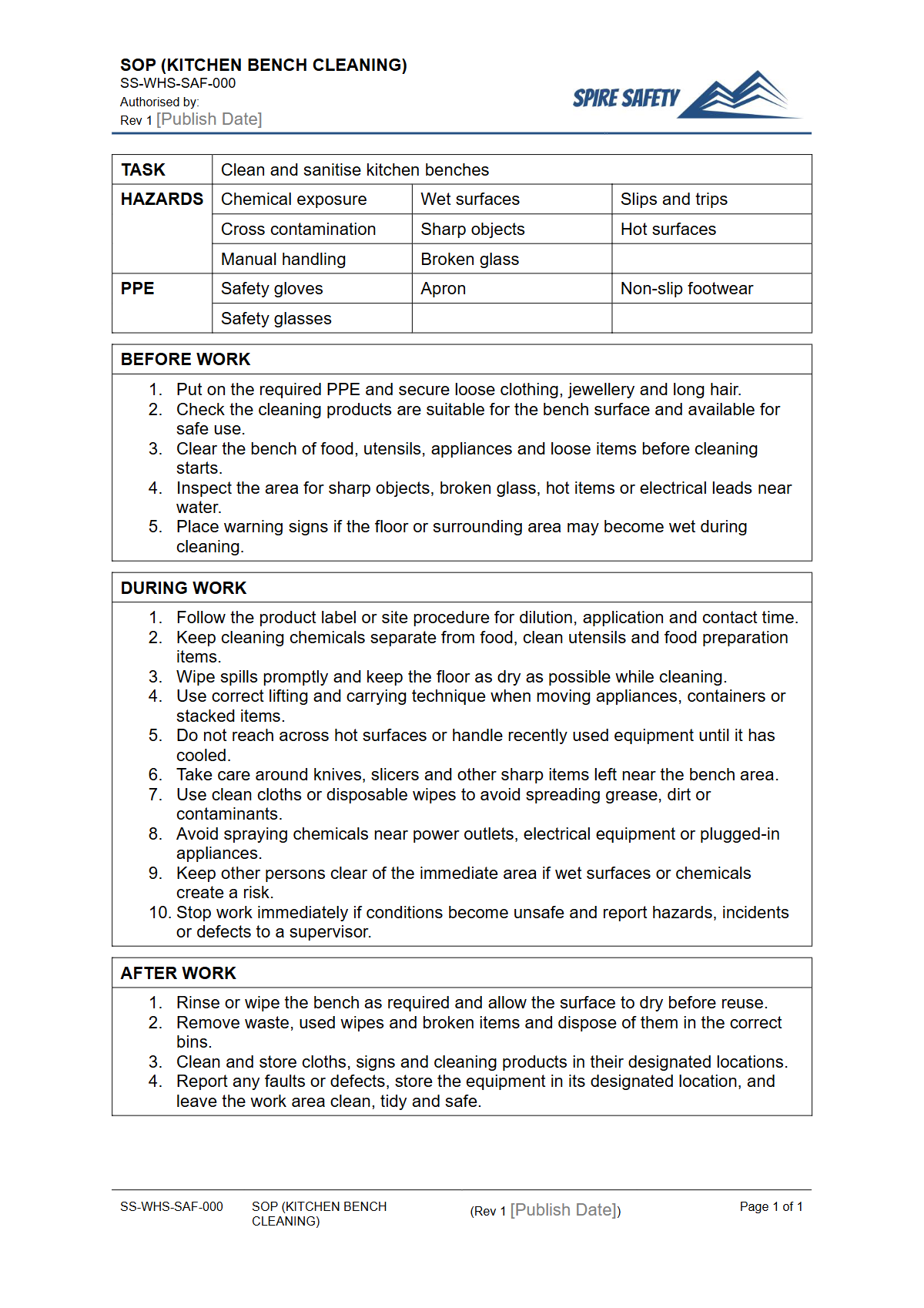
Maintaining clean and hygienic kitchen surfaces is fundamental in any commercial food preparation environment. This free Safe Operating Procedure (Kitchen Bench Cleaning) Template provides a structured framework for documenting the required steps to clean and sanitise benches effectively and safely.
A well-defined SOP helps standardise processes, reduces the risk of food contamination, and controls hazards associated with chemical handling and manual tasks. Implementing this procedure ensures all workers follow a consistent, safe, and effective method every time.
Using a documented SOP for routine tasks like bench cleaning is a key element of a proactive safety culture. It serves as a vital training tool for new staff and a consistent reference point for experienced employees.
This SOP forms a crucial part of your broader WHS management systems, demonstrating a commitment to controlling risks and meeting food safety obligations in industries like hospitality, healthcare, and food manufacturing.
Video walkthrough
How to use the Free Safe Operating Procedure (Kitchen Bench Cleaning) Template
This resource is available for download as a DOCX file for easy customisation or as a ready-to-print PDF. The SOP outlines a logical sequence for cleaning kitchen benches, including sections for identifying hazards, listing required Personal Protective Equipment (PPE), detailing emergency procedures, and outlining the step-by-step process.
To use it, simply download the DOCX version and edit the content to align with your specific operational context.
For example, you might complement this document with task-specific procedures for other equipment by using our Safe Operating Procedure (Deep Fryer - Standard Operation) template to build a complete kitchen safety library. This helps create a comprehensive suite of documents that cover all key activities in your workplace.
Important Note: This document is a template and must be customised. We have provided a structured starting point based on Australian WHS principles, but you are responsible for adapting it to reflect the specific chemicals, equipment, PPE, and environment of your workplace to ensure it is fit for purpose.
When to use it
A Safe Operating Procedure for cleaning kitchen benches should be an active document integrated into your daily workflow. It is not designed to be filed away and forgotten. The SOP should be used:
- As the primary training document for new employees learning how to perform cleaning tasks.
- As a regular refresher for all staff to ensure consistency and adherence to standards.
- Before starting daily, weekly, or periodic deep-cleaning tasks involving kitchen benches.
- As a reference guide when dealing with spills or contamination events.
- During safety audits or inspections as evidence of your risk management processes.
If you are unsure how to integrate this SOP into your daily operations or require assistance with the associated risk assessments for chemical use, our WHS consulting team can provide expert guidance and support.
Who should use it
This SOP is designed for use by multiple roles within an organisation to ensure a shared understanding of safe work practices. Key personnel include:
- Kitchen Hands, Chefs, and Catering Staff: The primary users who will follow the step-by-step instructions to perform the cleaning task safely and effectively.
- Supervisors and Kitchen Managers: Responsible for training workers on the SOP, ensuring it is followed correctly, and conducting periodic checks or observations.
- Work Health and Safety (WHS) Managers: Responsible for developing, reviewing, and updating the SOP as part of the overall safety management system. They ensure the procedure aligns with chemical Safety Data Sheets (SDS) and relevant codes of practice.
Regular reviews of SOPs and their practical application are also a key focus during WHS compliance auditing to verify that documented procedures are being effectively implemented in the workplace.
By clearly defining responsibilities and procedures, this SOP helps create a safer and more hygienic environment for everyone. Explore our full free WHS resources library for more templates to support your organisation's safety management.
Common mistakes
Common mistakes to avoid
- Using the wrong chemical for a surface or applying incorrect dilution ratios, which can damage surfaces or be ineffective.
- Failing to wear the correct Personal Protective Equipment (PPE) specified in the chemical's Safety Data Sheet (SDS).
- Not allowing sufficient contact time for sanitisers to work, rendering the disinfection step ineffective.
- Neglecting to properly clean and store cleaning equipment itself after use, leading to bacterial growth and cross-contamination.
Legal references
Legal considerations
The following legal requirements may be relevant to this type of work.
- Work Health and Safety Act (Harmonised) — Provides the primary duties for protecting workers and other people from work health and safety risks.
- Work Health and Safety Regulations (Harmonised) — Sets out requirements supporting the management of workplace hazards and risks.
The following codes may be relevant to this type of work.
- Managing WHS Risks Code of Practice — Provides practical guidance on identifying hazards, assessing risks and applying effective controls.
- Work Health and Safety Consultation, Cooperation and Coordination Code of Practice — Provides practical guidance on consulting workers and coordinating with other duty holders.
- Managing the Work Environment and Facilities Code of Practice — Provides practical guidance on safe work environments, workplace facilities and related controls.
Did you know
The Two-Step Process
Effective benchtop sanitation involves a two-step process: cleaning to remove dirt and food particles, followed by sanitising to kill harmful bacteria. Simply wiping with a wet cloth is not enough to ensure a hygienic surface.
Colour-Coded Cleaning
Many organisations use a colour-coding system for cleaning equipment like cloths and buckets. This simple practice helps prevent cross-contamination between areas, such as using the same cloth in a kitchen and a bathroom.
FAQ
Frequently asked questions
01What should be included in an SOP for cleaning kitchen benches?
02How often should kitchen cleaning SOPs be reviewed?
03Are cleaning chemicals considered hazardous substances?
04Can this template be used for food safety compliance?
Share this resource
Free Safe Operating Procedure (Kitchen Bench Cleaning) Template
Browse Categories
How To Use It
- 1Download and open in Word or PDF.
- 2Replace the placeholders with your business details.
- 3Get it reviewed by a WHS specialist before rollout.
Need it customised?
Our WHS consultants can adapt this template to your site, run a gap analysis, or audit what you already have in place.
Book a Free Consultation WHS consulting servicesor call 1300 156 382
Related templates
- Free Safe Operating Procedure (Kitchen Exhaust Clean) Template
- Free Safe Operating Procedure (Kitchen Floor Cleaning) Template
- Free Safe Operating Procedure (Kitchen Trolley Use) Template
- Free Safe Operating Procedure (Knife Handling) Template
- Free Safe Operating Procedure (Knife Sharpening) Template
- Free Safe Operating Procedure (Knitting Machine) Template