
Free Safe Operating Procedure (Knife Handling) Template
Establish clear, safe knife handling protocols in your workplace with our customisable template. Download your free Safe Operating Procedure today.
Free Safe Operating Procedure (Knife Handling) Template
DOCX • 126 KB + PDF
Updated Oct 2026
No signup required
Purpose of the Free Safe Operating Procedure (Knife Handling) Template
Knives are an essential tool in many industries, from hospitality and food processing to warehousing and retail. However, their improper use is a leading cause of serious workplace injuries.
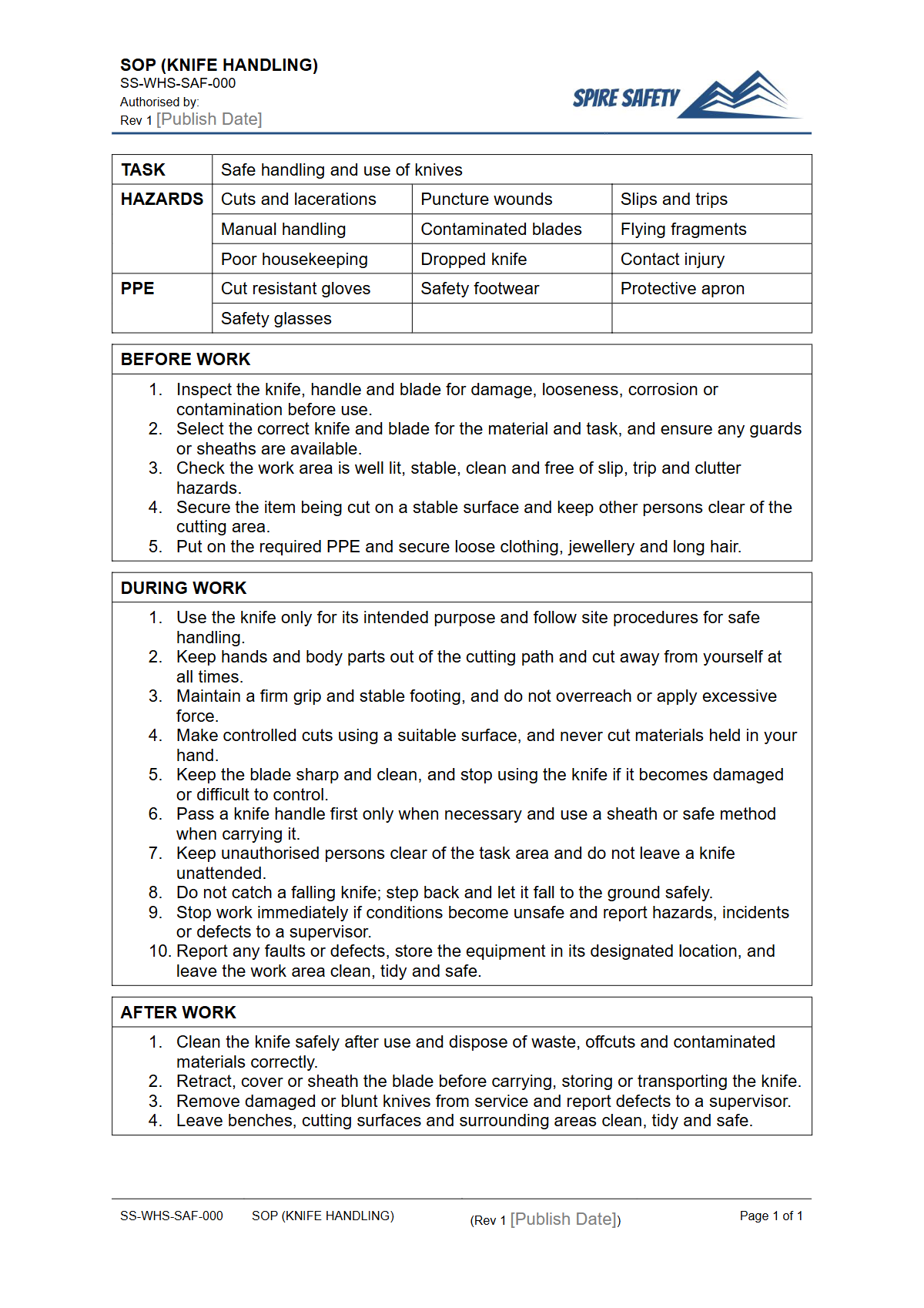
This Free Safe Operating Procedure (Knife Handling) Template provides a structured starting point for documenting a safe system of work to manage the risks associated with knife use. Formalising your procedures helps ensure all workers, including new and young employees, understand the expected safe behaviours, required personal protective equipment (PPE), and emergency actions. It is a critical component of demonstrating your commitment to risk management and forms a key part of effective WHS management systems.
Video walkthrough
How to use the Free Safe Operating Procedure (Knife Handling) Template
This Safe Operating Procedure for knife handling is provided in an easy-to-edit DOCX format, allowing you to tailor it precisely to your operational needs. A PDF version is also available for straightforward printing and distribution.
To use the template effectively, you must methodically work through each section and replace the placeholder text with information specific to your equipment, environment, and tasks. This includes detailing the types of knives used, the specific cutting tasks performed, maintenance schedules, and clear instructions for safe storage and disposal of blades.
Integrating it with other procedural documents, such as an SOP for deep fryer operation in a commercial kitchen, creates a more comprehensive safety framework.
Important: This is a template only. We have provided a solid foundation based on Australian WHS principles, but you must customise it to reflect the specific hazards and control measures relevant to your workplace.
A generic document is not sufficient for compliance; it must be made site-specific.
Key Elements to Customise
- Knife and Task Identification: List all types of knives used (e.g., utility knives, boning knives, butcher's knives) and the specific tasks they are used for.
- Personal Protective Equipment (PPE): Specify the mandatory PPE, such as cut-resistant gloves (including the required cut level rating), safety glasses, and aprons.
- Pre-operational Checks: Detail the process for inspecting knives before use, checking for sharpness, and ensuring handles are clean and intact.
- Step-by-Step Procedure: Clearly outline the safe steps for each cutting task, including proper grip techniques (e.g., the 'claw' grip), cutting direction (away from the body), and maintaining a stable cutting surface.
- Storage and Cleaning: Define the procedures for cleaning, sanitising, and storing knives safely, such as in designated knife blocks, magnetic strips, or sheaths. Never leave knives loose in sinks.
- Maintenance and Disposal: Describe how knives will be sharpened and who is responsible. Outline the procedure for safely disposing of worn-out or broken blades using a sharps container.
- First Aid and Emergencies: Specify the immediate first aid response for cuts and lacerations and list the locations of first aid kits and trained personnel.
When to use a Safe Operating Procedure
A Safe Operating Procedure for knife handling should be a core document used consistently across your organisation. It is essential for inducting new workers, providing refresher training for existing staff, and before undertaking non-routine cutting tasks.
The SOP should be readily available near work areas where knives are used. It also serves as a critical reference tool during incident investigations and regular WHS compliance audits to verify that documented procedures are being followed in practice.
Who should use it
This SOP is intended for all persons conducting a business or undertaking (PCBUs) where knives are used. It must be read and understood by any worker required to handle knives as part of their job, including chefs, kitchen hands, butchers, food processing workers, warehouse staff, and retail employees who open boxes.
Supervisors and managers are responsible for implementing the SOP, ensuring workers are trained on its contents, and monitoring its application in the workplace. For complex operations, engaging specialist WHS consulting support can help ensure your procedures are robust. While this document is for manual knives, other cutting tools require their own specific procedures, such as our circular saw SOP.
By implementing and enforcing a clear SOP, you create a safer, more predictable work environment. Explore our free WHS resources library to find other templates that can help you build out your safety management system.
Common mistakes
Common mistakes to avoid
- Using a dull knife, which requires more force and is more likely to slip.
- Leaving knives loose on benchtops or hidden in sinks full of water.
- Failing to specify safe storage and disposal methods for blades in a sharps container.
- Not providing task-specific training (e.g., deboning vs. chopping vegetables).
Legal references
Legal considerations
The following legal requirements may be relevant to this type of work.
- Work Health and Safety Act (Harmonised) — Provides the primary duties for protecting workers and other people from work health and safety risks.
- Work Health and Safety Regulations (Harmonised) — Sets out requirements supporting the management of workplace hazards and risks.
The following codes may be relevant to this type of work.
- Managing WHS Risks Code of Practice — Provides practical guidance on identifying hazards, assessing risks and applying effective controls.
- Work Health and Safety Consultation, Cooperation and Coordination Code of Practice — Provides practical guidance on consulting workers and coordinating with other duty holders.
- Managing the Work Environment and Facilities Code of Practice — Provides practical guidance on safe work environments, workplace facilities and related controls.
Did you know
A Leading Cause of Injury
Lacerations from knives and other sharp implements are one of the most common causes of workplace injury in the hospitality, retail, and food processing industries, often resulting in significant time off work.
Dull is Dangerous
A dull knife is more dangerous than a sharp one. It requires more pressure to cut, increasing the likelihood of the blade slipping and causing a severe injury.
FAQ
Frequently asked questions
01What must be included in a knife handling SOP?
02How often should we review our knife handling procedures?
03Are cut-resistant gloves mandatory when using knives?
04Can a generic knife SOP be used for all types of knives?
Share this resource
Free Safe Operating Procedure (Knife Handling) Template
Browse Categories
How To Use It
- 1Download and open in Word or PDF.
- 2Replace the placeholders with your business details.
- 3Get it reviewed by a WHS specialist before rollout.
Need it customised?
Our WHS consultants can adapt this template to your site, run a gap analysis, or audit what you already have in place.
Book a Free Consultation WHS consulting servicesor call 1300 156 382
Related templates
- Free Safe Operating Procedure (Knife Sharpening) Template
- Free Safe Operating Procedure (Knitting Machine) Template
- Free Safe Operating Procedure (Label Applicator) Template
- Free Safe Operating Procedure (Lake Edge Cleanup) Template
- Free Safe Operating Procedure (Laminar Flow Cabinet) Template
- Free Safe Operating Procedure (Landfill Face Check) Template