
Free Safe Operating Procedure (Lake Edge Cleanup) Template
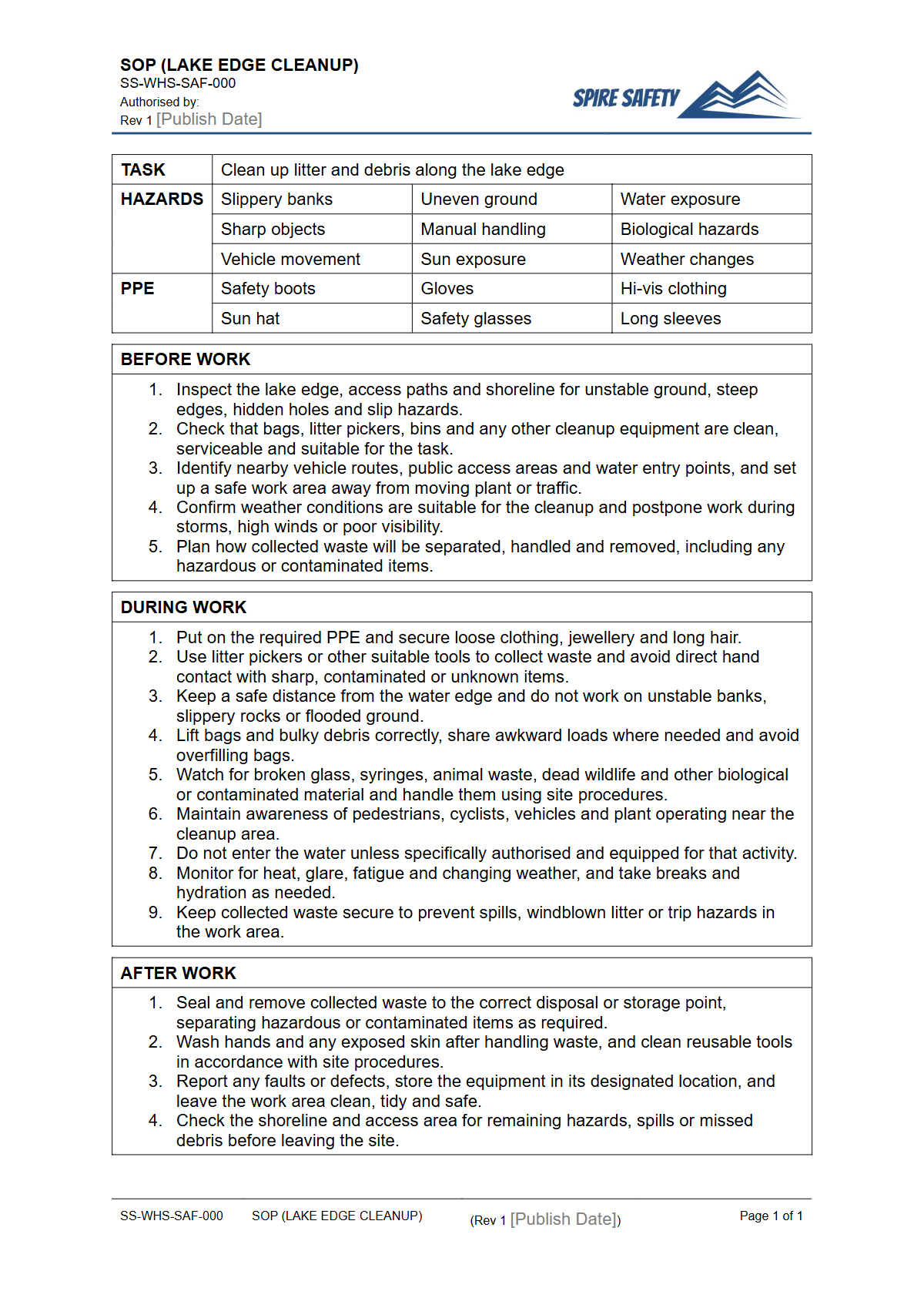
Download our free Safe Operating Procedure (Lake Edge Cleanup) template. This customisable document helps you outline risks and controls for cleanup tasks.
Free Safe Operating Procedure (Lake Edge Cleanup) Template
DOCX • 126 KB + PDF
Updated Oct 2026
No signup required
Purpose of the Free Safe Operating Procedure (Lake Edge Cleanup) Template
Working near bodies of water presents unique and serious risks. This Free Safe Operating Procedure (Lake Edge Cleanup) Template provides a structured framework for identifying hazards and implementing control measures for tasks performed along the edges of lakes, rivers, and dams. It is designed to help persons conducting a business or undertaking (PCBUs) establish and document a safe system of work, which is a critical component of any effective WHS management system.
The primary purpose of a Safe Operating Procedure (SOP) is to provide clear, step-by-step instructions that guide workers to perform a task safely. For lake edge cleanup, this involves addressing hazards such as slips on wet or unstable ground, drowning, exposure to contaminated water or biological hazards, manual handling injuries from lifting debris, and risks associated with wildlife.
Using this template helps ensure these factors are considered and managed before work begins, promoting a safer environment for everyone involved.
Video walkthrough
How to use the Free Safe Operating Procedure (Lake Edge Cleanup) Template
This document is a template, not a finished procedure. You must customise it to reflect the specific conditions, equipment, and tasks at your workplace.
To use the template effectively, consult with workers and supervisors who will be performing the cleanup. Walk through the job from start to finish, identifying all potential hazards and agreeing on the safest way to perform each step.
Important: We have drafted this template to be aligned with Australian WHS principles, but it is a generic starting point. Your final SOP must be tailored to the unique environment of your site.
This includes specifying the exact types of Personal Protective Equipment (PPE) required (e.g., life jackets, waterproof gloves, waders), emergency procedures, and communication protocols.
The template guides you to document key areas such as pre-operational checks, the sequential steps of the cleanup process, and post-task actions. For larger cleanups that involve moving significant amounts of soil or debris, you may also need procedures for specific machinery.
As an example, a well-documented process like our FREE Scraper SOP (Safe Operating Procedure) Template demonstrates how to detail machine-specific controls.
When to use it
A Safe Operating Procedure for lake edge cleanup should be developed and implemented before any such work is undertaken. It is essential for a wide range of scenarios, including environmental remediation projects, routine maintenance by local councils, storm debris removal, and organised community or volunteer cleanup events.
The SOP serves as a crucial tool for training new workers and as a reference for experienced personnel to ensure consistency and safety. It also forms a key part of your safety documentation, which can be reviewed during a WHS compliance audit.
Who should use it
This SOP should be used by anyone responsible for planning, supervising, or carrying out lake edge cleanup tasks. This includes:
- Supervisors and Team Leaders: To plan the work, conduct pre-start briefings, and ensure controls are in place.
- Workers and Volunteers: To understand the approved, safe method for completing their tasks and the associated hazards.
- WHS Managers and Advisors: To develop and review safety documentation as part of the organisation's overall safety framework.
The effectiveness of an SOP relies on all personnel being trained in its contents and competent to perform the described tasks. If the cleanup involves moving large objects like fallen trees or submerged items, specific procedures for mechanical aids are necessary. For instance, tasks requiring heavy lifting and placement may be covered by a FREE Telehandler SOP (Safe Operating Procedure) Template.
Similarly, if clearing fallen branches and timber debris is part of the scope, a separate procedure for the tools involved is essential for managing risks like cuts and kickback. A specific document such as a FREE Circular Saw SOP (Safe Operating Procedure) Template would be required for these activities.
For situations involving complex environmental hazards or regulatory requirements, seeking external advice from a qualified professional is recommended. Spire Safety offers expert WHS consulting to help navigate such challenges.
Common mistakes
Common mistakes to avoid
- Using a generic template without site-specific customisation.
- Forgetting to assess water quality and potential biological or chemical contamination.
- Neglecting to plan for emergency response, especially for work near or over water.
- Failing to provide and enforce the use of appropriate PPE, such as life jackets and waterproof gear.
Legal references
Legal considerations
The following legal requirements may be relevant to this type of work.
- Work Health and Safety Act (Harmonised) — Provides the primary duties for protecting workers and other people from work health and safety risks.
- Work Health and Safety Regulations (Harmonised) — Sets out requirements supporting the management of workplace hazards and risks.
The following codes may be relevant to this type of work.
- Managing WHS Risks Code of Practice — Provides practical guidance on identifying hazards, assessing risks and applying effective controls.
- Work Health and Safety Consultation, Cooperation and Coordination Code of Practice — Provides practical guidance on consulting workers and coordinating with other duty holders.
- Managing the Work Environment and Facilities Code of Practice — Provides practical guidance on safe work environments, workplace facilities and related controls.
Did you know
The Drowning Risk
In Australia, a significant number of drowning deaths occur in inland waterways like rivers and lakes. Many of these incidents involve falls into water, highlighting the importance of secure footing and fall prevention when working near water edges.
Manual Task Injuries
According to Safe Work Australia, injuries resulting from hazardous manual tasks are the most common type of workplace injury. Activities like lifting and moving awkward or heavy debris during cleanup are a primary source of these preventable injuries.
FAQ
Frequently asked questions
01What is the difference between an SOP and a Safe Work Method Statement (SWMS)?
02Is this template suitable for volunteer cleanup groups?
03What are the key hazards to consider in a lake edge cleanup SOP?
04How often should a Safe Operating Procedure be reviewed?
Share this resource
Free Safe Operating Procedure (Lake Edge Cleanup) Template
Browse Categories
How To Use It
- 1Download and open in Word or PDF.
- 2Replace the placeholders with your business details.
- 3Get it reviewed by a WHS specialist before rollout.
Need it customised?
Our WHS consultants can adapt this template to your site, run a gap analysis, or audit what you already have in place.
Book a Free Consultation WHS consulting servicesor call 1300 156 382
Related templates
- Free Safe Operating Procedure (Laminar Flow Cabinet) Template
- Free Safe Operating Procedure (Landfill Face Check) Template
- Free Safe Operating Procedure (Landfill Litter Patrol) Template
- Free Safe Operating Procedure (Landscape Fabric Install) Template
- Free Safe Operating Procedure (Laser Level) Template
- Free Safe Operating Procedure (Laser Marker) Template