
Free Safe Operating Procedure (Landfill Litter Patrol) Template
Effectively manage the risks of on-foot waste collection with our free Safe Operating Procedure (Landfill Litter Patrol) template.
Free Safe Operating Procedure (Landfill Litter Patrol) Template
DOCX • 126 KB + PDF
Updated Oct 2026
No signup required
Purpose of the Free Safe Operating Procedure (Landfill Litter Patrol) Template
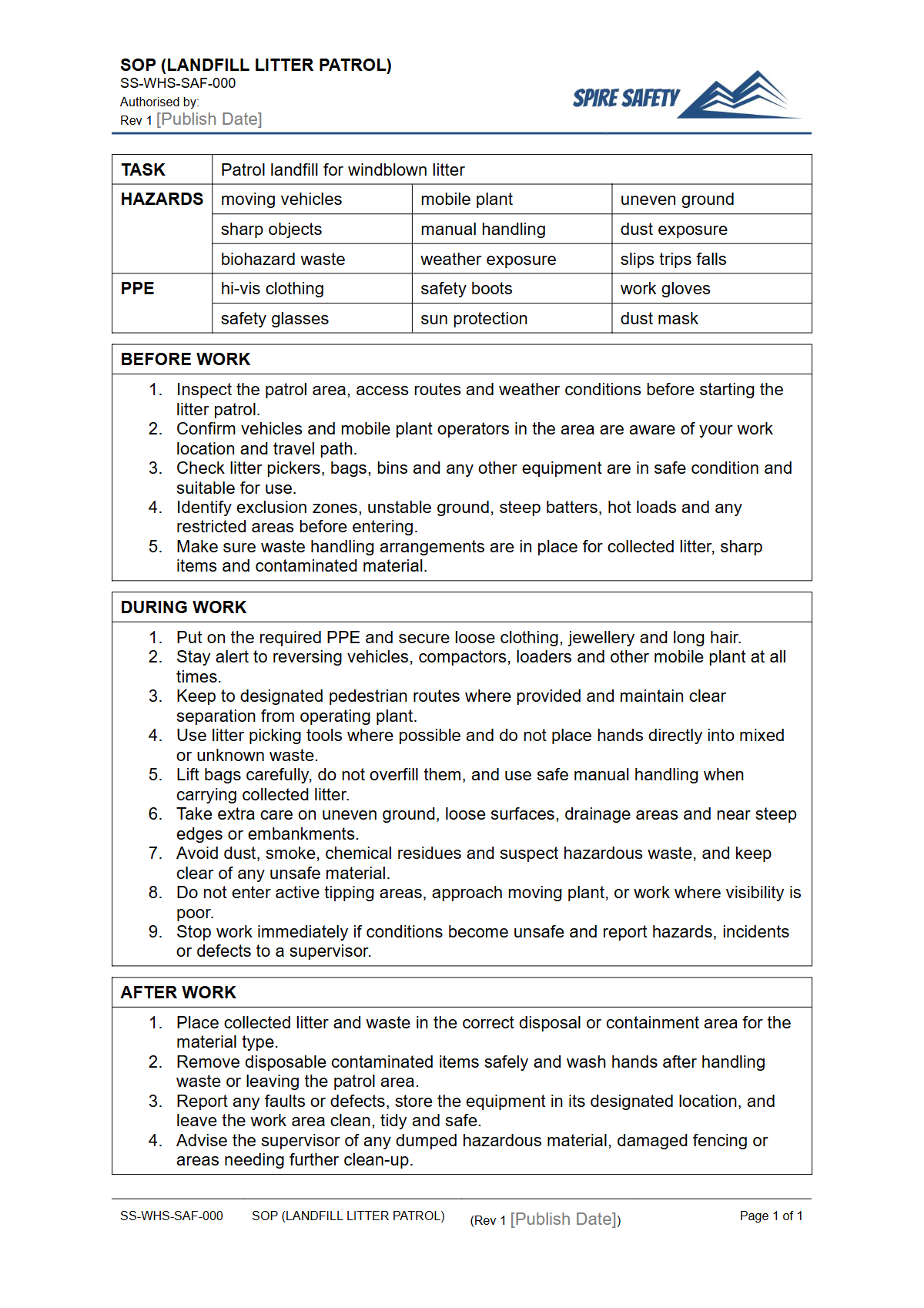
This free Safe Operating Procedure (Landfill Litter Patrol) template provides a structured framework for documenting the safe methods required to collect wind-blown litter and other debris at a landfill or waste management facility. Landfill litter patrol is a critical task for environmental compliance and site presentation, but it exposes workers to significant hazards.
This SOP is designed to help your organisation identify these risks and implement effective control measures to ensure worker safety.
Key risks addressed include interactions with heavy mobile plant, slips, trips, and falls on unstable or uneven ground, manual handling injuries, and exposure to hazardous materials, sharps, and biological contaminants. The procedure outlines necessary controls such as Personal Protective Equipment (PPE), communication protocols, safe work zones, and emergency responses.
Using this template helps standardise your approach, ensuring every worker understands the required safety precautions before stepping onto the active site. It forms a key part of the risk management process for routine operational tasks that involve working near heavy machinery, such as those covered in our free Scraper SOP template.
Video walkthrough
How to use the Free Safe Operating Procedure (Landfill Litter Patrol) Template
Download the template in your preferred format (DOCX for easy editing or PDF) and adapt it to your specific operational context. This document is a comprehensive starting point, but it must be tailored to reflect the unique conditions of your workplace.
Fill in the designated sections with details about your site layout, the types of machinery in use, specific emergency contacts, and any state or territory-specific WHS regulations.
Important: This is a template, not a finished document. We have drafted it based on common Australian WHS practices, but for it to be effective, you must customise it with your site-specific risk assessments, procedures, and personnel roles.
We strongly recommend consulting with the workers who actually perform the litter patrols, as their firsthand experience is invaluable for identifying practical hazards and effective controls. This process of customisation and consultation ensures the final SOP is both relevant and practical.
Once finalised, this SOP should be integrated into your overall safety framework. A robust procedure is most effective when it is part of comprehensive WHS management systems that connect documentation, training, and operational practice.
When to use it
A Safe Operating Procedure for landfill litter patrol is a foundational document that should be used in several key situations. It is essential during the induction and training of new employees who will be assigned this task, ensuring they understand the risks and safety protocols from day one.
It should also be reviewed with experienced workers as part of regular refresher training to prevent complacency.
The SOP serves as a direct reference guide before a litter patrol task begins, allowing supervisors and workers to conduct a pre-start check against its requirements. Furthermore, it is an invaluable tool during incident investigations or near-miss reviews, helping to identify any procedural gaps or non-conformance.
Regular reviews of the SOP, prompted by formal safety reviews or WHS compliance auditing, ensure it remains current with changing site conditions or regulations.
Who should use it
This Safe Operating Procedure is intended for multiple roles within a waste management organisation:
- Workers/Operators: The primary users are the individuals tasked with performing litter patrols. They must understand and follow the specified steps to protect themselves and others.
- Supervisors and Site Managers: These leaders are responsible for ensuring workers are trained on the SOP and that its procedures are followed correctly. They use it to monitor work, enforce safety standards, and lead pre-start briefings.
- WHS/HSE Personnel: Safety officers and advisors use this template to develop, implement, and review safety documentation. They are responsible for ensuring it aligns with the organisation’s risk assessments and legal obligations.
Effective use involves clear communication between all parties, particularly between workers on foot and the operators of mobile plant. The principles of maintaining situational awareness and clear communication are universal across all tasks, whether performing a litter patrol or operating heavy equipment as detailed in documents like our free Grader SOP template.
Key Hazards and Controls
While this template provides a full list, some of the most critical hazards to manage during litter patrol include:
- Mobile Plant and Vehicles: Collision risks from dozers, compactors, trucks, and other vehicles.
- Unstable Ground: Slips, trips, and falls on uneven surfaces, loose waste, or steep batters.
- Hazardous Materials: Contact with sharps (needles), chemical waste, asbestos, or unidentified substances.
- Biological Hazards: Exposure to bacteria, pathogens, and vectors (e.g., rodents, insects) in decaying waste.
- Environmental Exposure: Risks from heat stress, UV radiation, high winds, and cold temperatures.
Essential controls often involve a hierarchy, from establishing exclusion zones to using specific PPE. For instance, some sites may use smaller, more agile equipment to assist in consolidating collected litter before removal, a task that would require its own procedure similar in principle to our FREE Telehandler SOP Template. The most important thing is to match the control to the specific hazard identified in your risk assessment.
After customising this document, explore our entire free WHS resources library for more templates to support your safety management system.
Common mistakes
Common mistakes to avoid
- Failing to establish clear exclusion zones between workers on foot and heavy machinery.
- Using inadequate PPE, especially gloves that don't protect against sharps or chemicals.
- Neglecting to account for environmental factors like heat stress, UV exposure, or high winds.
- Not providing clear instructions for handling potentially hazardous or unknown materials.
Legal references
Legal considerations
The following legal requirements may be relevant to this type of work.
- Work Health and Safety Act (Harmonised) — Provides the primary duties for protecting workers and other people from work health and safety risks.
- Work Health and Safety Regulations (Harmonised) — Sets out requirements supporting the management of workplace hazards and risks.
The following codes may be relevant to this type of work.
- Managing WHS Risks Code of Practice — Provides practical guidance on identifying hazards, assessing risks and applying effective controls.
- Work Health and Safety Consultation, Cooperation and Coordination Code of Practice — Provides practical guidance on consulting workers and coordinating with other duty holders.
- Managing the Work Environment and Facilities Code of Practice — Provides practical guidance on safe work environments, workplace facilities and related controls.
Did you know
Wind's Impact
Wind is a major factor in landfill management. A moderate 25 km/h wind can carry light plastic bags and paper several kilometres, making litter patrols a critical and ongoing task for environmental compliance.
FAQ
Frequently asked questions
01What is the main purpose of an SOP for landfill litter patrol?
02What PPE is typically required for landfill litter collection?
03How often should a Safe Operating Procedure be reviewed?
04Can this template be used for other waste management tasks?
Share this resource
Free Safe Operating Procedure (Landfill Litter Patrol) Template
Browse Categories
How To Use It
- 1Download and open in Word or PDF.
- 2Replace the placeholders with your business details.
- 3Get it reviewed by a WHS specialist before rollout.
Need it customised?
Our WHS consultants can adapt this template to your site, run a gap analysis, or audit what you already have in place.
Book a Free Consultation WHS consulting servicesor call 1300 156 382
Related templates
- Free Safe Operating Procedure (Landscape Fabric Install) Template
- Free Safe Operating Procedure (Laser Level) Template
- Free Safe Operating Procedure (Laser Marker) Template
- Free Safe Operating Procedure (Laundry Bag Collection) Template
- Free Safe Operating Procedure (Laundry Bag Handling) Template
- Free Safe Operating Procedure (Laundry Cart Handling) Template