
Free Safe Operating Procedure (Laundry Bag Collection) Template
Download our free Safe Operating Procedure (Laundry Bag Collection) Template. This DOCX & PDF resource helps document safe work practices. Get started now.
Free Safe Operating Procedure (Laundry Bag Collection) Template
DOCX • 126 KB + PDF
Updated Oct 2026
No signup required
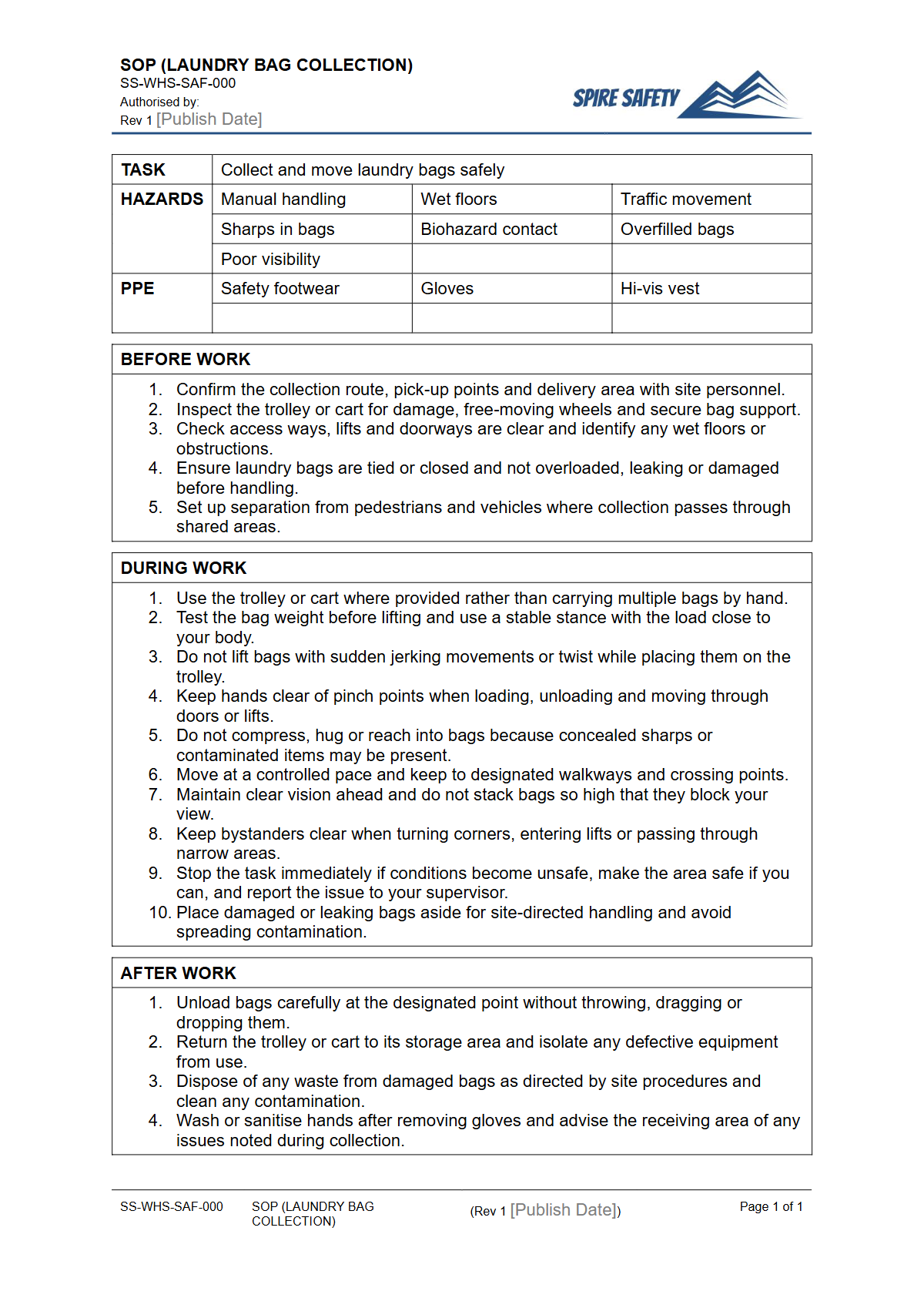
Purpose of the Free Safe Operating Procedure (Laundry Bag Collection) Template
Collecting and transporting laundry bags, while a routine task in many industries like hospitality, healthcare, and accommodation, carries significant work health and safety risks. This Free Safe Operating Procedure (Laundry Bag Collection) Template provides a structured framework for documenting the safe and correct method for performing this task.
Its primary purpose is to help your organisation control hazards and minimise the risk of injury. By clearly outlining steps, required personal protective equipment (PPE), and emergency protocols, the SOP serves as a vital tool for worker training and operational consistency.
A well-defined SOP is a cornerstone of effective WHS management systems. It demonstrates a commitment to safety, standardises performance, and provides a clear reference point for workers and supervisors. This template helps you address common hazards associated with laundry collection, including manual handling injuries from lifting, pushing, and pulling; exposure to biological hazards from soiled linen; and slips, trips, and falls from spills or cluttered environments.
Video walkthrough
How to use the Free Safe Operating Procedure (Laundry Bag Collection) Template
To get the most value from this resource, you should download the DOCX file and adapt it to your specific operational context. A generic procedure is not sufficient; customisation is essential for effective risk management.
The template is designed as a starting point, aligned with Australian WHS principles, to guide you in creating a site-specific document.
Follow these steps to implement the SOP:
- Assess the Task: Conduct a thorough risk assessment of the laundry collection process in your workplace. Identify all potential hazards, from the point of collection to the transport destination.
- Customise the Content: Edit the template to include details specific to your site. This includes the types of laundry carts or trolleys used, the exact routes taken, the specific PPE required (e.g., nitrile gloves, aprons), and your organisation’s emergency contact information.
- Consult with Workers: Involve the employees who actually perform the task. Their direct experience is invaluable for identifying practical challenges and effective controls. Consultation is a key part of ensuring the procedure is workable and accepted by the team.
- Train and Supervise: Use the finalised Safe Operating Procedure as a training document for all relevant staff. Supervisors should ensure the procedure is consistently followed during daily operations.
Important: This is a template document that we have created as a starting point. To be effective, you MUST customise it to reflect the specific hazards, equipment, and environment of your workplace.
If you require assistance with this process, engaging professional WHS consulting services can provide expert guidance.
When to use it
A Safe Operating Procedure for laundry bag collection should be a living document integrated into your daily operations. It is not a set-and-forget tool.
It should be used as a primary reference during new employee induction and job-specific training to ensure they understand the established safe method from day one. It also serves as a critical resource for refresher training, helping to correct unsafe habits that may develop over time.
Furthermore, the SOP should be readily accessible in the work area for workers to consult before starting their shift or if they are unsure about a step. It is also an essential document to review during incident investigations or when a near-miss occurs, as it helps identify whether the procedure was followed and if it requires revision.
This process of review and improvement applies to all workplace tasks, whether you are using a FREE Step Ladder SOP Template or documenting complex machinery operation.
Who should use it
This SOP is intended for several groups within an organisation. The primary users are the workers who perform laundry collection tasks, such as hotel housekeepers, hospital orderlies, aged care staff, and commercial laundry employees.
For these individuals, the SOP is their guide to performing the job safely and efficiently, protecting them from injury.
Supervisors and team leaders are also key users. They are responsible for enforcing the procedure, monitoring for correct application, and providing coaching or corrective action when necessary.
They use the SOP as the benchmark for safe performance. WHS managers and safety officers use the document as part of the broader safety management system, using it to inform risk assessments, training plans, and audit checklists. Even logistics teams involved in off-site transport can benefit, as the principles extend to safely loading and unloading vehicles, which may be covered in a specific FREE Body Truck SOP Template.
Finally, maintenance personnel may refer to parts of the SOP when servicing equipment like laundry carts and trolleys. Ensuring equipment is in good working order is a critical control measure, just as it is for equipment in other departments, where a Free Air Compressor SOP (Safe Operating Procedure) Template might be used to ensure maintenance tasks are performed safely. For a wider selection of procedural documents, you can browse our complete free WHS resources library.
Common mistakes
Common mistakes to avoid
- Overfilling laundry bags, making them too heavy and difficult to handle safely.
- Using incorrect lifting techniques, such as bending from the back instead of the knees.
- Failing to wear appropriate Personal Protective Equipment (PPE) like gloves when handling soiled linen.
- Continuing to use damaged equipment, such as carts with faulty wheels or torn bags.
Legal references
Legal considerations
The following legal requirements may be relevant to this type of work.
- Work Health and Safety Act (Harmonised) — Provides the primary duties for protecting workers and other people from work health and safety risks.
- Work Health and Safety Regulations (Harmonised) — Sets out requirements supporting the management of workplace hazards and risks.
The following codes may be relevant to this type of work.
- Managing WHS Risks Code of Practice — Provides practical guidance on identifying hazards, assessing risks and applying effective controls.
- Work Health and Safety Consultation, Cooperation and Coordination Code of Practice — Provides practical guidance on consulting workers and coordinating with other duty holders.
- Managing the Work Environment and Facilities Code of Practice — Provides practical guidance on safe work environments, workplace facilities and related controls.
Did you know
Manual Handling Risks
According to Safe Work Australia, injuries resulting from manual handling are the most common type of workplace injury, accounting for a significant percentage of serious workers' compensation claims each year.
Linen Contamination
Soiled hotel or hospital linen can harbour pathogenic microorganisms for extended periods. Proper handling procedures, including the use of gloves and hand hygiene, are critical to prevent cross-contamination and protect workers.
FAQ
Frequently asked questions
01What hazards should an SOP for laundry bag collection cover?
02Why is a Safe Operating Procedure important for a simple task like collecting laundry?
03How often should an SOP for laundry bag collection be reviewed?
04Can this template be used for healthcare laundry collection?
Share this resource
Free Safe Operating Procedure (Laundry Bag Collection) Template
Browse Categories
How To Use It
- 1Download and open in Word or PDF.
- 2Replace the placeholders with your business details.
- 3Get it reviewed by a WHS specialist before rollout.
Need it customised?
Our WHS consultants can adapt this template to your site, run a gap analysis, or audit what you already have in place.
Book a Free Consultation WHS consulting servicesor call 1300 156 382
Related templates
- Free Safe Operating Procedure (Laundry Bag Handling) Template
- Free Safe Operating Procedure (Laundry Cart Handling) Template
- Free Safe Operating Procedure (Laundry Chute Use) Template
- Free Safe Operating Procedure (Laundry Detergent Refill) Template
- Free Safe Operating Procedure (Laundry Folding Station) Template
- Free Safe Operating Procedure (Laundry Press) Template