
Free Safe Operating Procedure (Laundry Folding Station) Template
Download our free Safe Operating Procedure (Laundry Folding Station) template. This customisable DOCX & PDF resource helps document safe work practices.
Free Safe Operating Procedure (Laundry Folding Station) Template
DOCX • 126 KB + PDF
Updated Oct 2026
No signup required
Purpose of the Free Safe Operating Procedure (Laundry Folding Station) Template
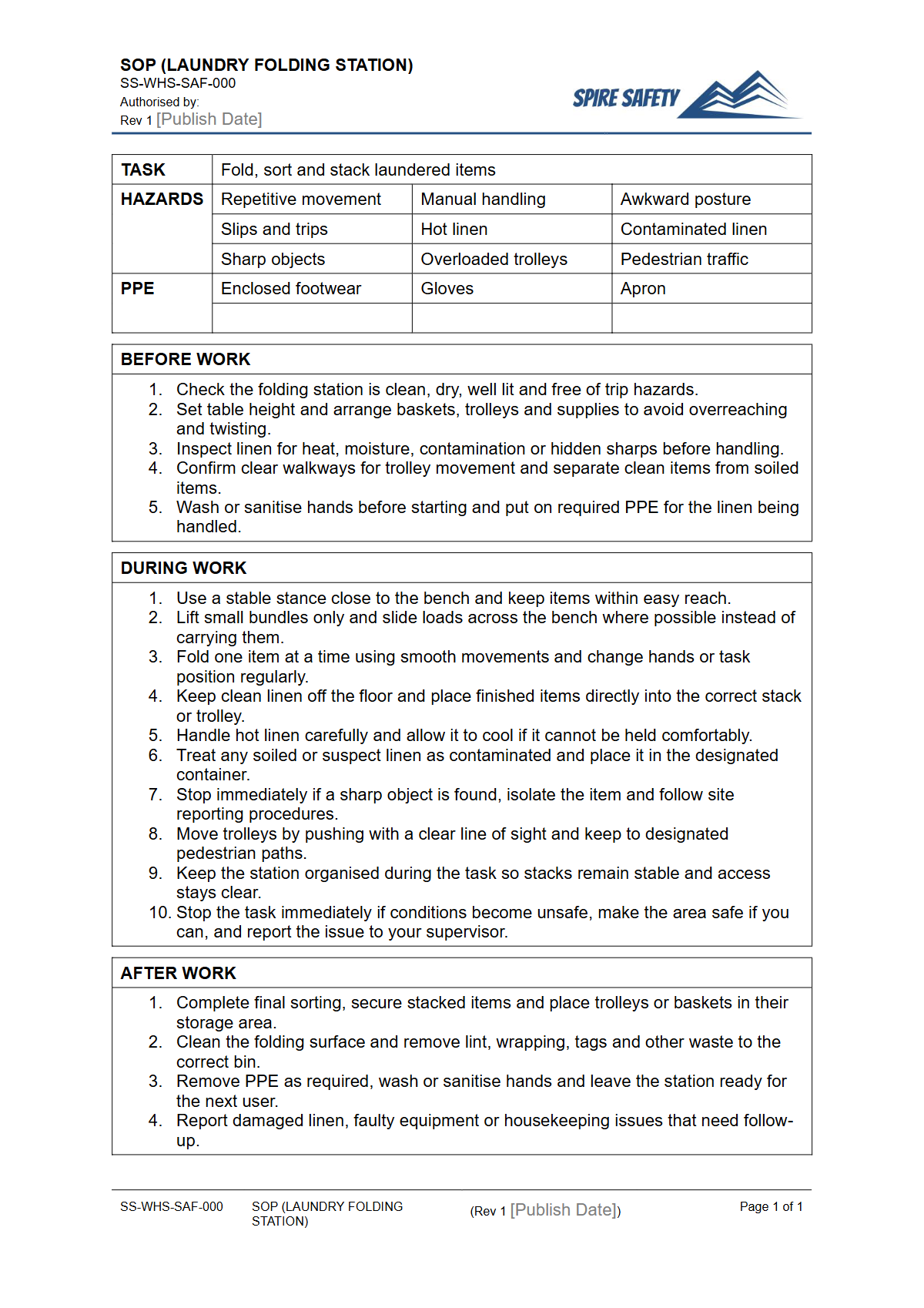
This Free Safe Operating Procedure (Laundry Folding Station) Template provides a structured starting point for documenting the risks and required controls for folding laundry in a commercial or industrial setting. An SOP is a fundamental administrative control that outlines a step-by-step process for performing a task safely.
Using this template helps your organisation manage WHS risks associated with manual tasks, repetitive actions, and machinery operation, ensuring workers understand and follow established safety protocols.
Developing a clear SOP supports your duty of care by demonstrating a systematic approach to health and safety. It forms a key part of an effective safety management system, providing a clear reference for workers and supervisors.
The document is designed to be adapted to both manual folding stations and those with automated folding equipment, covering a range of potential hazards.
Common Hazards at a Laundry Folding Station
When customising this document, it is crucial to conduct a site-specific risk assessment to identify all relevant hazards. Common risks include:
- Musculoskeletal Disorders (MSDs): Resulting from repetitive movements, prolonged standing, awkward postures (bending and reaching), and forceful exertions when handling heavy or wet linen.
- Slips, Trips, and Falls: Caused by linen, carts, or baskets obstructing walkways, or wet floors in the laundry environment.
- Manual Handling Injuries: Strains and sprains from lifting, carrying, pushing, or pulling heavy loads of laundry.
- Mechanical Hazards: If using automated folding machines, risks include entanglement in moving parts, pinch points, and crushing hazards.
- Thermal Hazards: Contact with hot linen directly from dryers can cause burns.
Effective management of these risks is essential for preventing workplace injuries. In the event of a serious incident, having immediate access to first aid and emergency equipment is critical, which is why procedures like a Safe Operating Procedure for Defibrillator Operation should also be part of your emergency plan.
Video walkthrough
How to use the Free Safe Operating Procedure (Laundry Folding Station) Template
This template is provided in both DOCX and PDF formats for your convenience. The DOCX file is fully editable, allowing you to tailor it precisely to your operational needs.
Follow these steps to implement the SOP effectively:
- Download the Template: Choose the DOCX version for customisation.
- Conduct a Risk Assessment: Identify all hazards specific to your laundry folding station, equipment, and environment.
- Customise the Content: Add your company name, logo, and other details. Modify the procedure steps, safety precautions, and personal protective equipment (PPE) requirements to reflect your risk assessment findings. Consult directly with the workers who perform the task to ensure the SOP is practical and accurate.
- Review and Approve: Have the draft SOP reviewed by a competent person, such as a supervisor or WHS manager, before final approval.
- Train Your Team: Induct and train all relevant workers on the finalised SOP. Ensure they understand the steps and the reasons behind them. Keep records of this training.
- Display and Monitor: Make the SOP easily accessible in the work area. Regularly monitor compliance and review its effectiveness.
Important: This document is a template only. It must be customised to suit the specific equipment, processes, and risks present in your workplace.
We cannot guarantee that this document will be suitable for your circumstances or that it will cover all hazards. If you are unsure about your obligations, seeking professional WHS consulting is recommended.
When to use this Safe Operating Procedure
A Safe Operating Procedure for a laundry folding station should be used consistently as part of daily operations. It is particularly important in the following situations:
- Worker Training and Induction: For new employees or those new to the task, the SOP serves as a primary training tool.
- Refresher Training: For existing staff to reinforce safe work practices and introduce any procedural updates.
- Pre-start Checks: As a reference for workers to review before commencing work, especially if the task is not performed frequently.
- Incident Investigation: To determine if procedural deviations contributed to an incident or near miss.
- Audits and Inspections: As evidence of a formalised system for controlling risks. Similar structured procedures, like a step ladder SOP, help demonstrate a commitment to safety across all workplace activities.
Who should use this Safe Operating Procedure
This SOP is intended for use by multiple roles within an organisation to foster a shared understanding of safety requirements:
- Laundry Workers and Operators: To understand and follow the correct, safe procedure for folding laundry and operating any associated machinery.
- Supervisors and Team Leaders: To train staff, monitor compliance, and enforce safe work standards.
- WHS Managers and Personnel: To use as a tool for risk management, training development, and integration into broader comprehensive WHS management systems.
- Training Coordinators: To form the basis of competency-based training programs for laundry operations.
While this document focuses on laundry folding, many workplaces use a variety of equipment that also requires documented procedures. For instance, an air compressor SOP is essential for workshops and maintenance areas.
You can find more templates in our free WHS resources library to build a complete suite of safety documents.
Common mistakes
Common mistakes to avoid
- Using the template without customising it for the specific workplace equipment and conditions.
- Failing to train workers on the finalised SOP and verify their understanding.
- Not reviewing or updating the SOP after an incident, near miss, or when processes change.
- Writing the procedure in complex language that workers cannot easily follow.
Legal references
Legal considerations
The following legal requirements may be relevant to this type of work.
- Work Health and Safety Act (Harmonised) — Provides the primary duties for protecting workers and other people from work health and safety risks.
- Work Health and Safety Regulations (Harmonised) — Sets out requirements supporting the management of workplace hazards and risks.
The following codes may be relevant to this type of work.
- Managing WHS Risks Code of Practice — Provides practical guidance on identifying hazards, assessing risks and applying effective controls.
- Work Health and Safety Consultation, Cooperation and Coordination Code of Practice — Provides practical guidance on consulting workers and coordinating with other duty holders.
- Managing the Work Environment and Facilities Code of Practice — Provides practical guidance on safe work environments, workplace facilities and related controls.
Did you know
Ergonomic Risk
Repetitive tasks, like folding laundry, are a leading cause of musculoskeletal disorders (MSDs), which account for a significant portion of serious workers' compensation claims in Australia.
Consultation is Key
The model WHS Act requires employers to consult with workers on matters that directly affect their health and safety, including the development of Safe Operating Procedures.
FAQ
Frequently asked questions
01What are the main hazards at a laundry folding station?
02How often should a Safe Operating Procedure for a laundry station be reviewed?
03Is this template suitable for both automated and manual folding stations?
04Who is responsible for creating and implementing the SOP?
Share this resource
Free Safe Operating Procedure (Laundry Folding Station) Template
Browse Categories
How To Use It
- 1Download and open in Word or PDF.
- 2Replace the placeholders with your business details.
- 3Get it reviewed by a WHS specialist before rollout.
Need it customised?
Our WHS consultants can adapt this template to your site, run a gap analysis, or audit what you already have in place.
Book a Free Consultation WHS consulting servicesor call 1300 156 382
Related templates
- Free Safe Operating Procedure (Laundry Press) Template
- Free Safe Operating Procedure (Laundry Sorting) Template
- Free Safe Operating Procedure (Laundry Stain Treatment) Template
- Free Safe Operating Procedure (Laundry Trolley Clean) Template
- Free Safe Operating Procedure (Laundry Washer) Template
- Free Safe Operating Procedure (Lavatory Service Cart) Template