
Free Safe Operating Procedure (Laundry Press) Template
Download our free Safe Operating Procedure (Laundry Press) template.
Free Safe Operating Procedure (Laundry Press) Template
DOCX • 126 KB + PDF
Updated Oct 2026
No signup required
Purpose of the Free Safe Operating Procedure (Laundry Press) Template
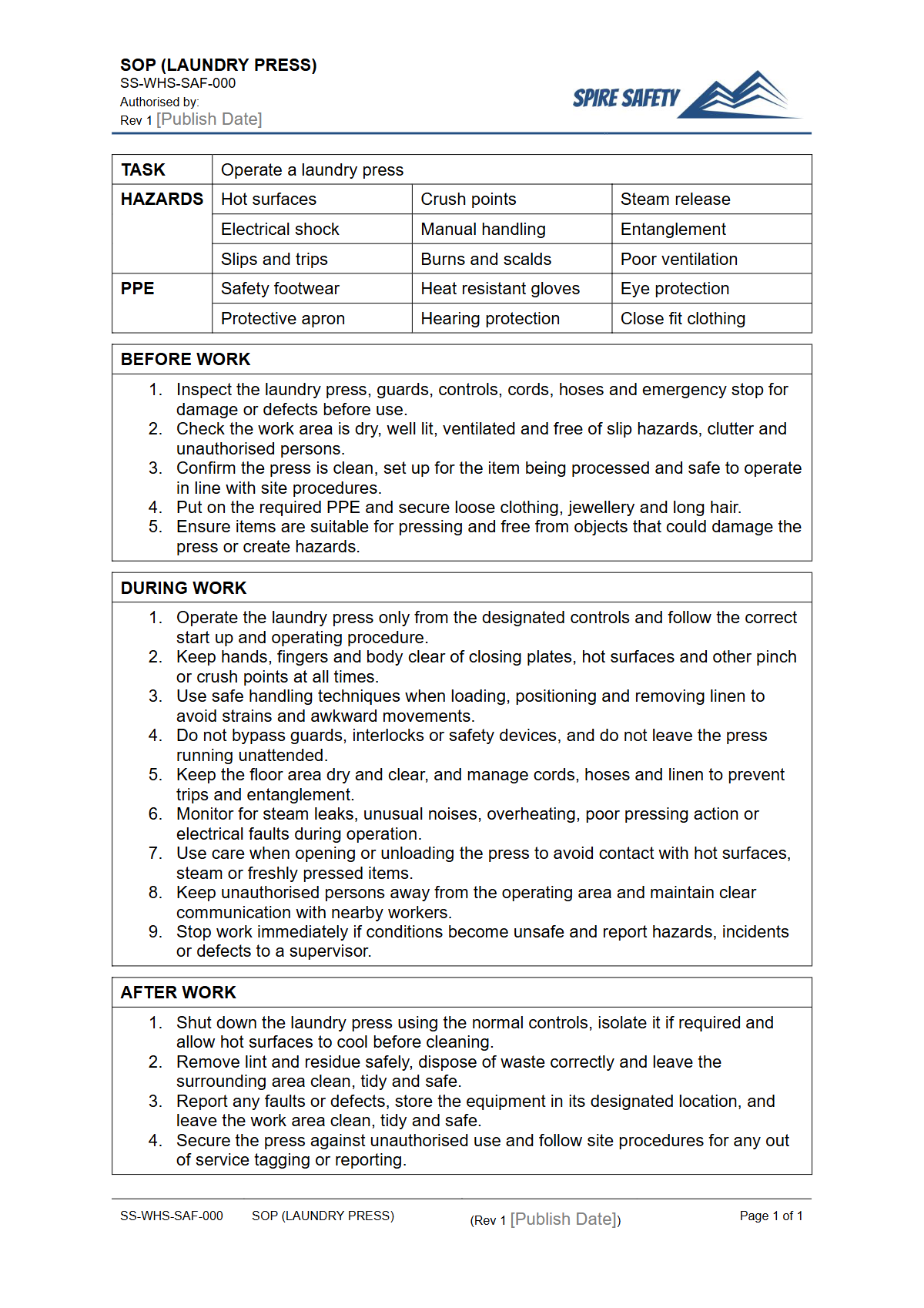
Operating industrial laundry equipment presents significant workplace health and safety risks. This free Safe Operating Procedure (Laundry Press) template provides a structured starting point for documenting the required steps to operate this machinery safely.
Laundry presses use a combination of heat, steam, and pressure, creating hazards such as severe burns, crushing, and pinch-point injuries. A documented SOP helps to control these risks by formalising a safe, repeatable process for all operators.
A well-developed SOP is a critical tool for training new employees, providing a clear reference for experienced workers, and demonstrating a commitment to systematic risk management. It ensures that every operator understands the specific hazards of the machine and the control measures required to prevent injury.
For machinery that relies on pneumatic power, it's also important to have documented processes for ancillary equipment; you may find our free Air Compressor SOP a useful supplementary document.
Video walkthrough
How to use the Free Safe Operating Procedure (Laundry Press) Template
This template is designed as a foundation, not a finished document. It is essential to adapt its contents to reflect the unique conditions of your workplace, including the specific make and model of your laundry press, the tasks performed, and the environment in which it is used.
To effectively implement this Safe Operating Procedure, you should:
- Conduct a thorough risk assessment on the laundry press and the surrounding work area.
- Consult the manufacturer’s operating manual for specific instructions, safety warnings, and maintenance schedules.
- Involve the workers who operate the press in the customisation process. Their direct experience is invaluable for creating a practical and effective procedure.
- Clearly detail the required Personal Protective Equipment (PPE), such as heat-resistant gloves, eye protection, and non-slip footwear.
- Incorporate specific instructions for pre-start checks, startup, operation, shutdown, and cleaning.
- Add detailed lockout/tagout procedures for all maintenance, cleaning, and fault-finding tasks.
Please note: This document is a template and must be customised to suit the specific make and model of the equipment, tasks, and environment at your workplace. We recommend a consultation process involving the workers who operate the machinery to ensure the SOP is practical and effective.
Integrating procedures like this one into robust WHS management systems is a key step in fulfilling your safety obligations.
When to use a Laundry Press SOP
A Safe Operating Procedure for a laundry press is not a document to be filed away and forgotten. It should be an active part of your daily operations and safety culture. Key times to use the SOP include:
- Worker Training: As the primary document for inducting and training new operators.
- Refresher Training: For periodic retraining of existing staff to prevent complacency and reinforce safe behaviour.
- Pre-Operational Checks: As a checklist to ensure the machine is safe to use before every shift.
- Incident Investigation: To review whether procedures were followed correctly after an incident or near miss.
- Safety Audits: To demonstrate procedural controls during internal or external WHS compliance audits.
Who should use it
This procedure is relevant to several roles within any organisation that operates commercial or industrial laundry equipment, such as hotels, commercial laundries, hospitals, and aged care facilities.
- Laundry Operators: The primary users who must follow the step-by-step instructions for safe operation, from startup to shutdown.
- Supervisors and Managers: Responsible for training workers against the SOP, ensuring it is followed, and conducting regular reviews to confirm its continued relevance.
- Maintenance Personnel: To follow documented isolation, lockout, and tagout procedures before any servicing or repairs, preventing accidental startup.
- WHS Managers/Officers: To use as a key control measure within the overall risk management framework and to ensure it aligns with legislative requirements. For complex machinery or developing comprehensive safety systems, engaging specialist WHS consulting can provide valuable expertise.
In addition to machine-specific procedures, every workplace should be prepared for medical emergencies. Having a clear and accessible defibrillator operation procedure can be a life-saving component of your overall safety plan. You can explore many other templates and guides in our free WHS resources library to build out your safety systems.
Common mistakes
Common mistakes to avoid
- Using a generic SOP without customising it for the specific machine and site risks.
- Failing to adequately train all operators on the finalised procedure and verify their understanding.
- Neglecting to include specific lockout/tagout steps for maintenance and cleaning tasks.
- Not reviewing and updating the SOP after an equipment modification, near miss, or incident.
Legal references
Legal considerations
The following legal requirements may be relevant to this type of work.
- Work Health and Safety Act (Harmonised) — Provides the primary duties for protecting workers and other people from work health and safety risks.
- Work Health and Safety Regulations (Harmonised) — Sets out requirements supporting the management of workplace hazards and risks.
The following codes may be relevant to this type of work.
- Managing WHS Risks Code of Practice — Provides practical guidance on identifying hazards, assessing risks and applying effective controls.
- Work Health and Safety Consultation, Cooperation and Coordination Code of Practice — Provides practical guidance on consulting workers and coordinating with other duty holders.
- Managing the Work Environment and Facilities Code of Practice — Provides practical guidance on safe work environments, workplace facilities and related controls.
Did you know
Burn Hazards
The surfaces of a laundry press can exceed 150°C. Contact burns from hot surfaces and steam are among the most common injuries associated with this type of equipment.
Force and Pressure
Industrial laundry presses can exert several tonnes of force. This is why safety features like two-hand controls, light curtains, and emergency stops are critical to prevent severe crushing injuries.
FAQ
Frequently asked questions
01What should an SOP for a laundry press include?
02How often should laundry press SOPs be reviewed?
03Is a template enough to be WHS-aligned?
04Who is responsible for training workers on the SOP?
Share this resource
Free Safe Operating Procedure (Laundry Press) Template
Browse Categories
How To Use It
- 1Download and open in Word or PDF.
- 2Replace the placeholders with your business details.
- 3Get it reviewed by a WHS specialist before rollout.
Need it customised?
Our WHS consultants can adapt this template to your site, run a gap analysis, or audit what you already have in place.
Book a Free Consultation WHS consulting servicesor call 1300 156 382
Related templates
- Free Safe Operating Procedure (Laundry Sorting) Template
- Free Safe Operating Procedure (Laundry Stain Treatment) Template
- Free Safe Operating Procedure (Laundry Trolley Clean) Template
- Free Safe Operating Procedure (Laundry Washer) Template
- Free Safe Operating Procedure (Lavatory Service Cart) Template
- Free Safe Operating Procedure (Lawn Aeration) Template