
Free Safe Operating Procedure (Laundry Washer) Template
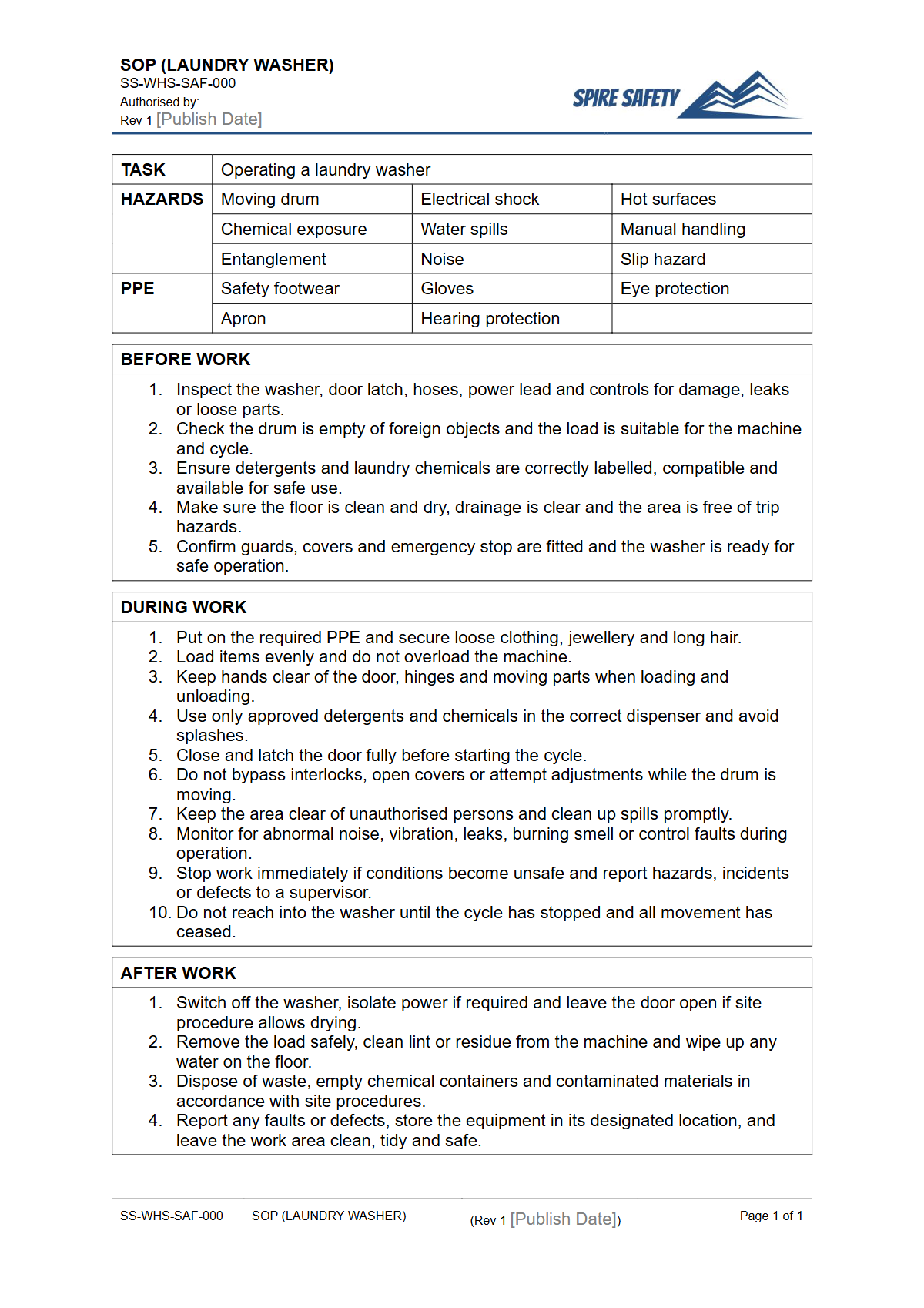
Download our free Safe Operating Procedure (Laundry Washer) template. This customisable DOCX and PDF helps formalise safe work methods for your team.
Free Safe Operating Procedure (Laundry Washer) Template
DOCX • 126 KB + PDF
Updated Oct 2026
No signup required
Purpose of the Free Safe Operating Procedure (Laundry Washer) Template
Operating commercial or industrial laundry washers introduces significant workplace hazards. This free Safe Operating Procedure (Laundry Washer) template provides a structured starting point for documenting the required steps to perform the task safely.
Using a documented procedure helps your organisation meet its primary duty of care under WHS legislation by controlling risks associated with chemical exposure, manual handling, hot water, electricity, and moving parts. It establishes a clear, repeatable process for workers, reducing the likelihood of incidents and injuries.
A well-drafted SOP is a cornerstone of a proactive safety culture. It forms a key part of your overall safety framework, demonstrating a commitment to worker wellbeing.
Integrating clear procedures for all plant and equipment is essential for building robust WHS management systems that protect both your people and your business.
Key Hazards to Consider
When customising this SOP, you must conduct a risk assessment specific to your workplace. Key hazards associated with laundry washers often include:
- Chemical Hazards: Exposure to detergents, bleaches, and other cleaning agents can cause skin irritation, respiratory issues, or chemical burns.
- Mechanical Hazards: Pinch points, rotating drums, and moving parts can cause serious crush or entanglement injuries, particularly if safety interlocks are faulty or bypassed.
- Thermal Hazards: Contact with hot surfaces, steam, or hot water can lead to severe burns.
- Electrical Hazards: Faulty wiring, improper maintenance, or water ingress can create a risk of electric shock or fire.
- Manual Handling: Loading and unloading heavy, wet laundry can cause musculoskeletal injuries.
- Slips, Trips, and Falls: Wet floors are common in laundry areas and increase the risk of falls.
Once controls for these hazards are implemented, their effectiveness should be regularly verified. This is a critical function of internal safety checks and formal WHS compliance auditing, ensuring that safety measures remain effective over time.
Video walkthrough
How to Use the Free Safe Operating Procedure (Laundry Washer) Template
This document is provided in both DOCX and PDF formats for your convenience. The DOCX file is fully editable, allowing you to tailor the content to your specific operational needs.
It is designed to align with Australian WHS practices but must be adapted to be relevant to your workplace.
Important: It is critical that you customise this template to reflect the specific laundry washer models, chemicals, and unique environmental factors of your workplace. We have provided a framework, but the final responsibility for accuracy and suitability rests with the Person Conducting a Business or Undertaking (PCBU).
Developing SOPs is a key step in managing risks associated with workplace plant. This systematic approach is also necessary for other common equipment, as shown in our Free Air Compressor SOP (Safe Operating Procedure) Template, which addresses a different set of but equally important operational risks.
When to Use a Safe Operating Procedure
A Safe Operating Procedure for a laundry washer should be a living document integrated into daily operations. It should be used during the induction and training of new employees to ensure they understand the correct, safe method from day one.
It also serves as a critical reference for experienced workers, reinforcing safe behaviour and providing clarity on less frequent tasks like cleaning or basic maintenance. Furthermore, the SOP is an invaluable tool during safety audits, incident investigations, and performance reviews.
Just as you would have a clear process for high-stakes emergencies outlined in a Free Safe Operating Procedure (Defibrillator Operation) Template, consistent procedures for routine tasks are fundamental to everyday safety.
Who Should Use This SOP?
This SOP is intended for all individuals who interact with laundry washing equipment. This includes:
- Workers and Operators: To guide their actions and ensure they perform tasks according to the established safe method.
- Supervisors and Managers: To assist in training, monitoring work practices, and conducting safety conversations or inspections.
- WHS Personnel and Trainers: As a foundational document for developing training materials and competency assessments.
Clear procedures help standardise work across all staff and shifts, ensuring safety isn't dependent on one individual's personal experience. This principle applies to all workplace tasks, including those that seem simple, such as using equipment detailed in our FREE Step Ladder SOP Template.
By implementing and enforcing this Safe Operating Procedure, your organisation can significantly improve safety outcomes in your laundry operations. For more tools to support your safety management efforts, feel free to browse our complete free WHS resources library.
Common mistakes
Common mistakes to avoid
- Overloading the machine beyond its specified weight and volume capacity.
- Bypassing or disabling safety interlocks on the door to save time.
- Using incorrect, unapproved, or improperly mixed cleaning chemicals.
- Failing to report machine faults, unusual noises, or vibrations, leading to catastrophic failure.
Legal references
Legal considerations
The following legal requirements may be relevant to this type of work.
- Work Health and Safety Act (Harmonised) — Provides the primary duties for protecting workers and other people from work health and safety risks.
- Work Health and Safety Regulations (Harmonised) — Sets out requirements supporting the management of workplace hazards and risks.
The following codes may be relevant to this type of work.
- Managing WHS Risks Code of Practice — Provides practical guidance on identifying hazards, assessing risks and applying effective controls.
- Work Health and Safety Consultation, Cooperation and Coordination Code of Practice — Provides practical guidance on consulting workers and coordinating with other duty holders.
- Managing the Work Environment and Facilities Code of Practice — Provides practical guidance on safe work environments, workplace facilities and related controls.
Did you know
Slips, Trips and Falls
According to Safe Work Australia, slips, trips and falls are a leading cause of workplace injury, and laundry areas with consistently wet floors are considered high-risk environments.
Chemical Safety
Many laundry detergents and cleaning agents are classified as hazardous chemicals, requiring specific controls for storage, handling, and use, including provision of Safety Data Sheets (SDS) and appropriate Personal Protective Equipment (PPE).
FAQ
Frequently asked questions
01What are the main hazards of using a commercial laundry washer?
02Why can't I just use the manufacturer's manual instead of an SOP?
03How often should an SOP for a laundry washer be reviewed?
04Does this SOP cover domestic washing machines used in a workplace?
Share this resource
Free Safe Operating Procedure (Laundry Washer) Template
Browse Categories
How To Use It
- 1Download and open in Word or PDF.
- 2Replace the placeholders with your business details.
- 3Get it reviewed by a WHS specialist before rollout.
Need it customised?
Our WHS consultants can adapt this template to your site, run a gap analysis, or audit what you already have in place.
Book a Free Consultation WHS consulting servicesor call 1300 156 382
Related templates
- Free Safe Operating Procedure (Lavatory Service Cart) Template
- Free Safe Operating Procedure (Lawn Aeration) Template
- Free Safe Operating Procedure (Lawn Fertilising) Template
- Free Safe Operating Procedure (Lawn Hand Edging) Template
- Free Safe Operating Procedure (Lawn Overseeding) Template
- Free Safe Operating Procedure (Lawn Repair) Template