
Free Safe Operating Procedure (Lawn Overseeding) Template
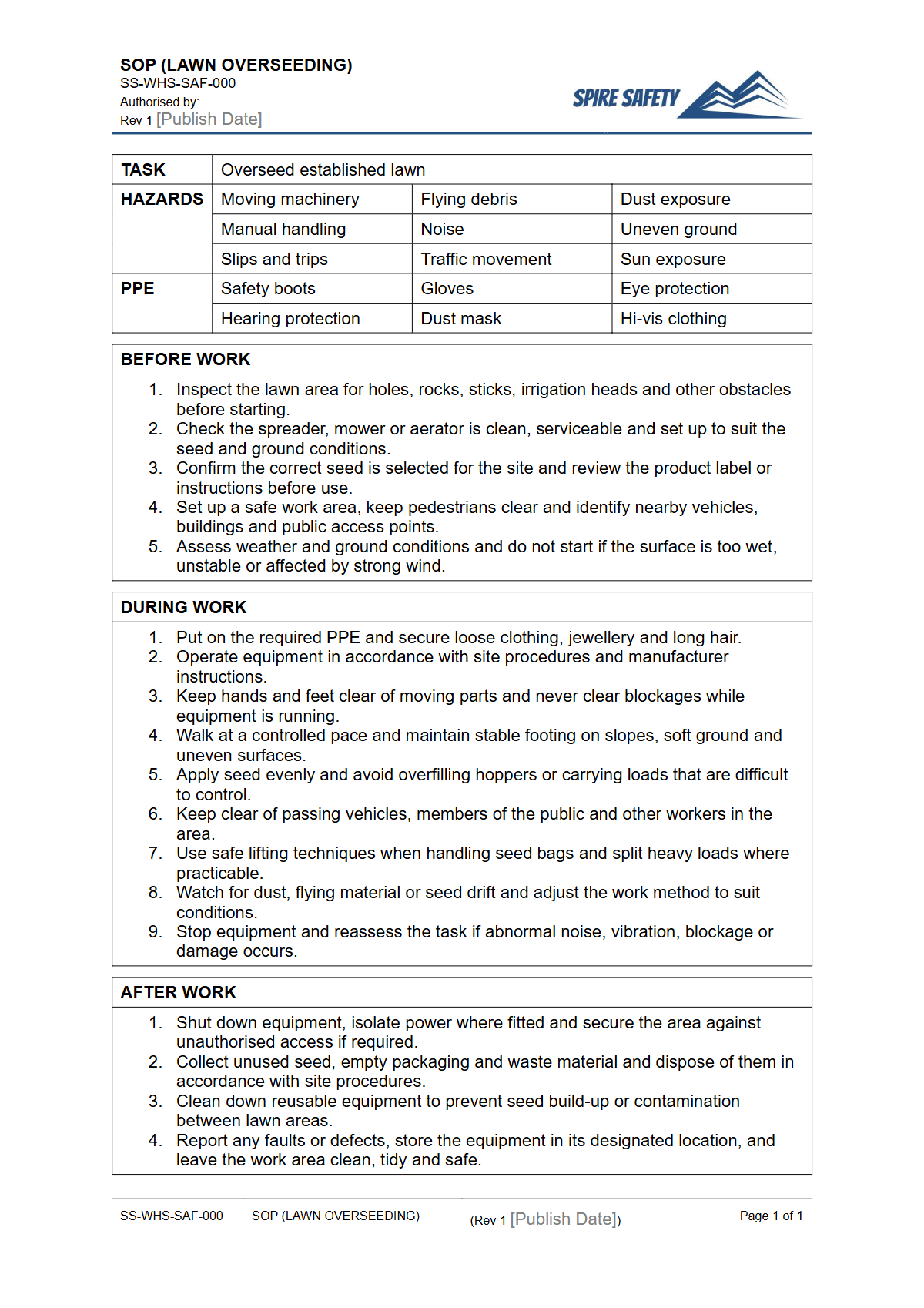
Download our free Safe Operating Procedure (Lawn Overseeding) Template. This DOCX & PDF resource helps document safety controls for lawn care tasks.
Free Safe Operating Procedure (Lawn Overseeding) Template
DOCX • 126 KB + PDF
Updated Oct 2026
No signup required
Purpose of the Free Safe Operating Procedure (Lawn Overseeding) Template
Lawn overseeding, while a common landscaping task, involves multiple hazards that require careful management. This free Safe Operating Procedure (Lawn Overseeding) Template provides a structured starting point for businesses to document a safe system of work for this activity.
Using a formal SOP helps standardise procedures, ensures all workers understand the risks, and outlines the control measures needed to prevent injury. It forms a critical component of robust WHS management systems, demonstrating a commitment to workplace safety aligned with Australian WHS principles.
Key Hazards in Lawn Overseeding
An effective SOP must identify all foreseeable hazards associated with the task. For lawn overseeding, these often include:
- Mechanical Hazards: Entanglement, crushing, or impact from machinery such as aerators, slit seeders, and spreaders.
- Manual Tasks: Musculoskeletal injuries from lifting and carrying heavy bags of seed, fertiliser, or equipment.
- Chemical Exposure: Inhalation or skin contact with fertilisers, soil amendments, or herbicides.
- Environmental Hazards: Slips, trips, and falls on uneven or wet ground, heat stress from working outdoors, and noise from machinery.
- Public Safety: Risks to passers-by from moving equipment or trip hazards in public-access areas.
Documenting these risks is the first step. The next is defining clear, actionable control measures for your team to follow. This includes ensuring immediate access to first aid and emergency response equipment, covered in resources like our Safe Operating Procedure (Defibrillator Operation) template.
Video walkthrough
How to use the Free Safe Operating Procedure (Lawn Overseeding) Template
This document is designed to be a foundation, not a final product. To implement it effectively, you should download the DOCX version and adapt it to your specific operational context.
This involves detailing the exact models of equipment used, the specific chemicals applied (referencing their Safety Data Sheets), and the unique conditions of your work sites. Worker consultation is a mandatory part of developing safe work procedures; involve your team in the drafting process to ensure the SOP is practical and reflects how the work is actually done.
Please note: this document is a template. We are not WHS consultants for your business; you must adapt it to the specific equipment, chemicals, environment, and personnel at your workplace.
Once customised, the SOP should be approved by management, used to train all relevant personnel, and kept readily accessible for reference. Periodic reviews and WHS compliance auditing can help ensure your documented procedures remain effective and current.
When to use it
A Safe Operating Procedure for lawn overseeding should be used consistently as part of your daily operations. It is not a document to be filed away and forgotten. It should be consulted:
- Before any overseeding job begins, as part of the pre-start risk assessment.
- During the induction and training of new employees or contractors.
- As a reference tool for experienced workers to refresh their knowledge.
- When planning jobs that involve similar agricultural equipment, such as that covered in our FREE Grain Drill SOP (Safe Operating Procedure) Template.
- Following any incident, near miss, or change in equipment or process to review and update safety controls.
Who should use it
This SOP is intended for any Person Conducting a Business or Undertaking (PCBU) whose workers perform lawn overseeding. This includes landscaping companies, turf management specialists, local councils, and groundskeeping departments for schools or sports facilities.
Specifically, it should be used by:
- Supervisors and Managers: To train workers, verify competency, and supervise adherence to safe work practices.
- Workers: As a clear, step-by-step guide to performing their tasks safely and correctly.
- WHS Officers: As a tool for risk management, incident investigation, and compliance monitoring.
The principles outlined can be adapted for a wide range of landscaping plant and equipment, including machinery detailed in our FREE Trencher SOP Template. By ensuring everyone understands their role in the process, you create a stronger safety culture across the organisation. For other procedural documents, feel free to browse our complete free WHS resources library.
Common mistakes
Common mistakes to avoid
- Using equipment without conducting proper pre-start safety checks.
- Failing to read the Safety Data Sheet (SDS) for fertilisers or soil conditioners before use.
- Neglecting to secure the work area from public access, especially in parks or residential settings.
- Applying poor manual handling techniques when lifting heavy bags of seed or equipment.
Legal references
Legal considerations
The following legal requirements may be relevant to this type of work.
- Work Health and Safety Act (Harmonised) — Provides the primary duties for protecting workers and other people from work health and safety risks.
- Work Health and Safety Regulations (Harmonised) — Sets out requirements supporting the management of workplace hazards and risks.
The following codes may be relevant to this type of work.
- Managing WHS Risks Code of Practice — Provides practical guidance on identifying hazards, assessing risks and applying effective controls.
- Work Health and Safety Consultation, Cooperation and Coordination Code of Practice — Provides practical guidance on consulting workers and coordinating with other duty holders.
- Managing the Work Environment and Facilities Code of Practice — Provides practical guidance on safe work environments, workplace facilities and related controls.
Did you know
Manual Task Risk
Lifting a standard 20kg bag of lawn seed is classified as a hazardous manual task. WHS regulations require controls to be implemented to manage the risk of musculoskeletal disorders.
Soil Aeration Hazards
Core aeration, often performed before overseeding, can create significant trip hazards from the soil plugs left on the surface. These must be managed as part of the safe work procedure.
FAQ
Frequently asked questions
01What are the main hazards involved in lawn overseeding?
02Is an SOP legally required for lawn overseeding in Australia?
03How often should a Lawn Overseeding SOP be reviewed?
04Can I use this template for both commercial and residential jobs?
Share this resource
Free Safe Operating Procedure (Lawn Overseeding) Template
Browse Categories
How To Use It
- 1Download and open in Word or PDF.
- 2Replace the placeholders with your business details.
- 3Get it reviewed by a WHS specialist before rollout.
Need it customised?
Our WHS consultants can adapt this template to your site, run a gap analysis, or audit what you already have in place.
Book a Free Consultation WHS consulting servicesor call 1300 156 382
Related templates
- Free Safe Operating Procedure (Lawn Repair) Template
- Free Safe Operating Procedure (Lawn Top Dressing) Template
- Free Safe Operating Procedure (Leachate Area Check) Template
- Free Safe Operating Procedure (Leachate Spill Cleanup) Template
- Free Safe Operating Procedure (Lead Acid Battery Work) Template
- Free Safe Operating Procedure (Lead Paint Removal) Template