
Free Safe Operating Procedure (Lead Acid Battery Work) Template
Download our free Safe Operating Procedure (Lead Acid Battery Work) template. This customisable DOCX & PDF helps you document safe work practices.
Free Safe Operating Procedure (Lead Acid Battery Work) Template
DOCX • 126 KB + PDF
Updated Oct 2026
No signup required
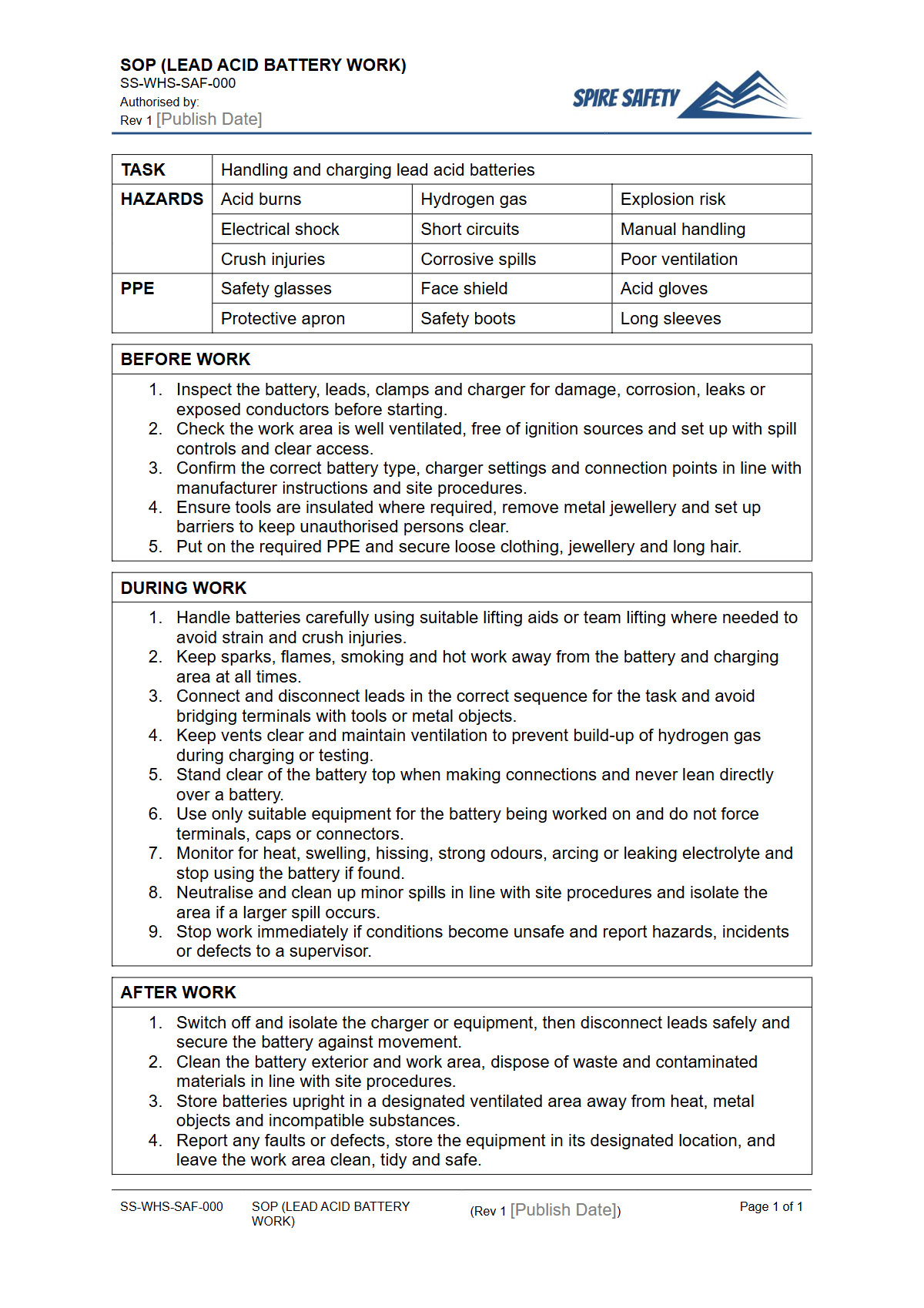
Purpose of the Free Safe Operating Procedure (Lead Acid Battery Work) Template
Working with lead acid batteries presents significant risks, including chemical burns from sulfuric acid, electric shock, and explosions from hydrogen gas build-up. This Free Safe Operating Procedure (Lead Acid Battery Work) Template provides a structured starting point for your organisation to document and implement safe work methods for handling, charging, testing, and storing these batteries.
Using a clear SOP helps control hazards, ensures workers understand their responsibilities, and demonstrates a commitment to workplace health and safety. This document is aligned with Australian WHS best practices and is designed to be adapted to your specific operational needs.
Properly managing hazardous tasks is a cornerstone of effective safety management. This SOP forms part of a broader system that ensures all work activities are assessed for risk.
For complex facilities, integrating these procedures into comprehensive WHS management systems ensures consistency and continuous improvement across your entire organisation.
Video walkthrough
How to use the Free Safe Operating Procedure (Lead Acid Battery Work) Template
This template is provided in both DOCX and PDF formats for your convenience. To implement it effectively, you must customise it to reflect the specific environment, equipment, and processes at your workplace.
This is not a finished document; it is a foundation for you to build upon.
Customisation is essential:
- Review and Edit: Open the DOCX file and carefully read through each section. Add or remove steps to match your company's exact procedures for battery handling, charging stations, and spill response.
- Site-Specific Details: Insert details specific to your workplace, such as the location of eyewash stations, fire extinguishers, spill kits, and emergency contact numbers.
- Equipment Information: Specify the types of batteries and charging equipment used by your team.
- PPE Requirements: Update the Personal Protective Equipment (PPE) list to match your site's risk assessment. This should detail the specific type of gloves, eye protection, and protective clothing required.
- Consultation: Involve workers who perform the task in the review process. Their practical experience is invaluable for creating a procedure that is both safe and workable. We recommend you consult with your team to ensure the final document is practical and understood by everyone who will use it.
A well-drafted SOP is a critical control measure, but it must be supported by training and supervision. Consider that tasks like battery handling often occur alongside other workshop activities.
For instance, you may also need a safe operating procedure for an air compressor to ensure all equipment in the area is managed safely.
When to use it
A Safe Operating Procedure for lead acid battery work should be developed, implemented, and referenced before and during any task involving these batteries. This is not limited to specialised roles and applies across various industries, from automotive workshops to warehouses and manufacturing plants. Key situations include:
- Charging and Boosting: Connecting and disconnecting batteries from chargers or other vehicles.
- Installation and Removal: Replacing batteries in vehicles, forklifts, or uninterruptible power supply (UPS) systems.
- Testing and Maintenance: Using hydrometers or multimeters to check battery condition.
- Handling and Storage: Moving batteries manually or with equipment, and placing them in designated storage areas.
- Spill Response: Cleaning up spills of battery acid.
Electrical risks are not to be underestimated. In the event of an incident involving electric shock, immediate response is critical.
Having a clear Safe Operating Procedure for defibrillator operation available can be a life-saving measure.
Who should use it
This Safe Operating Procedure template is intended for any person conducting a business or undertaking (PCBU) where employees or contractors work with or near lead acid batteries. It should be used by:
- Workers and Operators: Mechanics, auto electricians, forklift operators, warehouse staff, and maintenance personnel who directly handle batteries.
- Supervisors and Managers: To train workers, induct new employees, and monitor compliance with safe work practices.
- WHS Professionals and Officers: As a tool for conducting risk assessments, developing training materials, and investigating incidents.
Verifying the effectiveness of your safety procedures is just as important as writing them. Conducting regular WHS compliance audits can help identify gaps in your SOPs and ensure they are being followed correctly on the ground.
Similar procedures for other high-risk equipment, such as a Telehandler safe operating procedure, are also vital for overall site safety. You can find these and more in our extensive free WHS resources library.
Common mistakes
Common mistakes to avoid
- Wearing metallic jewellery (rings, watches, necklaces) that can short-circuit terminals and cause severe burns or arcs.
- Using uninsulated or improper tools that can create sparks near a charging battery.
- Charging batteries in poorly ventilated spaces, allowing dangerous hydrogen gas to accumulate.
- Failing to use an acid neutraliser (like sodium bicarbonate) for spills, instead just diluting with water which can spread contamination.
Legal references
Legal considerations
The following legal requirements may be relevant to this type of work.
- Work Health and Safety Act (Harmonised) — Provides the primary duties for protecting workers and other people from work health and safety risks.
- Work Health and Safety Regulations (Harmonised) — Sets out requirements supporting the management of workplace hazards and risks.
The following codes may be relevant to this type of work.
- Managing WHS Risks Code of Practice — Provides practical guidance on identifying hazards, assessing risks and applying effective controls.
- Work Health and Safety Consultation, Cooperation and Coordination Code of Practice — Provides practical guidance on consulting workers and coordinating with other duty holders.
- Managing the Work Environment and Facilities Code of Practice — Provides practical guidance on safe work environments, workplace facilities and related controls.
Did you know
Explosive Potential
A lead acid battery can produce flammable hydrogen gas during charging. A tiny spark from a metal tool, static electricity, or connecting clamps incorrectly can ignite this gas, causing a powerful explosion that sprays acid and shrapnel.
Silent Corrosive
The sulfuric acid in a battery is highly corrosive and can cause severe chemical burns to skin and permanent blindness if it contacts the eyes. It can also damage clothing and corrode concrete and metal surfaces.
FAQ
Frequently asked questions
01What are the main hazards of working with lead acid batteries?
02What PPE is required for handling lead acid batteries?
03Is a Safe Operating Procedure a legal requirement for lead acid battery work in Australia?
04How often should an SOP for battery handling be reviewed?
Share this resource
Free Safe Operating Procedure (Lead Acid Battery Work) Template
Browse Categories
How To Use It
- 1Download and open in Word or PDF.
- 2Replace the placeholders with your business details.
- 3Get it reviewed by a WHS specialist before rollout.
Need it customised?
Our WHS consultants can adapt this template to your site, run a gap analysis, or audit what you already have in place.
Book a Free Consultation WHS consulting servicesor call 1300 156 382
Related templates
- Free Safe Operating Procedure (Lead Paint Removal) Template
- Free Safe Operating Procedure (Leaf Blower) Template
- Free Safe Operating Procedure (Leaf Collection) Template
- Free Safe Operating Procedure (Leaf Litter Removal) Template
- Free Safe Operating Procedure (Leak Detection Spray) Template
- Free Safe Operating Procedure (Leather Cutter) Template