
Free Safe Operating Procedure (Leaf Blower) Template
Download our free Safe Operating Procedure (Leaf Blower) template.
Free Safe Operating Procedure (Leaf Blower) Template
DOCX • 126 KB + PDF
Updated Oct 2026
No signup required
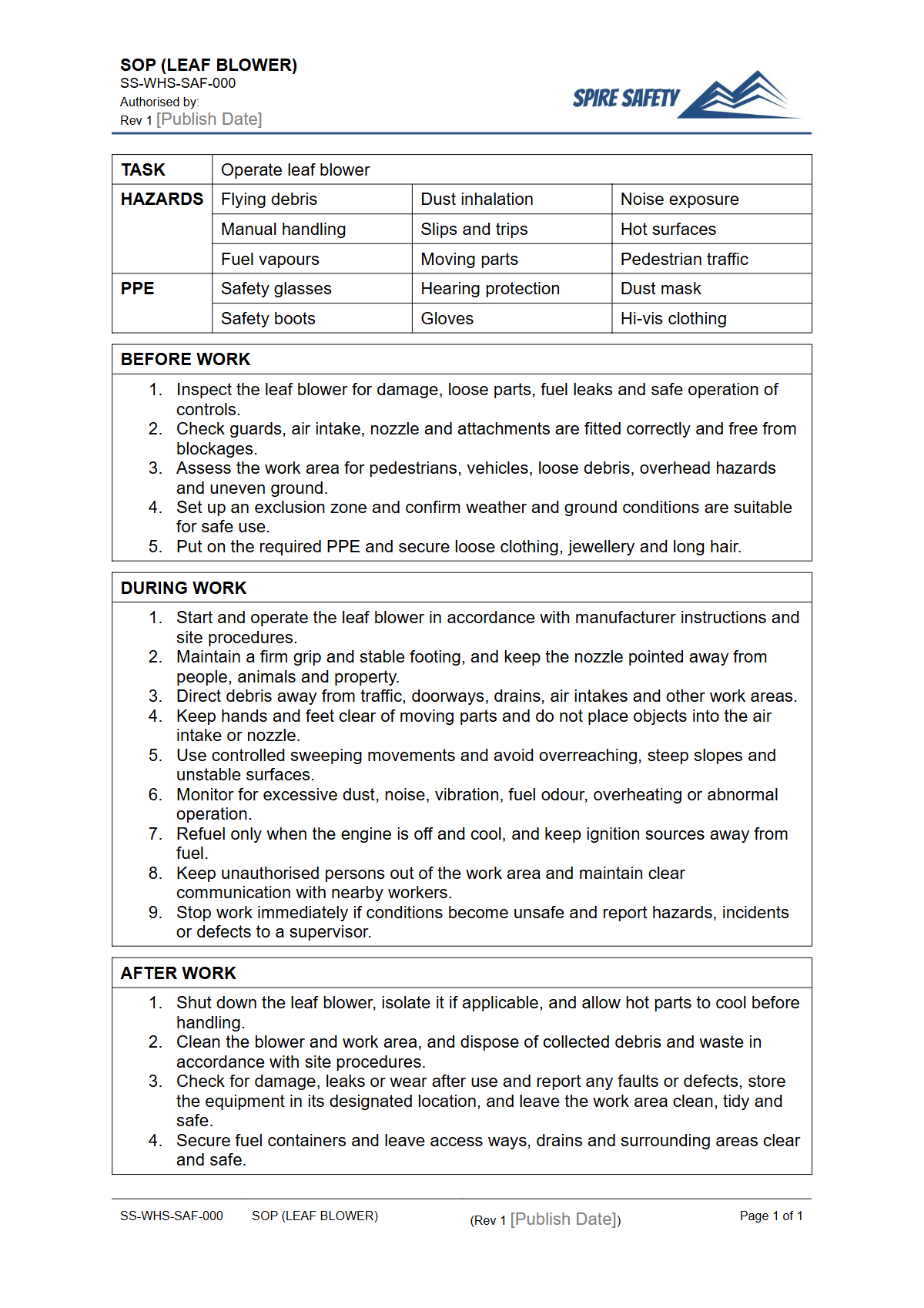
Purpose of the Free Safe Operating Procedure (Leaf Blower) Template
Operating a leaf blower, whether petrol, electric, or battery-powered, introduces several workplace hazards that must be managed. This Free Safe Operating Procedure (Leaf Blower) Template provides a structured document for outlining the required steps to use this equipment safely.
An SOP is a fundamental tool for any Person Conducting a Business or Undertaking (PCBU) to meet their primary duty of care. It formalises a safe system of work, helping to control risks such as airborne particles, noise exposure, projectiles, ergonomic strain, and contact with hot or moving parts.
By documenting pre-start checks, operational controls, and shutdown procedures, this SOP helps ensure that all workers follow a consistent, safe method. A well-drafted procedure acts as a critical component within comprehensive WHS management systems, demonstrating a proactive approach to health and safety management in your organisation.
Video walkthrough
How to use the Free Safe Operating Procedure (Leaf Blower) Template
This document is a downloadable template provided in both DOCX and PDF formats. It is designed to be a starting point, not a finished document.
To use it effectively, you must adapt it to the unique circumstances of your workplace.
Follow these steps:
- Download the DOCX file.
- Review the content against the specific make and model of leaf blower used at your site.
- Consult with the workers and supervisors who will be using the equipment. Their practical experience is invaluable for creating a procedure that is both safe and workable.
- Customise the sections to reflect your site-specific hazards, risk controls, required Personal Protective Equipment (PPE), and emergency procedures.
- Finalise the document and gain approval from the relevant manager or PCBU.
- Use the finalised SOP as a basis for training all relevant workers, and keep records of this training.
Important: We have created this template as a foundational guide aligned with Australian WHS principles. You are responsible for ensuring the final, customised document accurately reflects the tasks, equipment, and control measures at your specific workplace.
A generic procedure that doesn't account for your environment is not sufficient for managing risk. Regular WHS compliance auditing can help verify that your documented procedures are being effectively implemented in practice.
When to use a Safe Operating Procedure
An SOP for a leaf blower should be developed and implemented before any worker is permitted to operate the equipment. It is not just a document to be filed away; it is an active safety tool.
Use it during worker induction and onboarding, for specific task training, and as a refresher tool. It should also be referenced during safety talks, when planning jobs in new or unusual environments, and as a key document during an incident investigation should one occur.
Procedures for other common tools, such as those covered in our FREE Circular Saw SOP (Safe Operating Procedure) Template, should be treated with the same importance.
Who should use it
This template is intended for use by WHS managers, safety officers, supervisors, team leaders, and business owners. Essentially, anyone with responsibility for the health and safety of workers who operate leaf blowers should use this resource.
It provides the framework to fulfil their obligation to provide clear, written instructions for high-risk tasks. While workers are the end-users of the finalised procedure, management is responsible for ensuring the SOP is developed, implemented, and reviewed in consultation with their teams.
For organisations needing support in developing a suite of practical safety documents, engaging with expert WHS consulting can provide tailored guidance.
Key Elements Covered in the Template
Our template provides a logical structure covering the full lifecycle of the task. It includes sections for identifying required PPE (e.g., eye protection, hearing protection, respiratory protection), conducting pre-operational safety checks, and detailing step-by-step instructions for safe operation.
It also covers procedures for refuelling (for petrol models), post-operation cleaning, and maintenance. This comprehensive approach is similar to what you would find in our Free Air Compressor SOP (Safe Operating Procedure) Template, ensuring all key safety stages are considered.
Integrating SOPs into Your Safety System
A Safe Operating Procedure works best when it is part of a connected safety system. It should be directly informed by your risk assessment for the task.
The controls listed in the SOP (like using a low-vibration model or implementing work/rest cycles) should be the same controls identified in your risk register. Similarly, training records should show that workers have been trained specifically on the contents of the SOP.
By ensuring these documents are linked and consistent, you build a more robust and defensible safety framework. You can find other foundational documents, like our FREE Step Ladder SOP (Safe Operating Procedure) Template, in our extensive resources library to help build out your system.
Common mistakes
Common mistakes to avoid
- Using a generic template without customising it for specific site conditions and leaf blower models.
- Failing to consult with workers who actually operate the equipment when drafting the procedure.
- Not providing adequate training on the SOP, assuming workers will just read and understand it.
- Neglecting to schedule and document regular reviews of the SOP, especially after an incident.
Legal references
Legal considerations
The following legal requirements may be relevant to this type of work.
- Work Health and Safety Act (Harmonised) — Provides the primary duties for protecting workers and other people from work health and safety risks.
- Work Health and Safety Regulations (Harmonised) — Sets out requirements supporting the management of workplace hazards and risks.
The following codes may be relevant to this type of work.
- Managing WHS Risks Code of Practice — Provides practical guidance on identifying hazards, assessing risks and applying effective controls.
- Work Health and Safety Consultation, Cooperation and Coordination Code of Practice — Provides practical guidance on consulting workers and coordinating with other duty holders.
- Managing the Work Environment and Facilities Code of Practice — Provides practical guidance on safe work environments, workplace facilities and related controls.
Did you know
Noise Exposure
A typical petrol-powered leaf blower can generate noise levels over 100 decibels (dB). Under Australian WHS Regulations, the exposure standard for noise is 85 dB averaged over eight hours, meaning hearing protection is mandatory when using such equipment.
Vibration Risk
Prolonged use of handheld power tools like leaf blowers can expose operators to Hand-Arm Vibration (HAV). This can lead to permanent and painful conditions, making it crucial to select low-vibration tools and implement work/rest schedules.
FAQ
Frequently asked questions
01What is a Safe Operating Procedure (SOP)?
02Is using a leaf blower considered a high-risk activity?
03Can I just download and use this leaf blower SOP template as is?
04How often should we review our Safe Operating Procedures?
Share this resource
Free Safe Operating Procedure (Leaf Blower) Template
Browse Categories
How To Use It
- 1Download and open in Word or PDF.
- 2Replace the placeholders with your business details.
- 3Get it reviewed by a WHS specialist before rollout.
Need it customised?
Our WHS consultants can adapt this template to your site, run a gap analysis, or audit what you already have in place.
Book a Free Consultation WHS consulting servicesor call 1300 156 382
Related templates
- Free Safe Operating Procedure (Leaf Collection) Template
- Free Safe Operating Procedure (Leaf Litter Removal) Template
- Free Safe Operating Procedure (Leak Detection Spray) Template
- Free Safe Operating Procedure (Leather Cutter) Template
- Free Safe Operating Procedure (Leather Skiver) Template
- Free Safe Operating Procedure (Level Transmitter Test) Template