
Free Safe Operating Procedure (Leaf Collection) Template
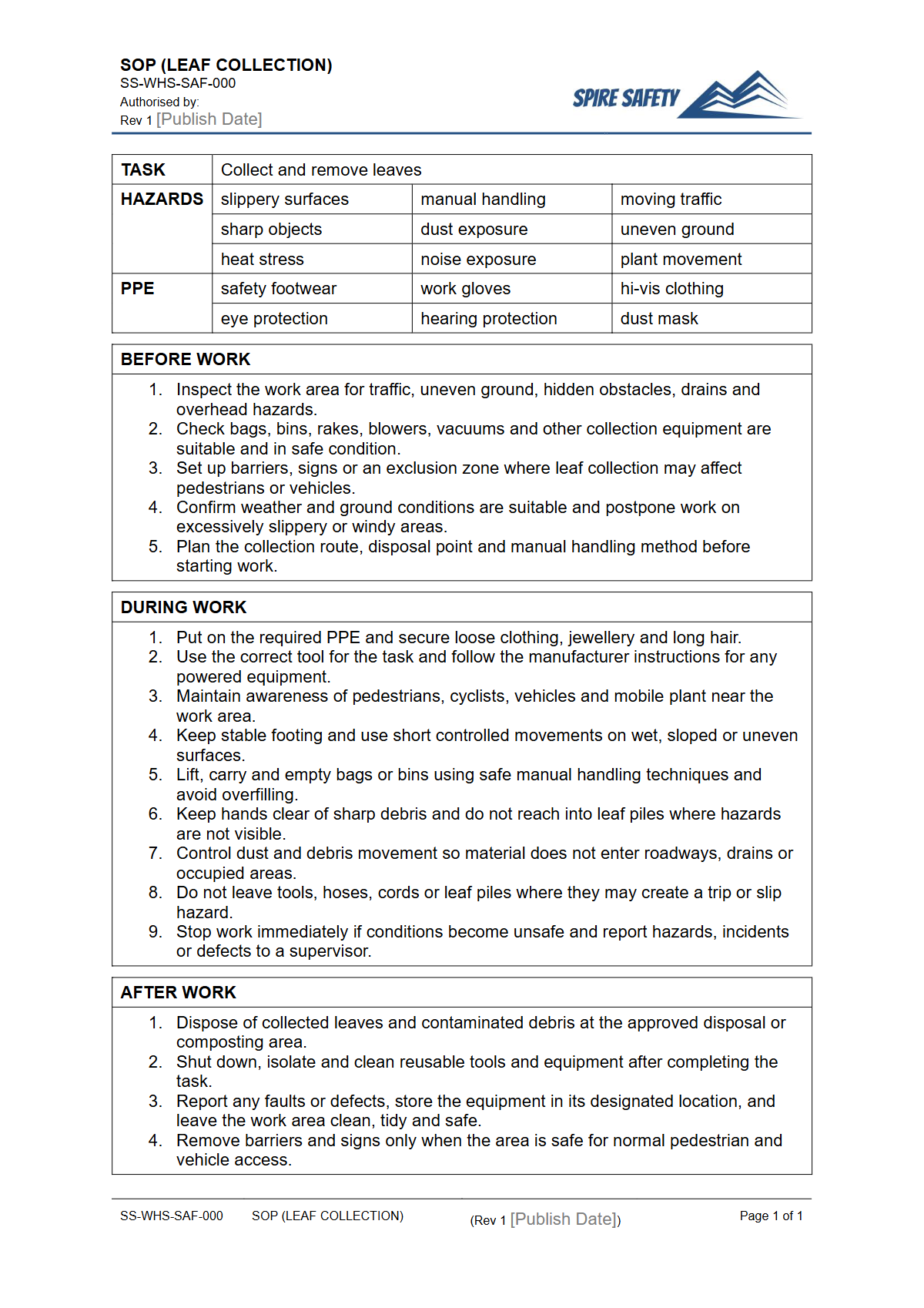
Download our free Safe Operating Procedure (Leaf Collection) template. This structured DOCX & PDF helps manage risks from leaf blowers and manual collection.
Free Safe Operating Procedure (Leaf Collection) Template
DOCX • 126 KB + PDF
Updated Oct 2026
No signup required
Purpose of the Free Safe Operating Procedure (Leaf Collection) Template
This Free Safe Operating Procedure (Leaf Collection) Template provides a clear and structured framework for businesses to document the safe methods for collecting and disposing of leaves. Whether using leaf blowers, vacuums, rakes, or simply bagging by hand, having a formalised procedure is critical for managing workplace risks.
A well-drafted SOP helps to standardise your process, effectively train your team, and demonstrate your commitment to providing safe systems of work.
Leaf collection, while seeming routine, involves numerous hazards. These can include noise exposure from petrol or electric blowers, airborne particles like dust and mould, manual handling risks from lifting heavy bags, and slip, trip, and fall hazards from wet leaves or equipment cords.
This template is designed as a foundational document within your overall safety framework, helping you systematically address these risks. Integrating such procedures is a cornerstone of effective WHS management systems.
By clearly outlining pre-start checks, operational steps, required Personal Protective Equipment (PPE), and emergency procedures, you create a reliable reference for all personnel. Using a standardised SOP ensures that safety is not left to chance, but is a planned and integral part of the task. It also serves as crucial evidence of your risk management processes, which can be invaluable during a comprehensive WHS compliance audit.
Video walkthrough
How to use the Free Safe Operating Procedure (Leaf Collection) Template
Our Free Safe Operating Procedure (Leaf Collection) Template is available for download as a DOCX file for easy editing in Microsoft Word, or as a PDF for quick printing and distribution. To make this document effective for your organisation, it is essential that you customise it to your specific operational context.
A generic procedure is not sufficient to ensure safety; it must reflect the reality of your workplace.
Important: We have provided a comprehensive starting point based on common Australian WHS practices. However, you must adapt this document to reflect the specific equipment (make and model), unique environmental conditions of your site(s), and your company's internal procedures.
You should add your company name, specific site locations, review dates, and list the exact PPE required as determined by your own risk assessment.
Once customised, the SOP should be communicated to all relevant workers. This includes providing training on its contents and ensuring supervisors are equipped to enforce the procedure.
If you require assistance in tailoring this document or developing other safety documentation, consider engaging professional expert WHS consulting services.
When to use this Safe Operating Procedure
A Safe Operating Procedure for leaf collection should be used consistently as a primary safety tool. It is not a document to be filed away and forgotten.
Its primary use is as an active reference guide before and during the task.
- Worker Training: Use it as a central document for inducting new employees or training existing staff on the correct procedures for leaf collection tasks.
- Pre-Task Planning: Refer to the SOP during pre-start meetings or toolbox talks to remind workers of the key hazards and safety controls. This is especially important at the start of autumn when leaf fall is heaviest.
- Risk Management: The SOP is a live document that should be reviewed and updated as part of your ongoing risk management process.
- Incident Investigation: In the event of an incident or near-miss, the SOP provides a benchmark against which actual work practices can be compared to identify any procedural gaps.
This template is one of many tools available to improve safety in your workplace. For more templates covering various equipment and tasks, you can browse our extensive free WHS resources library.
Who should use this template
This SOP template is designed for a broad range of personnel within any organisation that conducts grounds maintenance or cleaning tasks. Different roles will interact with the document in different ways.
Key Users Include:
- Managers and Supervisors: They are responsible for ensuring the SOP is customised correctly, implemented on-site, and that workers are trained and compliant with its instructions.
- WHS/OHS Officers: They will use the template as a basis for developing formal risk controls and integrating them into the broader safety management system.
- Workers and Operators: The end-users of the procedure. They must read, understand, and follow the steps outlined in the SOP to ensure their own safety and the safety of others. This includes landscapers, gardeners, council workers, school groundskeepers, and maintenance staff.
For related tasks, workers may also need to be familiar with other procedures, such as our Safe Operating Procedure for step ladders if clearing leaves from low roofs or awnings. The document is also a useful reference for anyone involved in emergency preparedness, as it outlines steps to take in case of an accident.
In a serious medical event, having staff trained on first aid and emergency equipment is vital, which is why procedures like our SOP for defibrillator operation are also critical.
Common mistakes
Common mistakes to avoid
- Failing to customise the template with site-specific equipment and environmental hazards.
- Neglecting to provide adequate PPE, especially hearing and eye protection.
- Poor manual handling techniques when lifting and moving heavy bags of wet leaves.
- Using petrol-powered equipment in poorly ventilated areas, risking carbon monoxide exposure.
Legal references
Legal considerations
The following legal requirements may be relevant to this type of work.
- Work Health and Safety Act (Harmonised) — Provides the primary duties for protecting workers and other people from work health and safety risks.
- Work Health and Safety Regulations (Harmonised) — Sets out requirements supporting the management of workplace hazards and risks.
The following codes may be relevant to this type of work.
- Managing WHS Risks Code of Practice — Provides practical guidance on identifying hazards, assessing risks and applying effective controls.
- Work Health and Safety Consultation, Cooperation and Coordination Code of Practice — Provides practical guidance on consulting workers and coordinating with other duty holders.
- Managing the Work Environment and Facilities Code of Practice — Provides practical guidance on safe work environments, workplace facilities and related controls.
Did you know
Noise Exposure Risk
Petrol-powered leaf blowers can operate at over 100 decibels. Sustained exposure above 85 decibels can cause permanent hearing damage, making hearing protection essential.
Manual Task Hazard
Wet leaves are significantly heavier than dry leaves. A single bag can easily exceed safe manual handling limits, increasing the risk of musculoskeletal injuries.
FAQ
Frequently asked questions
01What hazards are involved in leaf collection?
02Is a Safe Operating Procedure a legal requirement in Australia?
03How often should a leaf collection SOP be reviewed?
04What personal protective equipment (PPE) is needed for leaf collection?
Share this resource
Free Safe Operating Procedure (Leaf Collection) Template
Browse Categories
How To Use It
- 1Download and open in Word or PDF.
- 2Replace the placeholders with your business details.
- 3Get it reviewed by a WHS specialist before rollout.
Need it customised?
Our WHS consultants can adapt this template to your site, run a gap analysis, or audit what you already have in place.
Book a Free Consultation WHS consulting servicesor call 1300 156 382
Related templates
- Free Safe Operating Procedure (Leaf Litter Removal) Template
- Free Safe Operating Procedure (Leak Detection Spray) Template
- Free Safe Operating Procedure (Leather Cutter) Template
- Free Safe Operating Procedure (Leather Skiver) Template
- Free Safe Operating Procedure (Level Transmitter Test) Template
- Free Safe Operating Procedure (Life Raft Handling) Template