
Free Safe Operating Procedure (Leather Skiver) Template
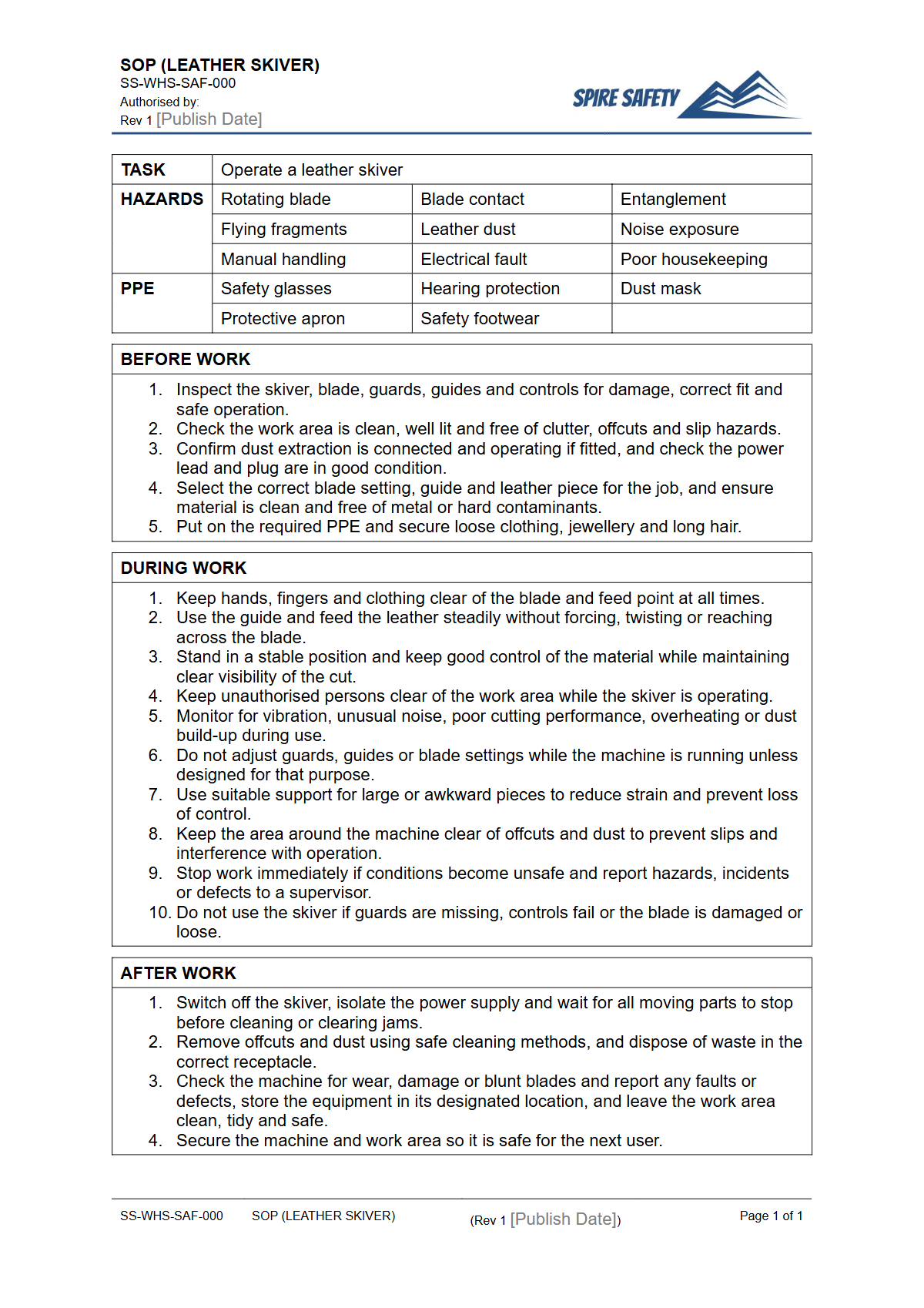
Download our free Safe Operating Procedure (Leather Skiver) template. This customisable DOCX & PDF helps manage risks associated with leather skiving.
Free Safe Operating Procedure (Leather Skiver) Template
DOCX • 126 KB + PDF
Updated Oct 2026
No signup required
Purpose of the Free Safe Operating Procedure (Leather Skiver) Template
Operating specialised machinery like a leather skiver requires clear, documented instructions to prevent serious injuries from its sharp, moving blade. This free Safe Operating Procedure (Leather Skiver) template provides a structured starting point for your business to establish and implement a safe system of work.
It is designed to help you meet your duties under Australian WHS laws by formalising pre-operational checks, operational steps, and post-operational cleaning and shutdown tasks.
A well-developed SOP serves as a critical training tool for new operators and a benchmark for competency. It ensures that every person using the equipment follows a consistent, approved method that minimises risk.
Using this template helps your organisation to systematically identify hazards associated with the leather skiver—such as cuts, entanglement, or ergonomic strain—and document the specific control measures required to keep workers safe. Similar to procedures for other high-risk cutting equipment, like those in our FREE Circular Saw SOP Template, this document ensures consistency and clarifies safety expectations for everyone in the workplace.
Video walkthrough
How to use the Free Safe Operating Procedure (Leather Skiver) Template
This template is provided in both DOCX and PDF formats for your convenience. The DOCX file is fully editable, allowing you to tailor the content directly to your operational needs.
To use it effectively, download the document and work through each section, replacing the placeholder text with information specific to your machinery and work environment.
Please note: This document is a template and must be customised to suit your specific workplace. We strongly advise you to consult with machine operators, supervisors, and review the manufacturer's instructions to ensure the final SOP is comprehensive and accurately reflects your operational risks and control measures.
This process of risk assessment and procedural documentation is a core part of effective WHS management systems, ensuring safety protocols are practical and embedded in your organisation's culture.
Key Customisation Steps:
- Plant and Equipment Details: Insert the specific make, model, and serial number of your leather skiver.
- Risk Assessment: Modify the pre-filled risk assessment to include hazards unique to your setup, such as workshop layout, lighting, and the types of leather being processed.
- Personal Protective Equipment (PPE): Specify the exact type of PPE required, such as cut-resistant gloves (ensure they are suitable for use with moving machinery), safety glasses, and hearing protection if applicable.
- Emergency Procedures: Detail your site-specific emergency stop and first aid procedures, including the location of emergency stop buttons and first aid kits.
When to use a Leather Skiver Safe Operating Procedure
A Safe Operating Procedure for a leather skiver should be a living document used consistently throughout your operations. It is essential during the induction and training of new employees to ensure they understand the correct and safe way to use the machine from day one.
It also serves as the basis for conducting competency assessments before an operator is authorised to use the equipment unsupervised.
Furthermore, the SOP should be referenced during regular workplace inspections and safety observations to verify that prescribed procedures are being followed. These documents are often reviewed during a WHS compliance audit to demonstrate that your organisation has a formal process for managing plant-related risks.
In the unfortunate event of an incident or near-miss, the SOP is an invaluable tool for the investigation, helping to identify whether a procedural breach occurred and what corrective actions are needed.
Who should use this Safe Operating Procedure
This Safe Operating Procedure is intended for use by several key roles within an organisation:
- Operators: The primary users of the SOP, who must follow the outlined steps to perform their work safely.
- Supervisors and Managers: Responsible for ensuring operators are trained on the SOP and adhere to it. They use it to enforce safety standards and conduct competency checks.
- WHS/HSE Professionals: Use the template to develop, review, and update workplace safety documentation as part of the overall safety management system.
- Training Coordinators: Use the SOP as a foundational document for developing training programs and assessment materials for leather skiver operators.
Just as with other specialised workshop machinery detailed in documents like our FREE Plasma Cutter SOP Template, the leather skiver demands specific knowledge that this SOP helps to standardise and communicate. For more templates to build out your safety systems, you can browse our complete free WHS resources library.
Common mistakes
Common mistakes to avoid
- Failing to properly customise the SOP template to the specific machine model and work environment.
- Using incorrect or poorly-fitting PPE, such as gloves that could get caught in the machinery.
- Bypassing or removing machine guards to get a 'better view' or to work on smaller pieces.
- Insufficient training and competency assessment before allowing unsupervised operation.
Legal references
Legal considerations
The following legal requirements may be relevant to this type of work.
- Work Health and Safety Act (Harmonised) — Provides the primary duties for protecting workers and other people from work health and safety risks.
- Work Health and Safety Regulations (Harmonised) — Sets out requirements supporting the management of workplace hazards and risks.
The following codes may be relevant to this type of work.
- Managing WHS Risks Code of Practice — Provides practical guidance on identifying hazards, assessing risks and applying effective controls.
- Work Health and Safety Consultation, Cooperation and Coordination Code of Practice — Provides practical guidance on consulting workers and coordinating with other duty holders.
- Managing the Work Environment and Facilities Code of Practice — Provides practical guidance on safe work environments, workplace facilities and related controls.
Did you know
Hidden Danger
The blade on many industrial leather skivers is bell-shaped and rotates at high speed. Many serious injuries occur not during active skiving, but during cleaning or adjustment when the machine is not properly isolated.
FAQ
Frequently asked questions
01What is a leather skiver?
02Is an SOP legally required for a leather skiver in Australia?
03How often should a leather skiver SOP be reviewed?
04What are the main hazards of using a leather skiver?
Share this resource
Free Safe Operating Procedure (Leather Skiver) Template
Browse Categories
How To Use It
- 1Download and open in Word or PDF.
- 2Replace the placeholders with your business details.
- 3Get it reviewed by a WHS specialist before rollout.
Need it customised?
Our WHS consultants can adapt this template to your site, run a gap analysis, or audit what you already have in place.
Book a Free Consultation WHS consulting servicesor call 1300 156 382
Related templates
- Free Safe Operating Procedure (Level Transmitter Test) Template
- Free Safe Operating Procedure (Life Raft Handling) Template
- Free Safe Operating Procedure (Lifebuoy Inspection) Template
- Free Safe Operating Procedure (Lift Car Cleaning) Template
- Free Safe Operating Procedure (Lift Door Cleaning) Template
- Free Safe Operating Procedure (Lift Isolation) Template