
Free Safe Operating Procedure (Level Transmitter Test) Template
Streamline your maintenance procedures with our Free Safe Operating Procedure (Level Transmitter Test) Template. Customisable for Australian workplaces.
Free Safe Operating Procedure (Level Transmitter Test) Template
DOCX • 126 KB + PDF
Updated Oct 2026
No signup required
Purpose of the Free Safe Operating Procedure (Level Transmitter Test) Template
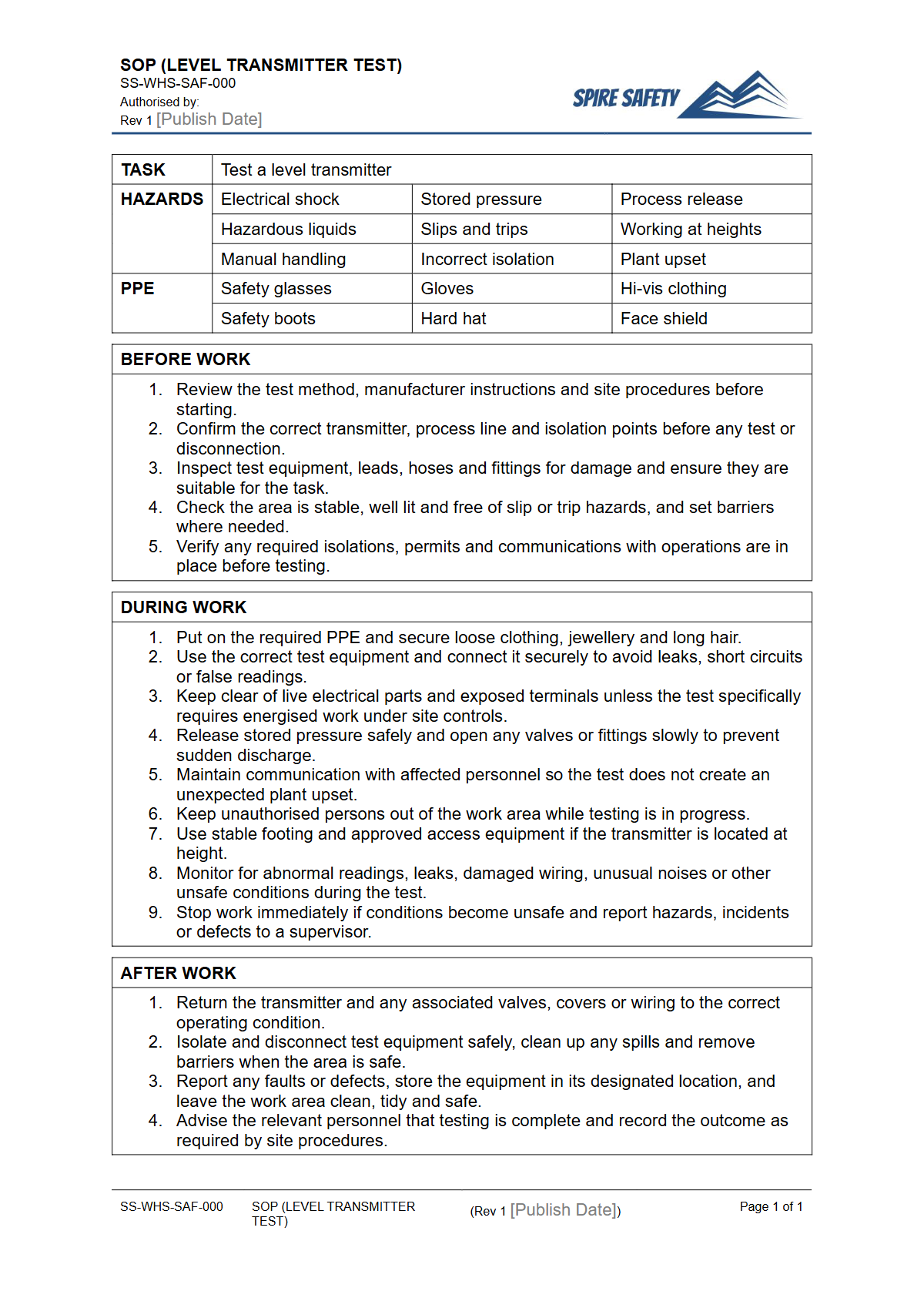
This Free Safe Operating Procedure (Level Transmitter Test) Template provides a structured framework for safely conducting function tests, calibration, and maintenance on level transmitters in an industrial setting. It helps organisations document a clear, step-by-step process that outlines potential hazards, required personal protective equipment (PPE), and emergency procedures.
Using a standardised SOP ensures that tasks are performed consistently and safely by all personnel, minimising the risk of incidents, equipment damage, or process disruption. This template is designed as a starting point, aligned with Australian WHS practice, to help you formalise your safety protocols for this critical maintenance task.
Implementing documented procedures like this is a fundamental component of effective WHS management systems. It demonstrates a commitment to managing risks and providing a safe working environment for employees and contractors involved in instrumentation and control system maintenance.
Video walkthrough
How to use the Free Safe Operating Procedure (Level Transmitter Test) Template
Our Free Safe Operating Procedure (Level Transmitter Test) Template is provided in both DOCX and PDF formats for your convenience. The DOCX file is fully editable, allowing you to adapt the content to the specific types of level transmitters (e.g., ultrasonic, radar, hydrostatic, float), equipment, and unique environmental conditions at your site.
To use it effectively, download the template and work through each section with competent personnel, such as instrumentation technicians and their supervisors.
It is essential that you customise this document to reflect your workplace. We are not familiar with your specific machinery, operational context, or internal procedures.
You must add site-specific details, including make and model of equipment, isolation point locations, specific test parameters, and emergency contact numbers. A generic procedure is not sufficient to control risk; it must be made relevant to the actual task being performed.
Conducting a thorough risk assessment is a prerequisite for finalising any SOP.
When to use it
This Safe Operating Procedure should be used whenever a level transmitter requires testing, calibration, inspection, or removal and replacement. This includes routine preventative maintenance scheduled according to manufacturer recommendations or internal maintenance strategies.
It is also applicable during commissioning of new equipment, after significant repairs, or as part of troubleshooting activities when a process upset is suspected to be related to faulty level measurement. If access to the transmitter requires working at heights, even on a small platform, a specific step ladder SOP should also be referenced.
Who should use it
This SOP is intended for use by competent and authorised personnel. This typically includes qualified instrumentation and control technicians, electricians, or specialist maintenance engineers who have received training on the specific equipment and control system.
Supervisors should use the document to instruct workers and to conduct pre-task safety briefings (e.g., toolbox talks). WHS managers and coordinators can use this template as part of a broader library of procedures to ensure a consistent approach to safety management across the organisation.
Regular WHS compliance auditing can verify that these procedures are being followed correctly in the field.
Before undertaking the work, all personnel involved must confirm they have read and understood the procedure. For tasks involving electrical isolation, only appropriately licensed individuals should perform the isolation and verification steps.
Where compressed air is used for cleaning or as part of the system, referencing an air compressor Safe Operating Procedure for associated equipment may also be necessary.
Maintaining a library of up-to-date procedures is critical for operational safety. Spire Safety offers a wide range of templates in our free WHS resources library to support your business.
Common mistakes
Common mistakes to avoid
- Failing to isolate all energy sources (electrical, pneumatic, process fluids) before starting work.
- Not notifying control room operators, leading to false alarms or incorrect process adjustments.
- Using uncalibrated or inappropriate test equipment, leading to inaccurate results.
- Neglecting to wear appropriate PPE for the specific chemical or physical hazards present.
Legal references
Legal considerations
The following legal requirements may be relevant to this type of work.
- Work Health and Safety Act (Harmonised) — Provides the primary duties for protecting workers and other people from work health and safety risks.
- Work Health and Safety Regulations (Harmonised) — Sets out requirements supporting the management of workplace hazards and risks.
The following codes may be relevant to this type of work.
- Managing WHS Risks Code of Practice — Provides practical guidance on identifying hazards, assessing risks and applying effective controls.
- Work Health and Safety Consultation, Cooperation and Coordination Code of Practice — Provides practical guidance on consulting workers and coordinating with other duty holders.
- Managing the Work Environment and Facilities Code of Practice — Provides practical guidance on safe work environments, workplace facilities and related controls.
Did you know
Process Safety
Incorrect level readings are a common cause of major industrial accidents, including tank overflows and vessel ruptures. Regular, documented testing is a key barrier in preventing these process safety events.
Technology Types
There are over a dozen different technologies for measuring level, from simple floats to non-contact radar and guided wave radar. The testing procedure must be adapted for the specific technology in use.
FAQ
Frequently asked questions
01What is a Safe Operating Procedure (SOP)?
02Why is an SOP needed for testing a level transmitter?
03What are common hazards when testing level transmitters?
04Who is responsible for creating and approving this SOP?
Share this resource
Free Safe Operating Procedure (Level Transmitter Test) Template
Browse Categories
How To Use It
- 1Download and open in Word or PDF.
- 2Replace the placeholders with your business details.
- 3Get it reviewed by a WHS specialist before rollout.
Need it customised?
Our WHS consultants can adapt this template to your site, run a gap analysis, or audit what you already have in place.
Book a Free Consultation WHS consulting servicesor call 1300 156 382
Related templates
- Free Safe Operating Procedure (Life Raft Handling) Template
- Free Safe Operating Procedure (Lifebuoy Inspection) Template
- Free Safe Operating Procedure (Lift Car Cleaning) Template
- Free Safe Operating Procedure (Lift Door Cleaning) Template
- Free Safe Operating Procedure (Lift Isolation) Template
- Free Safe Operating Procedure (Lift Lobby Cleaning) Template