
Free Safe Operating Procedure (Life Raft Handling) Template
Download our free Safe Operating Procedure (Life Raft Handling) template. This customisable DOCX and PDF helps define safe work methods for maritime safety.
Free Safe Operating Procedure (Life Raft Handling) Template
DOCX • 126 KB + PDF
Updated Oct 2026
No signup required
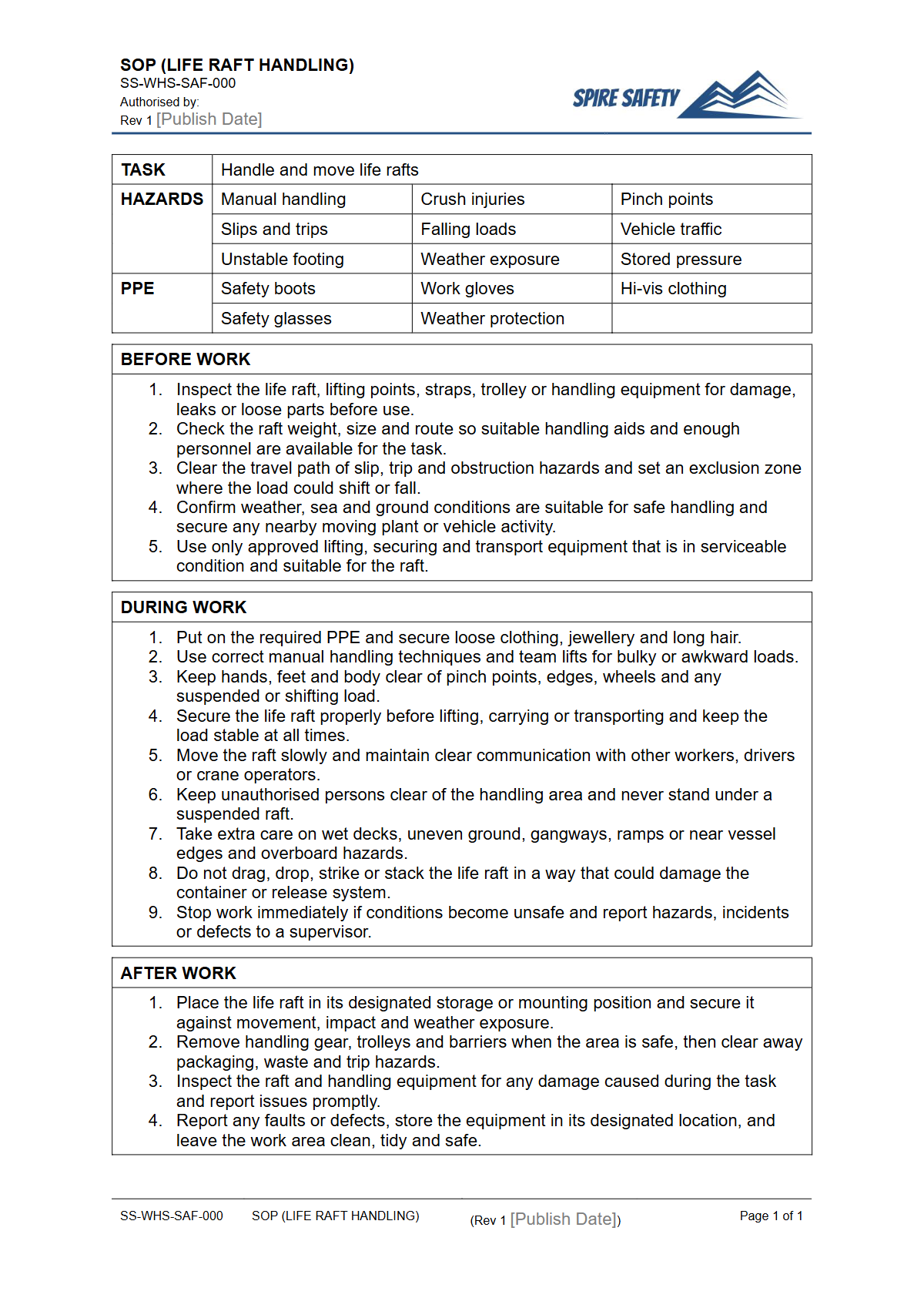
Purpose of the Free Safe Operating Procedure (Life Raft Handling) Template
This Free Safe Operating Procedure (Life Raft Handling) Template provides a structured framework for documenting the safe handling, inspection, and deployment of life rafts on vessels. Proper handling of this critical safety equipment is essential for emergency preparedness in maritime environments.
This SOP helps your organisation outline the step-by-step processes required to ensure life rafts are maintained in a ready state and can be operated correctly and safely by crew members during an emergency. Using a standardised procedure helps workers understand their responsibilities, minimises the risk of equipment malfunction, and supports your duty of care under Australian WHS legislation.
A well-defined SOP is a fundamental component of a proactive safety culture. It serves as a key training document for new and existing crew, ensuring consistent and safe work practices are followed by everyone on board.
By formalising these procedures, you create a clear reference point that can be used during safety drills, audits, and incident investigations. This template is designed as a starting point, aligned with the principles of the model WHS framework, to help you establish robust safety protocols.
Video walkthrough
How to use the Free Safe Operating Procedure (Life Raft Handling) Template
To effectively use this Safe Operating Procedure (Life Raft Handling) Template, you should download the DOCX file and begin customising it to reflect the specific conditions of your vessel and operations. The document includes sections for you to detail required personal protective equipment (PPE), a step-by-step task breakdown, and potential hazards and control measures associated with each step.
It is crucial to walk through the entire process on-site, consulting with the crew who will perform the tasks, to ensure the written procedure accurately reflects the practical realities of the job.
IMPORTANT: This document is a template and must be customised to your workplace. We are not responsible or liable for any incidents that may arise from the use of this template.
Your final SOP should include details such as the specific make and model of the life rafts in use, their storage locations, the vessel's layout, and your organisation's specific emergency response contacts. A generic procedure is not sufficient; customisation is essential for it to be a useful and effective safety tool.
What to include in your SOP
- Site-Specific Information: Detail the vessel name, life raft models and serial numbers, and storage locations.
- Personnel: List the roles and responsibilities of crew members involved in inspection and deployment.
- Pre-operational Checks: Outline routine inspection requirements, including checking hydrostatic release units (HRUs), container integrity, and painter line connections.
- Step-by-Step Procedures: Provide clear, sequential instructions for both manual and automatic deployment of the life raft.
- Emergency Procedures: Detail actions to take in case of deployment failure or other emergencies. This is also where you might reference other emergency documents, such as our Free Safe Operating Procedure (Defibrillator Operation) Template.
- Training and Drills: Specify the frequency and nature of training required to maintain crew competency.
When to use a Life Raft Handling SOP
A Safe Operating Procedure for life raft handling should be a living document integrated into your daily and emergency operations. It should be used as the primary reference document during crew training sessions and familiarisation for new personnel.
It is essential for conducting regular emergency drills, allowing the crew to practise deployment in a controlled manner. The SOP should also be consulted during pre-departure checks and routine safety inspections to ensure all equipment is correctly stowed and ready for immediate use.
In the unfortunate event of an incident or near miss involving the equipment, the SOP serves as a benchmark for investigation and review.
Who should use this SOP
This SOP is intended for all personnel with responsibilities related to maritime safety and emergency equipment. This includes the Vessel Master, who holds ultimate responsibility for safety on board, as well as Mates, Deck Officers, and Engineers who oversee safety procedures.
Deckhands and other crew members who may be required to handle or deploy life rafts must be thoroughly trained on the SOP's contents. Additionally, shore-based Safety Managers and Operations Managers can use this template to standardise procedures across a fleet and ensure they are integrated into the company’s broader WHS management systems.
Regular reviews of this and other safety documents are critical to maintaining their relevance and effectiveness. These reviews can be incorporated into your internal audit schedule or managed as part of a formal WHS compliance auditing program. For tasks related to accessing equipment stored at height, such as life rafts on larger vessels, procedures for safe access should also be considered, similar to those outlined in our FREE Step Ladder SOP Template.
This template is one of many documents available to help you build a comprehensive safety system. You can explore our complete free WHS resources library for more templates and guides to support your safety and compliance efforts.
Common mistakes
Common mistakes to avoid
- Storing the life raft in a location where it could be damaged or blocked, preventing deployment.
- Attaching the painter line's weak link to a non-structural point on the vessel, which could fail during deployment.
- Failing to conduct regular, hands-on training and emergency drills with crew members.
- Neglecting to inspect the hydrostatic release unit (HRU) and ensure its expiration date has not passed.
Legal references
Legal considerations
The following legal requirements may be relevant to this type of work.
- Work Health and Safety Act (Harmonised) — Provides the primary duties for protecting workers and other people from work health and safety risks.
- Work Health and Safety Regulations (Harmonised) — Sets out requirements supporting the management of workplace hazards and risks.
The following codes may be relevant to this type of work.
- Managing WHS Risks Code of Practice — Provides practical guidance on identifying hazards, assessing risks and applying effective controls.
- Work Health and Safety Consultation, Cooperation and Coordination Code of Practice — Provides practical guidance on consulting workers and coordinating with other duty holders.
- Managing the Work Environment and Facilities Code of Practice — Provides practical guidance on safe work environments, workplace facilities and related controls.
Did you know
SOLAS Requirements
The International Convention for the Safety of Life at Sea (SOLAS) mandates that life rafts must be capable of being deployed by one person and be fully inflated and ready for boarding within a few minutes.
Painter Line Strength
The painter line of a life raft is designed with a specific breaking strain. It is strong enough to inflate the raft when pulled but weak enough to break away if the ship sinks, preventing the raft from being pulled under.
FAQ
Frequently asked questions
01What is a Safe Operating Procedure for life raft handling?
02Who is responsible for developing a life raft SOP?
03How often should a life raft handling SOP be reviewed?
04Does this template cover both canister and valise-type life rafts?
Share this resource
Free Safe Operating Procedure (Life Raft Handling) Template
Browse Categories
How To Use It
- 1Download and open in Word or PDF.
- 2Replace the placeholders with your business details.
- 3Get it reviewed by a WHS specialist before rollout.
Need it customised?
Our WHS consultants can adapt this template to your site, run a gap analysis, or audit what you already have in place.
Book a Free Consultation WHS consulting servicesor call 1300 156 382
Related templates
- Free Safe Operating Procedure (Lifebuoy Inspection) Template
- Free Safe Operating Procedure (Lift Car Cleaning) Template
- Free Safe Operating Procedure (Lift Door Cleaning) Template
- Free Safe Operating Procedure (Lift Isolation) Template
- Free Safe Operating Procedure (Lift Lobby Cleaning) Template
- Free Safe Operating Procedure (Lift Pit Cleaning) Template