
Free Safe Operating Procedure (Lift Lobby Cleaning) Template
Download our free Safe Operating Procedure (Lift Lobby Cleaning) template.
Free Safe Operating Procedure (Lift Lobby Cleaning) Template
DOCX • 126 KB + PDF
Updated Oct 2026
No signup required
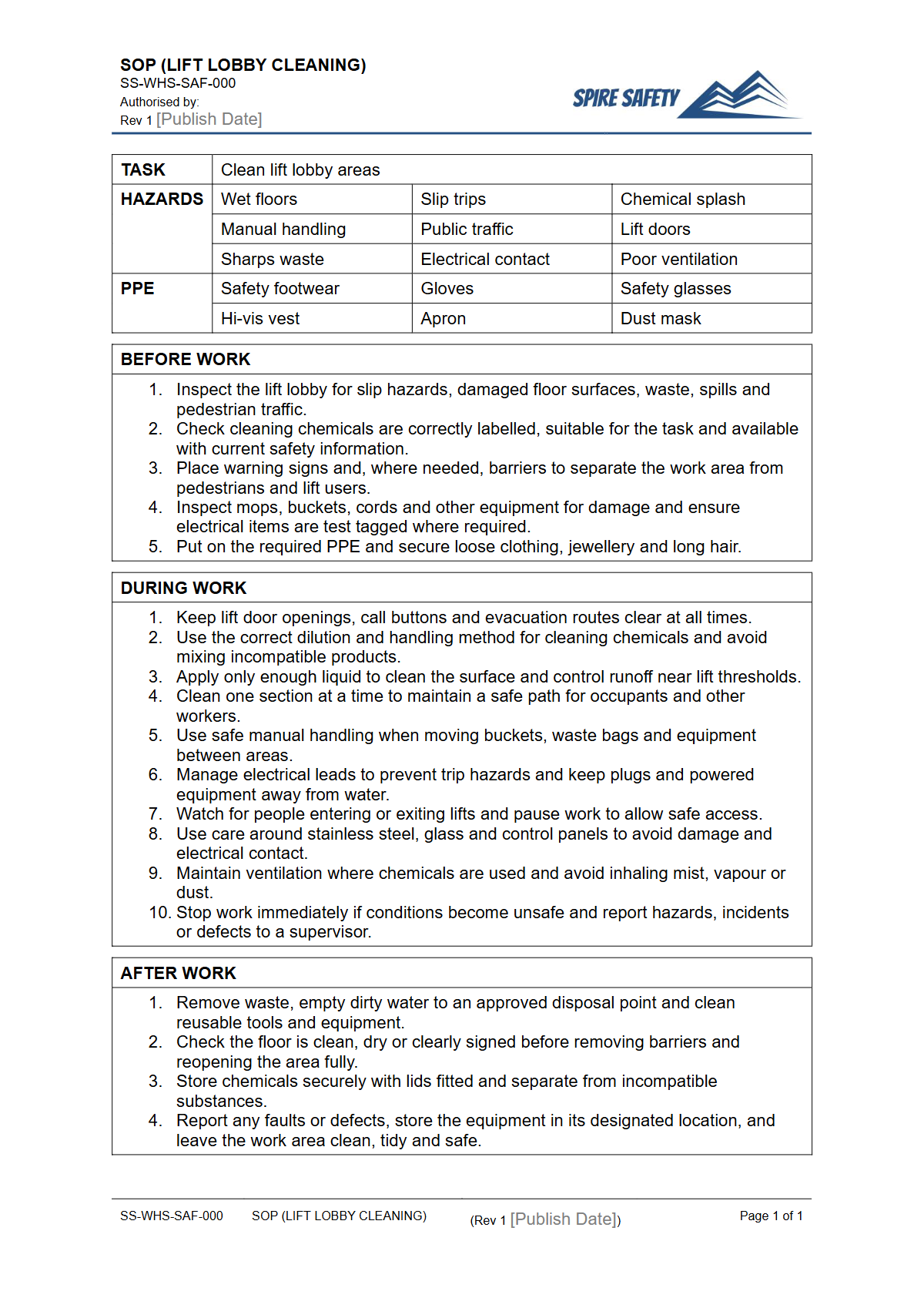
Purpose of the Free Safe Operating Procedure (Lift Lobby Cleaning) Template
Lift lobbies are high-traffic common areas that require regular cleaning to maintain hygiene and presentation. However, these tasks introduce hazards like slips on wet floors, trips over equipment, and exposure to cleaning chemicals.
This Free Safe Operating Procedure (Lift Lobby Cleaning) Template provides a structured framework for documenting step-by-step instructions to ensure these tasks are performed safely and consistently. Using a formal SOP helps organisations meet their WHS duties by managing foreseeable risks and providing clear guidance to workers.
A well-defined SOP is a critical tool for risk management. It prompts consideration of specific site hazards, from public interaction to cleaning high surfaces, which may require specific equipment.
For tasks involving work at height, even at low levels, a procedure like a step ladder SOP should also be implemented.
Video walkthrough
How to use the Free Safe Operating Procedure (Lift Lobby Cleaning) Template
This Safe Operating Procedure is available as a fully editable DOCX file and a PDF for easy printing and distribution. To use it, download the document and integrate it into your safety management system.
The most crucial step is customisation; you must adapt the content to your specific workplace environment and the tasks your team performs.
Important Note: This document is a template only. We have developed it as a starting point, but you must customise it to reflect the specific equipment, chemicals, hazards, and control measures relevant to your worksite. You must also consult with your workers during this process.
When customising, include details such as the specific brand and type of cleaning chemicals used (referencing their Safety Data Sheets), the makes and models of equipment like vacuums or floor polishers, and site-specific emergency contacts. A comprehensive SOP is a cornerstone of robust WHS management systems, demonstrating a commitment to proactive safety management.
When to use it
This SOP should be used as a primary reference document for all lift lobby cleaning activities. It serves as a training tool for new employees during their induction, ensuring they understand the approved methods and safety protocols from day one.
It can also be used as a guide for refresher training and as a topic for discussion during toolbox talks to reinforce safe work behaviour.
The procedure should be readily accessible to workers in the area where cleaning tasks are performed. It is a living document that forms part of a continuous improvement cycle, just as other critical procedures like a defibrillator operation SOP would be for first aid response.
Who should use it
This Safe Operating Procedure is intended for use by multiple roles within an organisation:
- Cleaning Operatives: To follow as a guide for performing their duties safely and efficiently.
- Supervisors and Team Leaders: To use as a tool for training, monitoring performance, and conducting workplace inspections.
- Facilities and Building Managers: To ensure a consistent and safe standard of cleaning is maintained across the property.
- WHS Managers and Officers: To use as evidence of a documented safe system of work and as a baseline for risk assessments and audits. Regular checks are essential to confirm procedures are being followed, which can be formalised through a WHS compliance auditing program.
Key Hazards in Lift Lobby Cleaning
While often seen as a low-risk task, cleaning lift lobbies presents several common hazards that must be controlled:
- Slips, trips, and falls: Caused by wet floors, trailing electrical cords from vacuums, or cleaning equipment left in walkways.
- Manual tasks: Injuries from lifting heavy buckets of water, moving furniture, or operating floor polishers with repetitive motions.
- Hazardous chemicals: Exposure to cleaning agents through inhalation, skin contact, or splashes to the eyes.
- Electrical hazards: Risk of electric shock from faulty equipment or using electrical appliances near water.
- Public interface: Managing interactions with building occupants and visitors who may walk through the work area.
For complex environments with unique risk profiles, such as those in healthcare or industrial settings, seeking external advice can help ensure all hazards are identified and adequately controlled. Engaging specialist WHS consulting services can provide clarity and expert guidance on developing your procedures.
Explore More WHS Resources
This document is one of many templates designed to assist Australian businesses in improving their safety practices. By establishing clear procedures for all common tasks, you create a safer and more organised workplace.
We encourage you to explore our complete free WHS resources library for more templates, checklists, and guides to support your safety management system.
Common mistakes
Common mistakes to avoid
- Failing to use "wet floor" signage, or removing it before the floor is completely dry.
- Using incorrect dilution rates for concentrated cleaning chemicals, leading to ineffectiveness or increased risk.
- Leaving vacuum cords or other equipment across pedestrian pathways, creating a trip hazard.
- Not consulting with cleaning staff when developing the procedure, missing valuable practical insights.
Legal references
Legal considerations
The following legal requirements may be relevant to this type of work.
- Work Health and Safety Act (Harmonised) — Provides the primary duties for protecting workers and other people from work health and safety risks.
- Work Health and Safety Regulations (Harmonised) — Sets out requirements supporting the management of workplace hazards and risks.
The following codes may be relevant to this type of work.
- Managing WHS Risks Code of Practice — Provides practical guidance on identifying hazards, assessing risks and applying effective controls.
- Work Health and Safety Consultation, Cooperation and Coordination Code of Practice — Provides practical guidance on consulting workers and coordinating with other duty holders.
- Managing the Work Environment and Facilities Code of Practice — Provides practical guidance on safe work environments, workplace facilities and related controls.
Did you know
Slips, Trips, and Falls
Slips, trips, and falls are a leading cause of workplace injury in Australia, particularly in the cleaning and property services industries. Wet floors and trailing electrical cords are major, yet preventable, contributors.
Chemical Safety
All cleaning chemicals must have a corresponding Safety Data Sheet (SDS) readily available to workers. The SDS provides critical information on handling, storage, PPE, first aid, and emergency measures.
FAQ
Frequently asked questions
01What should be included in a Safe Operating Procedure for cleaning?
02Is a Safe Work Method Statement (SWMS) required for lift lobby cleaning?
03How often should an SOP for cleaning be reviewed?
04Who is responsible for creating a cleaning SOP?
Share this resource
Free Safe Operating Procedure (Lift Lobby Cleaning) Template
Browse Categories
How To Use It
- 1Download and open in Word or PDF.
- 2Replace the placeholders with your business details.
- 3Get it reviewed by a WHS specialist before rollout.
Need it customised?
Our WHS consultants can adapt this template to your site, run a gap analysis, or audit what you already have in place.
Book a Free Consultation WHS consulting servicesor call 1300 156 382
Related templates
- Free Safe Operating Procedure (Lift Pit Cleaning) Template
- Free Safe Operating Procedure (Lifting Beam) Template
- Free Safe Operating Procedure (Lifting Magnet) Template
- Free Safe Operating Procedure (Lifting Sling Cleaning) Template
- Free Safe Operating Procedure (Lighting Circuit Test) Template
- Free Safe Operating Procedure (Line Marking) Template