
Free Safe Operating Procedure (Lifting Magnet) Template
Download our free Safe Operating Procedure (Lifting Magnet) Template. This customisable DOCX & PDF provides a clear framework for safe work practices.
Free Safe Operating Procedure (Lifting Magnet) Template
DOCX • 126 KB + PDF
Updated Oct 2026
No signup required
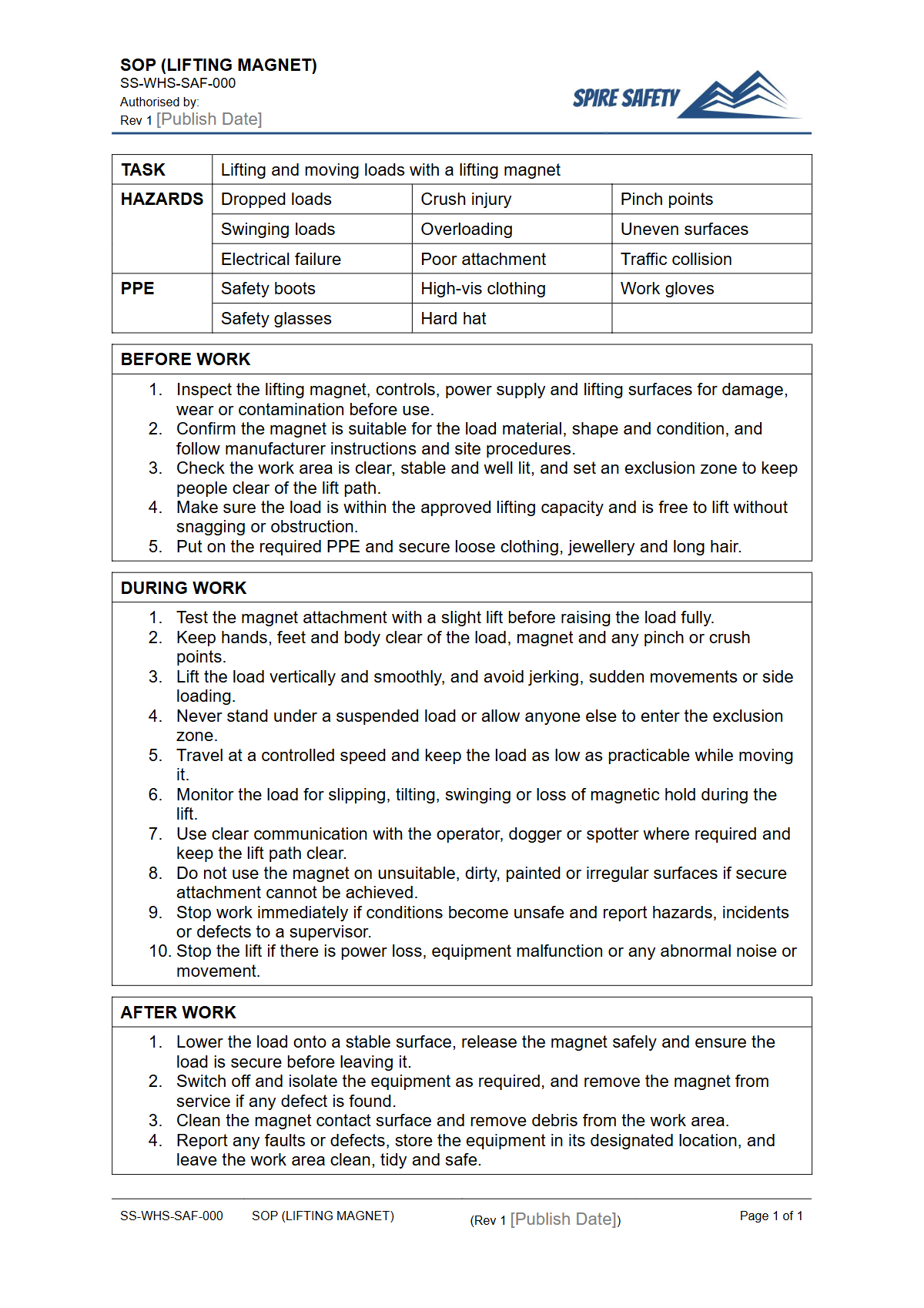
Purpose of the Free Safe Operating Procedure (Lifting Magnet) Template
Using industrial lifting magnets involves significant risks, including dropped loads, crushing injuries, and potential interference with medical devices. This Free Safe Operating Procedure (Lifting Magnet) Template provides a structured starting point for documenting the required steps to operate this equipment safely.
A well-drafted SOP is essential for minimising risk, ensuring consistent operational standards, and providing a clear reference for worker training and competency assessments. It formalises your commitment to a safe system of work, which is a critical component of any effective safety framework.
Implementing documented procedures like this one is a practical way to manage hazards at the source. They form an essential part of your overall safety management strategy, helping your organisation meet its duty of care obligations under Australian WHS legislation.
Formalising processes for all high-risk plant is a cornerstone of robust WHS management systems that protect both your workers and your business.
Video walkthrough
How to use the Free Safe Operating Procedure (Lifting Magnet) Template
This template is available for instant download in both DOCX and PDF formats. The DOCX file is fully editable, allowing you to tailor it to your specific operational needs.
The PDF version is useful for quick printing and distribution once your customisation is complete. It is crucial to understand that this document is a template, not a finished product.
Note: We've provided a comprehensive framework based on common industry practice, but you must customise this Safe Operating Procedure to reflect your unique workplace. This involves conducting a site-specific risk assessment and consulting with the people who actually use the equipment.
Be sure to insert details specific to your machinery, such as the make, model, safe working load (SWL) of the magnet, the types of loads handled, and your specific emergency procedures and contacts.
What the SOP Template Covers
Our template is designed to guide you through the key elements of a compliant and practical SOP. The structure includes sections for:
- Associated Risks: Identifying potential hazards before they cause harm.
- Required PPE: Listing mandatory personal protective equipment like steel-capped boots, gloves, and high-visibility clothing.
- Pre-Operational Checks: A step-by-step checklist for inspecting the magnet, lifting chains, hooks, and power source before every use.
- Operating Steps: A clear, sequential guide for attaching the magnet, conducting a test lift, moving the load, and safely releasing it.
- Post-Operational Procedures: Instructions for shutting down, cleaning, and storing the lifting magnet correctly.
- Emergency Procedures: Outlining immediate actions in case of power failure, a dropped load, or other incidents.
Documenting procedures for specific plant is a vital safety activity. This applies not just to lifting equipment but to all complex machinery, which is why we also offer resources like our FREE Telehandler SOP Template for other common high-risk plant.
When to use a Safe Operating Procedure
A Safe Operating Procedure for a lifting magnet should be a living document used throughout the workplace. It serves as a primary training tool during the induction of new operators and for refresher training.
Experienced workers should use it as a reference to ensure they are not taking shortcuts. Furthermore, it becomes an essential piece of evidence during safety investigations or formal process reviews.
Regular reviews of your SOPs are a key part of the continuous improvement cycle, often triggered during a WHS compliance auditing program.
Who Should Use This Template
This resource is designed for a range of personnel within an organisation:
- WHS Managers and Safety Officers use it to establish and implement standardised, safe work systems across the site.
- Supervisors and Team Leaders rely on it to train their teams, enforce correct procedures, and conduct informal checks on operator behaviour.
- Plant Operators use it as a direct guide for their day-to-day tasks, ensuring they follow every step correctly.
- Maintenance Personnel can refer to it for lockout/tagout procedures and to understand operational context before performing work.
In workshop and fabrication environments, consistency is key across all equipment. Standardising your documentation process for all machinery, from lifting devices to cutting tools, strengthens your safety culture. The same principles used in this SOP can be applied when drafting procedures for other equipment, such as the one in our FREE Plasma Cutter SOP (Safe Operating Procedure) Template.
By customising and implementing this SOP, you create a safer environment for everyone involved in lifting operations. For more templates and safety guides, explore our complete free WHS resources library.
Common mistakes
Common mistakes to avoid
- Failing to conduct a pre-lift test to ensure a secure hold.
- Lifting loads over personnel or in high-traffic areas.
- Using a magnet on materials with rough, painted, or uneven surfaces without de-rating the capacity.
- Not inspecting the magnet face and lifting accessories for damage before use.
Legal references
Legal considerations
The following legal requirements may be relevant to this type of work.
- Work Health and Safety Act (Harmonised) — Provides the primary duties for protecting workers and other people from work health and safety risks.
- Work Health and Safety Regulations (Harmonised) — Sets out requirements supporting the management of workplace hazards and risks.
The following codes may be relevant to this type of work.
- Managing WHS Risks Code of Practice — Provides practical guidance on identifying hazards, assessing risks and applying effective controls.
- Work Health and Safety Consultation, Cooperation and Coordination Code of Practice — Provides practical guidance on consulting workers and coordinating with other duty holders.
- Managing the Work Environment and Facilities Code of Practice — Provides practical guidance on safe work environments, workplace facilities and related controls.
Did you know
De-Rating is Crucial
A lifting magnet's capacity must be 'de-rated' for factors like thin materials, air gaps (due to rust or paint), and high temperatures. For example, a thin steel plate might only allow the magnet to lift at 50% of its maximum rated capacity.
Permanent vs. Electromagnets
Permanent lifting magnets use powerful rare-earth magnets and don't require electricity to hold a load, making them safer in a power outage. Electromagnets require a constant power supply to maintain their magnetic field and will instantly release the load if power is lost.
FAQ
Frequently asked questions
01What is the safe working load (SWL) for a lifting magnet?
02How often should lifting magnets be inspected?
03Can a lifting magnet be used to lift any type of metal?
04Do operators need a specific licence to use a lifting magnet?
Share this resource
Free Safe Operating Procedure (Lifting Magnet) Template
Browse Categories
How To Use It
- 1Download and open in Word or PDF.
- 2Replace the placeholders with your business details.
- 3Get it reviewed by a WHS specialist before rollout.
Need it customised?
Our WHS consultants can adapt this template to your site, run a gap analysis, or audit what you already have in place.
Book a Free Consultation WHS consulting servicesor call 1300 156 382
Related templates
- Free Safe Operating Procedure (Lifting Sling Cleaning) Template
- Free Safe Operating Procedure (Lighting Circuit Test) Template
- Free Safe Operating Procedure (Line Marking) Template
- Free Safe Operating Procedure (Linen Cupboard Restock) Template
- Free Safe Operating Procedure (Linen Trolley) Template
- Free Safe Operating Procedure (Liquid Nitrogen Use) Template