
Free Safe Operating Procedure (Line Marking) Template
Download our free Safe Operating Procedure (Line Marking) Template. This DOCX and PDF resource helps outline safe work steps for Australian workplaces.
Free Safe Operating Procedure (Line Marking) Template
DOCX • 126 KB + PDF
Updated Oct 2026
No signup required
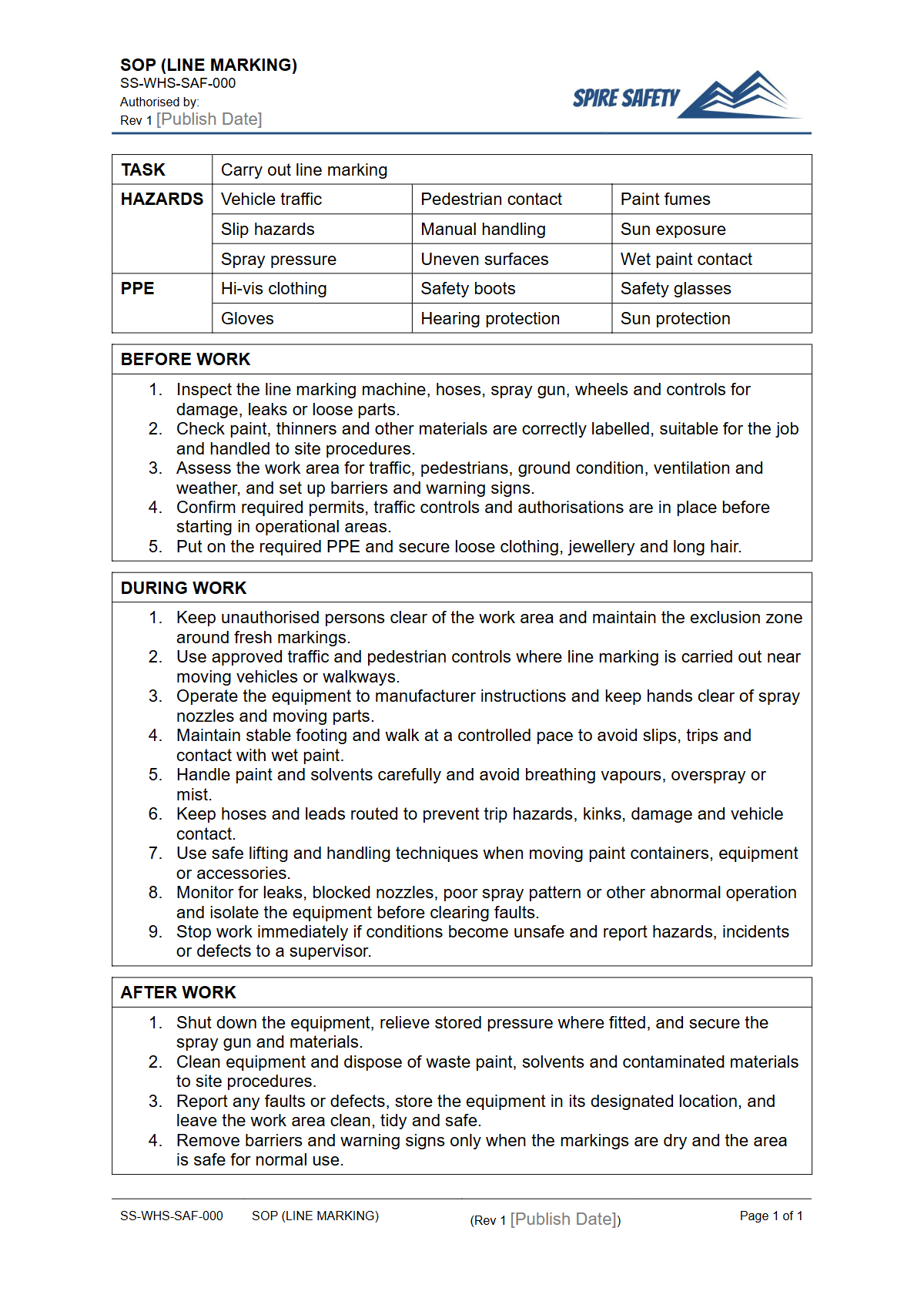
Purpose of the Free Safe Operating Procedure (Line Marking) Template
This Free Safe Operating Procedure (Line Marking) Template provides a structured framework for documenting the hazards and control measures associated with applying line marking in a workplace. Line marking is critical for designating pedestrian walkways, exclusion zones, vehicle paths, and storage areas, but the task itself introduces risks.
These can include exposure to chemicals, manual handling injuries, and interaction with traffic. Using a clear and concise SOP helps ensure the task is performed consistently and safely by all personnel.
A documented SOP is a key component of a robust safety framework. It serves as a training tool for new workers, a refresher for experienced staff, and evidence of your organisation's commitment to providing a safe system of work.
Integrating procedures like this one into your overall WHS management systems helps to formalise risk management and promote a proactive safety culture.
What is a Safe Operating Procedure?
A Safe Operating Procedure (SOP) is a written document that provides step-by-step instructions on how to perform a specific task safely. It identifies potential hazards at each stage and outlines the control measures required to eliminate or minimise the risk of injury or illness.
An effective SOP is clear, easy to follow, and specific to the equipment, chemicals, and environment of your workplace.
Video walkthrough
How to use the Free Safe Operating Procedure (Line Marking) Template
This document is a template and requires customisation. After downloading the DOCX or PDF file, you must adapt it to reflect the specific line marking equipment (e.g., aerosol applicators, airless sprayers, thermoplastic machines), chemicals, and unique environmental conditions of your worksite.
A generic procedure is not sufficient; it must be made site-specific to be effective. Conduct a risk assessment for the line marking task in consultation with the workers who will be performing it.
To complete the template, you should:
- Insert your company name and logo.
- Review the 'Potential Hazards' and 'Control Measures' sections, adding or removing items based on your site-specific risk assessment.
- Specify the exact types of Personal Protective Equipment (PPE) required, such as respiratory protection for certain paints or high-visibility clothing.
- Detail your workplace's specific emergency procedures, including first aid for chemical exposure and spill clean-up steps.
- Consult with your team to ensure the steps are practical, accurate, and easily understood.
By following a consistent format, your team will find it easier to understand and use various procedures across the business, whether it's this document or our free Safe Operating Procedure (Defibrillator Operation) template.
When to use it
This Safe Operating Procedure should be used whenever line marking activities are planned or conducted. This includes initial marking of a new area, re-marking faded lines, or applying temporary markings for events or construction.
It is particularly important when working in live environments with active vehicle or pedestrian traffic. In these scenarios, the SOP must integrate with a broader traffic management plan to ensure the safety of both the line marking crew and other site users.
The SOP should be reviewed and referenced during toolbox talks before work begins. For complex sites with significant vehicle movement, the principles in this SOP can supplement procedures for other equipment, such as our FREE Telehandler SOP Template, by defining clear operational zones. It's also vital before tasks that break ground, where marking is used to indicate the location of underground services ahead of excavation work outlined in a FREE Trencher SOP Template.
Who should use it
This SOP is designed for use by any person conducting a business or undertaking (PCBU) whose workers perform line marking tasks. This includes managers, supervisors, and health and safety representatives responsible for developing and implementing safe systems of work.
The final, customised document should be used by the workers (operators) who actually perform the line marking. They must be trained in the procedure and deemed competent to carry out the work safely.
Supervisors must ensure that the procedures are being followed correctly on-site and that all required controls are in place and functional. If you require assistance in developing or implementing SOPs as part of your safety system, consider engaging professional WHS consulting services to ensure your processes are robust and practical. For more document templates and safety guides, you can browse our complete free WHS resources library.
Common mistakes
Common mistakes to avoid
- Failing to adequately prepare the surface, leading to poor adhesion and premature failure of the lines.
- Neglecting to implement proper ventilation or use respiratory protection when working indoors or with high-VOC paints.
- Inadequate traffic and pedestrian management, creating a risk of collision with workers or equipment.
- Using a generic SOP without customising it for the specific chemicals, equipment, and environment of the worksite.
Legal references
Legal considerations
The following legal requirements may be relevant to this type of work.
- Work Health and Safety Act (Harmonised) — Provides the primary duties for protecting workers and other people from work health and safety risks.
- Work Health and Safety Regulations (Harmonised) — Sets out requirements supporting the management of workplace hazards and risks.
The following codes may be relevant to this type of work.
- Managing WHS Risks Code of Practice — Provides practical guidance on identifying hazards, assessing risks and applying effective controls.
- Work Health and Safety Consultation, Cooperation and Coordination Code of Practice — Provides practical guidance on consulting workers and coordinating with other duty holders.
- Managing the Work Environment and Facilities Code of Practice — Provides practical guidance on safe work environments, workplace facilities and related controls.
Did you know
Colour Psychology
The colours used in line marking aren't random. Standards like AS 2700 specify colours for safety applications, such as yellow for caution and physical hazards, and red for fire protection equipment.
Slip Resistance
Line marking paint can create a slip hazard, especially when wet. Some application standards require the addition of anti-slip media (like glass beads or grit) to the paint to ensure the marked surface remains safe for pedestrians.
FAQ
Frequently asked questions
01What PPE is required for line marking?
02Does this line marking SOP cover traffic management?
03How often should a Safe Operating Procedure be reviewed?
04Is an SOP a legal requirement for line marking in Australia?
Share this resource
Free Safe Operating Procedure (Line Marking) Template
Browse Categories
How To Use It
- 1Download and open in Word or PDF.
- 2Replace the placeholders with your business details.
- 3Get it reviewed by a WHS specialist before rollout.
Need it customised?
Our WHS consultants can adapt this template to your site, run a gap analysis, or audit what you already have in place.
Book a Free Consultation WHS consulting servicesor call 1300 156 382
Related templates
- Free Safe Operating Procedure (Linen Cupboard Restock) Template
- Free Safe Operating Procedure (Linen Trolley) Template
- Free Safe Operating Procedure (Liquid Nitrogen Use) Template
- Free Safe Operating Procedure (Litter Trap Cleaning) Template
- Free Safe Operating Procedure (Litter Trap Inspection) Template
- Free Safe Operating Procedure (Livestock Bedding Change) Template