
Free Safe Operating Procedure (Litter Trap Cleaning) Template
Download our free Safe Operating Procedure (Litter Trap Cleaning) template.
Free Safe Operating Procedure (Litter Trap Cleaning) Template
DOCX • 126 KB + PDF
Updated Oct 2026
No signup required
Purpose of the Free Safe Operating Procedure (Litter Trap Cleaning) Template
Effectively managing stormwater quality often involves the regular cleaning of litter traps, also known as Gross Pollutant Traps (GPTs). While a routine task, it presents numerous health and safety risks, including manual handling, biological hazards, and potential confined space entry.
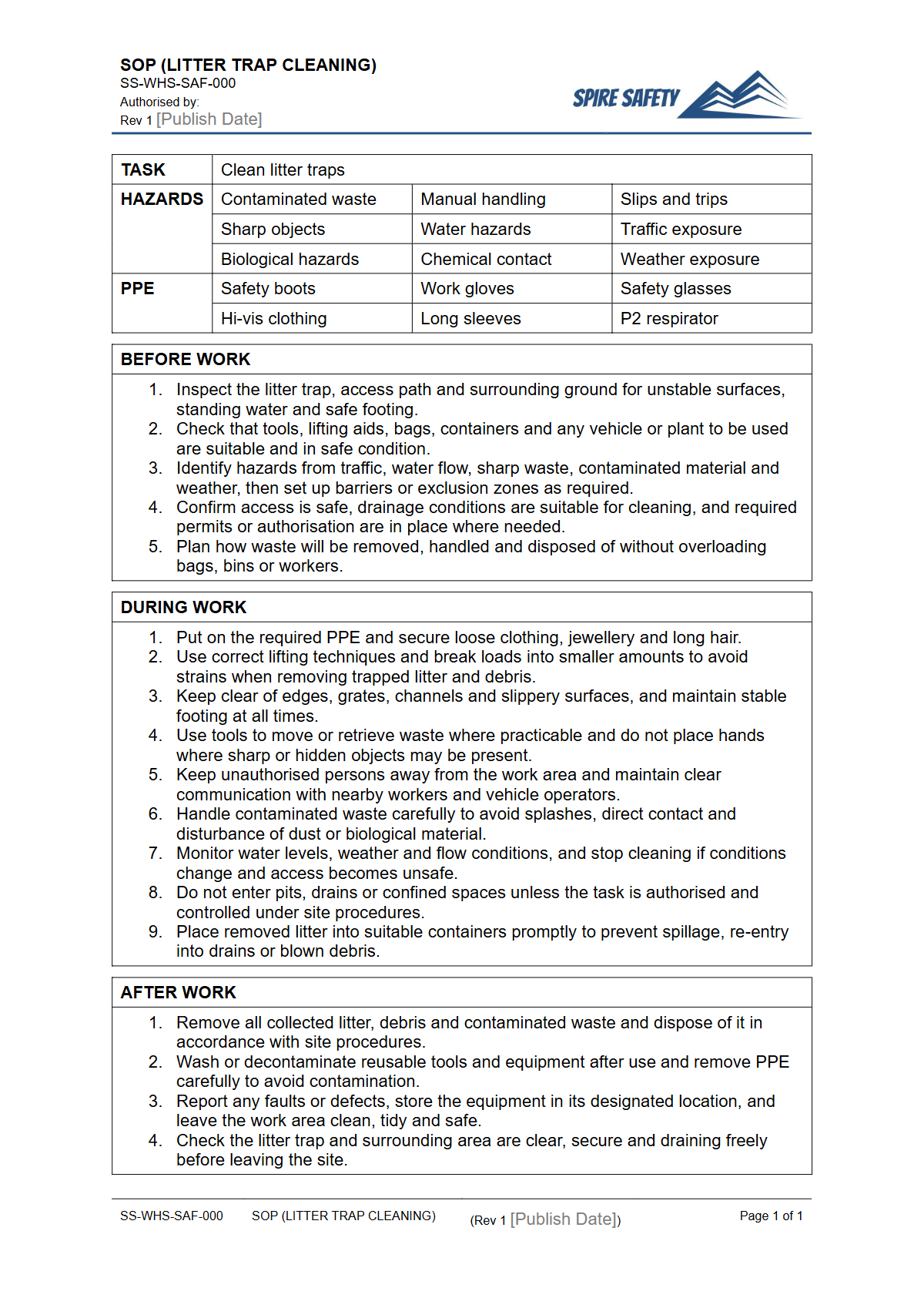
This Free Safe Operating Procedure (Litter Trap Cleaning) Template provides a structured framework for documenting a safe system of work to manage these hazards.
A Safe Operating Procedure (SOP) is a fundamental administrative control that outlines step-by-step instructions for performing a task safely. Using this template helps organisations fulfil their duty of care by clearly defining risks, control measures, and required personal protective equipment (PPE).
It serves as a vital tool for worker training and competency verification, forming a key part of a robust safety management system. For assistance in developing comprehensive safety documentation for your business, our WHS consulting team can provide expert guidance.
Key Hazards in Litter Trap Cleaning
Before customising the SOP, it's crucial to understand the potential hazards associated with the task. A site-specific risk assessment should be conducted, but common risks include:
- Manual Handling: Lifting heavy access grates, pulling out full baskets, and carrying bags of waste can lead to musculoskeletal injuries.
- Biological Hazards: Trapped water and debris can contain harmful bacteria, viruses, sharps (needles), and animal waste. Direct contact can cause infection or illness.
- Slips, Trips, and Falls: Wet and uneven surfaces around the trap area are common.
- Confined Spaces: Depending on the design, some larger traps may be classified as confined spaces, requiring specific entry permits and procedures.
- Atmospheric Contaminants: Decomposing organic matter can release gases like hydrogen sulphide, posing a respiratory risk in poorly ventilated traps.
- Traffic and Pedestrians: Many traps are located in car parks, near roadways, or on public footpaths, creating a risk of interaction with vehicles and people.
Video walkthrough
How to use the Free Safe Operating Procedure (Litter Trap Cleaning) Template
This resource is available for download as a fully editable DOCX file, allowing for complete customisation, and a PDF for easy printing and distribution. It is designed as a starting point, aligned with Australian WHS principles, but it is not a complete, ready-to-use document.
Important: Before implementation, you must customise this template to reflect the specific equipment, environment, and risks present in your workplace. We strongly advise conducting a site-specific risk assessment to inform your changes.
Integrating customised SOPs into your broader WHS management systems ensures consistent application and review across all operations.
When to use it
A formal SOP for litter trap cleaning should be used in several key situations. It should be the primary reference document consulted by workers before commencing the task.
It is an essential resource for inducting and training new employees or contractors assigned to the job, ensuring they understand the approved safe work method from the outset.
Furthermore, the SOP should be used for periodic refresher training and as a basis for toolbox talks on the topic. It also serves as crucial evidence of your safety processes during a formal WHS compliance auditing process.
In the event of an incident or near miss, the SOP is a critical document to review to identify any gaps in procedure.
Who should use it
This Safe Operating Procedure is intended for use by multiple parties within an organisation. Persons Conducting a Business or Undertaking (PCBUs) and their management teams are responsible for ensuring such procedures are developed, implemented, and reviewed.
Supervisors must use the SOP to direct work and monitor the safety of their teams on the ground.
The primary users are the workers or operators who physically perform the cleaning task. They must be trained in the SOP's content and follow its instructions diligently.
If access to the trap involves any form of work at height, even on a small platform, ensure related procedures like our FREE Step Ladder SOP Template are also consulted and followed. WHS advisors and safety committees can also use the document as a tool for risk reviews and workplace inspections.
All personnel should be trained in emergency response. This includes knowing the location of first aid kits and understanding procedures for incidents like needle-stick injuries or exposure to hazardous substances. Workers should also be trained in the use of critical equipment, a process that can be documented using a Free Safe Operating Procedure (Defibrillator Operation) Template.
By standardising the procedure for this common maintenance task, you can significantly reduce risk and demonstrate a proactive approach to safety. Browse our complete free WHS resources library for more templates and guides to support your safety management system.
Common mistakes
Common mistakes to avoid
- Assuming the water is clean and forgoing waterproof gloves and eye protection.
- Failing to assess the weight of grates and bags, leading to manual handling injuries.
- Neglecting traffic management when the trap is located near roads or pathways.
- Forgetting to check for sharps, snakes, or spiders before reaching into the trap.
Legal references
Legal considerations
The following legal requirements may be relevant to this type of work.
- Work Health and Safety Act (Harmonised) — Provides the primary duties for protecting workers and other people from work health and safety risks.
- Work Health and Safety Regulations (Harmonised) — Sets out requirements supporting the management of workplace hazards and risks.
The following codes may be relevant to this type of work.
- Managing WHS Risks Code of Practice — Provides practical guidance on identifying hazards, assessing risks and applying effective controls.
- Work Health and Safety Consultation, Cooperation and Coordination Code of Practice — Provides practical guidance on consulting workers and coordinating with other duty holders.
- Managing the Work Environment and Facilities Code of Practice — Provides practical guidance on safe work environments, workplace facilities and related controls.
Did you know
Hidden Dangers
Litter traps, or Gross Pollutant Traps (GPTs), can harbour dangerous bacteria, viruses, and fungi from decomposing matter and waste, making proper PPE essential.
A Weighty Issue
A single cast iron stormwater grate can weigh over 50 kilograms, posing a significant manual handling risk if not lifted with appropriate techniques or mechanical aids.
FAQ
Frequently asked questions
01What hazards are involved in cleaning a litter trap?
02Is a Safe Operating Procedure legally required for litter trap cleaning?
03What PPE is needed for cleaning a gross pollutant trap?
04How often should a litter trap SOP be reviewed?
Share this resource
Free Safe Operating Procedure (Litter Trap Cleaning) Template
Browse Categories
How To Use It
- 1Download and open in Word or PDF.
- 2Replace the placeholders with your business details.
- 3Get it reviewed by a WHS specialist before rollout.
Need it customised?
Our WHS consultants can adapt this template to your site, run a gap analysis, or audit what you already have in place.
Book a Free Consultation WHS consulting servicesor call 1300 156 382
Related templates
- Free Safe Operating Procedure (Litter Trap Inspection) Template
- Free Safe Operating Procedure (Livestock Bedding Change) Template
- Free Safe Operating Procedure (Livestock Ear Tagging) Template
- Free Safe Operating Procedure (Livestock Feed Handling) Template
- Free Safe Operating Procedure (Livestock Gate Handling) Template
- Free Safe Operating Procedure (Livestock Yard Cleaning) Template