
Free Safe Operating Procedure (Livestock Yard Cleaning) Template
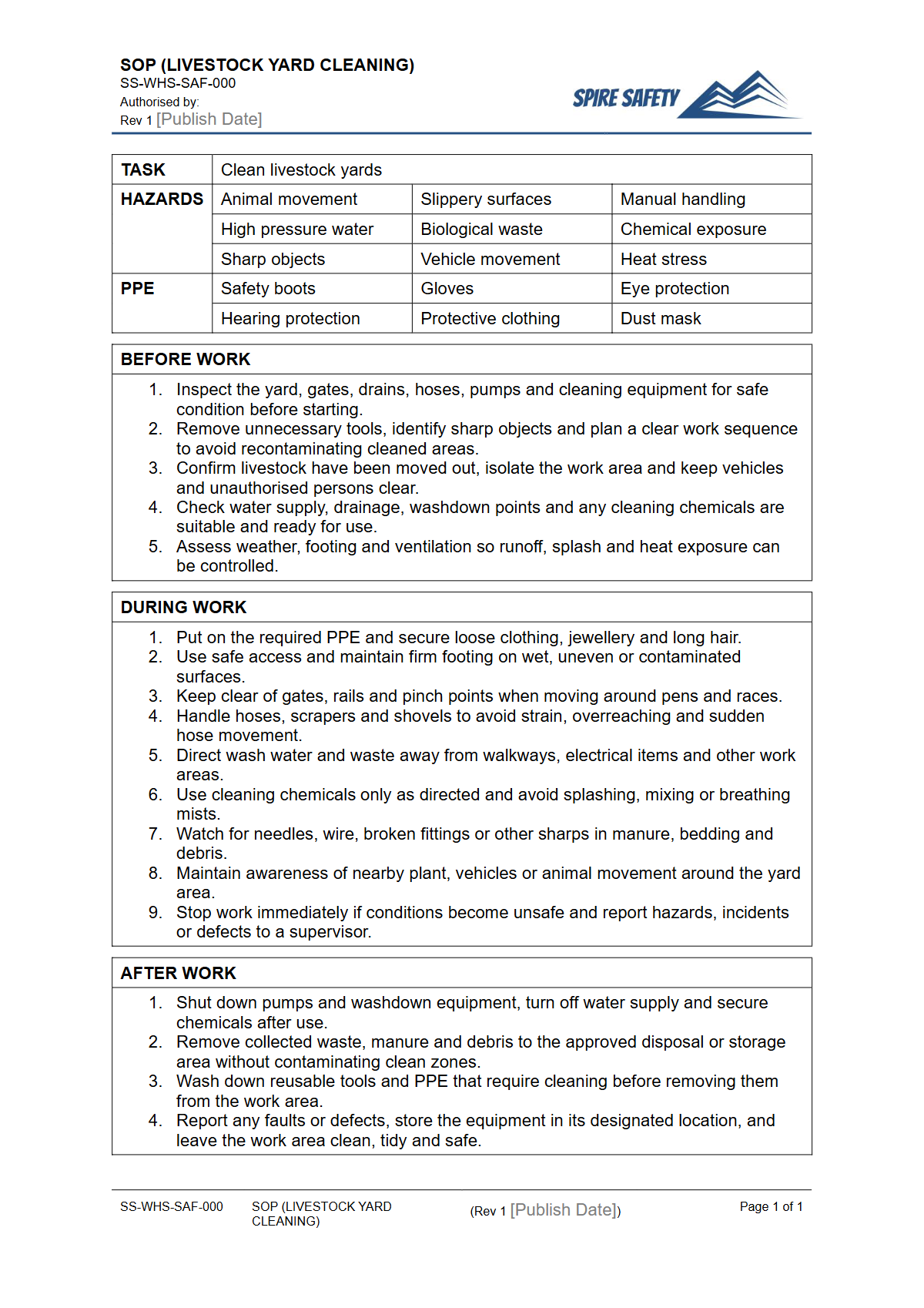
Download our free Safe Operating Procedure (Livestock Yard Cleaning) template. This customisable DOCX and PDF helps manage hazards in agricultural settings.
Free Safe Operating Procedure (Livestock Yard Cleaning) Template
DOCX • 126 KB + PDF
Updated Oct 2026
No signup required
Purpose of the Free Safe Operating Procedure (Livestock Yard Cleaning) Template
Spire Safety offers this Free Safe Operating Procedure (Livestock Yard Cleaning) Template to provide a structured starting point for managing health and safety in agricultural environments. Cleaning livestock yards is a high-risk activity involving numerous hazards.
This SOP template helps Persons Conducting a Business or Undertaking (PCBUs) and farm managers systematically identify risks and outline clear, step-by-step instructions for workers to follow, promoting a safer work environment.
A well-developed SOP is a critical tool for managing risks associated with the task. Key hazards in livestock yard cleaning include exposure to zoonotic diseases (like Q fever and leptospirosis), hazardous chemicals, atmospheric contaminants (dust, ammonia), and noise.
There are also significant physical risks, such as slips, trips, and falls on wet or uneven surfaces, manual handling injuries from moving equipment, and potential interaction with mobile plant. Properly documenting procedures helps ensure these risks are controlled. A comprehensive SOP should be a core component of your overall WHS management systems.
The procedure for cleaning may involve various types of machinery, each with its own set of hazards. This could include high-pressure water cleaners, tractors with front-end loaders, or skid-steer loaders.
For tasks involving heavy equipment, specific procedures are essential. For example, if your process involves moving materials with a telehandler, you should also consult a specific FREE Telehandler SOP Template to cover its operation in detail.
Video walkthrough
How to use the Free Safe Operating Procedure (Livestock Yard Cleaning) Template
This Safe Operating Procedure template is provided in both DOCX and PDF formats for your convenience. To implement it effectively, download the document and integrate it into your safety management processes.
The core of its use lies in customisation; a generic document cannot account for the unique variables of your workplace. You must adapt the content to reflect the specific layout of your yards, the types of livestock, the cleaning equipment used, and the chemicals stored and handled on site.
Customisation is Essential
IMPORTANT: This is a template only. We have not been to your site, and we cannot know your specific circumstances.
You MUST customise this document by conducting your own risk assessment and consulting with your workers to ensure it is suitable for your specific equipment, processes, and environment. Failure to tailor the SOP to your workplace can render it ineffective and may not fulfil your WHS obligations.
The customisation process should be a collaborative effort. Engage the workers who perform the cleaning tasks.
Their direct experience is invaluable for identifying practical hazards and developing workable, safe procedures. Once finalised, the SOP should be used as a primary training document for new and existing employees, ensuring everyone understands the agreed-upon safe method for completing the job.
Should you require assistance in developing site-specific documentation, our expert WHS consulting team can provide tailored support.
When to use it
A Safe Operating Procedure for livestock yard cleaning should be a living document, actively used within your daily operations. It should be consulted before any cleaning task is undertaken, especially by new or less experienced workers.
It serves as a critical reference during worker induction, on-the-job training, and refresher courses. The SOP should also be reviewed as part of any incident investigation or near-miss report related to yard cleaning to identify and rectify procedural gaps.
Furthermore, it is a key document to have on hand during safety audits and workplace inspections.
Who should use it
This SOP is designed for use by a range of personnel within an agricultural business. Farm managers and supervisors are responsible for developing, implementing, and reviewing the procedure as part of their duty of care.
Workers and farmhands who carry out the cleaning must be trained on the SOP and are expected to follow its instructions to ensure their own safety and that of their colleagues. WHS officers and safety representatives will also use this document to facilitate training, conduct risk assessments, and monitor safety performance.
It's a foundational document for any PCBU in the agricultural sector seeking to meet their WHS duties. A robust SOP for one task, like this one, complements other procedural documents, such as a FREE Grain Drill SOP Template, to build a comprehensive safety framework.
Regular reviews are crucial to ensure the SOP remains current and effective. This process might involve re-assessing risks, considering new technology, or updating procedures based on feedback.
Scheduling periodic reviews, for example annually or after any significant change, helps maintain a high standard of safety. An external review as part of a WHS compliance auditing program can also provide valuable insights and assurance.
This template is one of many resources designed to assist Australian businesses in managing workplace safety. You can explore a wide range of other procedural documents and checklists in our free WHS resources library to support your safety management system.
Common mistakes
Common mistakes to avoid
- Using a generic template without customising it for the specific site, equipment, and livestock.
- Failing to consult with the workers who perform the cleaning tasks when drafting the procedure.
- Neglecting to provide adequate, task-specific training on the finalised SOP and the correct use of PPE.
- Not reviewing or updating the SOP after an incident, a near miss, or when cleaning processes change.
Legal references
Legal considerations
The following legal requirements may be relevant to this type of work.
- Work Health and Safety Act (Harmonised) — Provides the primary duties for protecting workers and other people from work health and safety risks.
- Work Health and Safety Regulations (Harmonised) — Sets out requirements supporting the management of workplace hazards and risks.
The following codes may be relevant to this type of work.
- Managing WHS Risks Code of Practice — Provides practical guidance on identifying hazards, assessing risks and applying effective controls.
- Work Health and Safety Consultation, Cooperation and Coordination Code of Practice — Provides practical guidance on consulting workers and coordinating with other duty holders.
- Managing the Work Environment and Facilities Code of Practice — Provides practical guidance on safe work environments, workplace facilities and related controls.
Did you know
Zoonotic Risks
Many emerging infectious diseases are zoonotic, meaning they can be transmitted from animals to humans. Manure and animal waste are significant sources of pathogens like E. coli, Salmonella, and the bacteria that causes Q fever.
Manual Handling in Agriculture
The agriculture, forestry, and fishing industry has one of the highest rates of serious claims for work-related injuries, with manual handling being a consistent leading cause of harm.
FAQ
Frequently asked questions
01What are the main hazards when cleaning livestock yards?
02How often should a Safe Operating Procedure for livestock yard cleaning be reviewed?
03Is a Safe Operating Procedure a legal requirement in Australia?
04What Personal Protective Equipment (PPE) is needed for yard cleaning?
Share this resource
Free Safe Operating Procedure (Livestock Yard Cleaning) Template
Browse Categories
How To Use It
- 1Download and open in Word or PDF.
- 2Replace the placeholders with your business details.
- 3Get it reviewed by a WHS specialist before rollout.
Need it customised?
Our WHS consultants can adapt this template to your site, run a gap analysis, or audit what you already have in place.
Book a Free Consultation WHS consulting servicesor call 1300 156 382
Related templates
- Free Safe Operating Procedure (LNG Refuelling) Template
- Free Safe Operating Procedure (Load Bay Allocation) Template
- Free Safe Operating Procedure (Load Cell Use) Template
- Free Safe Operating Procedure (Load Damage Inspection) Template
- Free Safe Operating Procedure (Load Distribution Check) Template
- Free Safe Operating Procedure (Load Guiding) Template