
Free Safe Operating Procedure (Load Cell Use) Template
Download our free Safe Operating Procedure (Load Cell Use) template.
Free Safe Operating Procedure (Load Cell Use) Template
DOCX • 126 KB + PDF
Updated Oct 2026
No signup required
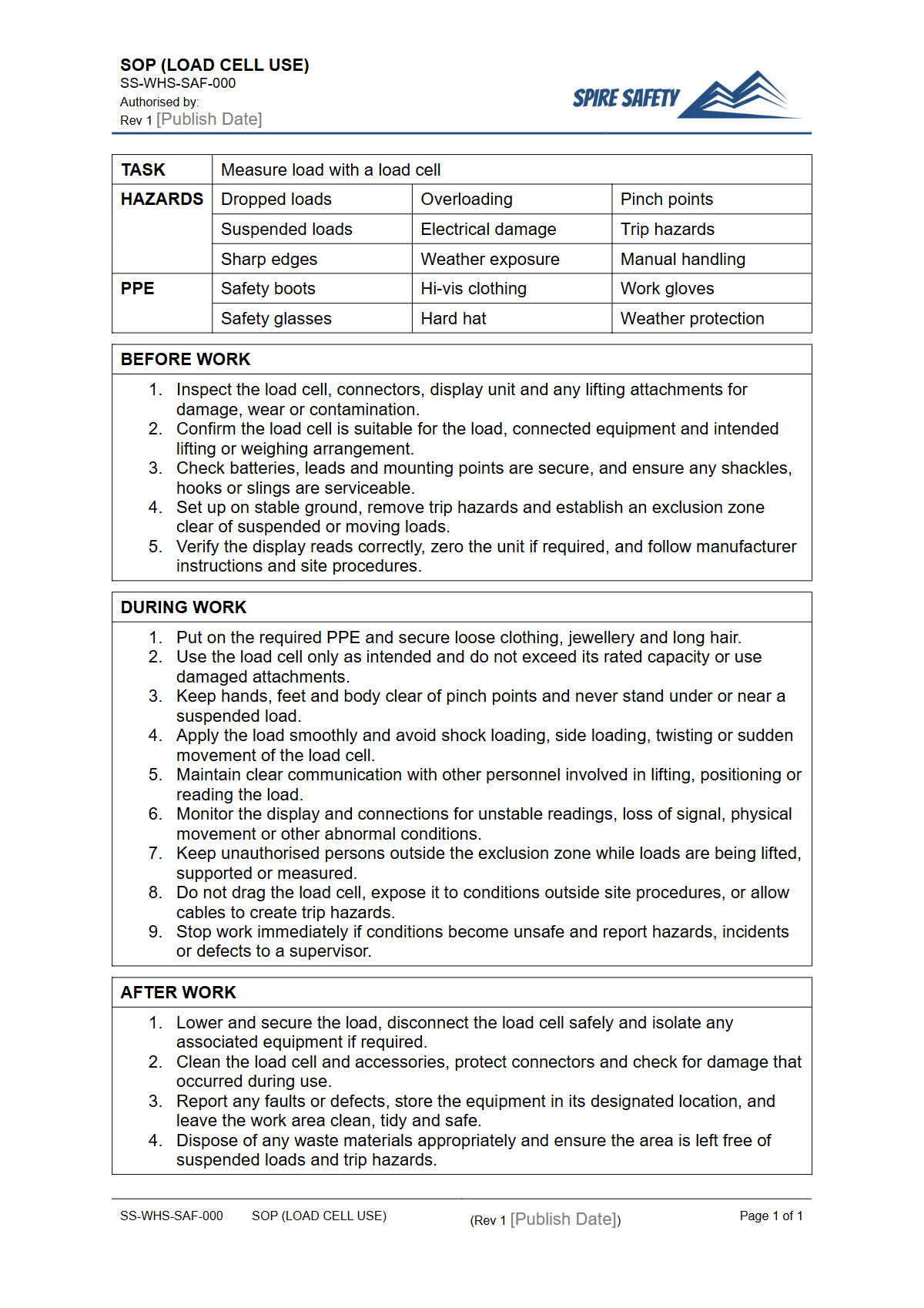
Purpose of the Free Safe Operating Procedure (Load Cell Use) Template
Effectively managing the risks associated with lifting and tensioning operations is a cornerstone of workplace safety. This free Safe Operating Procedure (Load Cell Use) Template provides a comprehensive framework for documenting the required steps to safely use load cells in your organisation.
A load cell is a sensor used to measure force or weight, and its accurate operation is critical in industries like construction, manufacturing, logistics, and engineering to prevent equipment failure and catastrophic accidents.
Implementing a formal SOP helps standardise procedures, ensuring that every operator performs tasks in a consistent, safe manner. It addresses key hazards such as overloading lifting equipment, structural failure from uneven loading, and dropped loads, all of which can lead to serious injury or death.
Having a documented procedure is a key part of demonstrating due diligence and forms an essential component of a site's overall safety management plan, much like a safe operating procedure for telehandlers or other critical plant.
Video walkthrough
How to use the Free Safe Operating Procedure (Load Cell Use) Template
This template is provided in both DOCX and PDF formats to give you a flexible starting point. To use it, simply download the file and integrate it into your safety documentation.
It is designed to be adapted to the unique requirements of your worksite and the specific types of load cells you use.
Note: This is a template and must be customised to your specific workplace. We have provided a structured starting point, but you must review, edit, and add site-specific details to ensure it is relevant and effective for your operations.
Customisation should include adding details such as specific load cell models and capacities, company branding, designated responsible persons, emergency contact numbers, and site-specific emergency procedures. Properly customised SOPs are a vital part of developing robust WHS management systems that protect your workers and your business.
When to use it
A Safe Operating Procedure for load cell use should be consulted before and during any task that involves measuring tensile or compressive force. This document is not meant to sit on a shelf; it is an active tool for risk management. Key moments to refer to the SOP include:
- Planning the Task: Before work begins, the SOP should be used to plan the operation, select the correct equipment, and conduct a risk assessment.
- Pre-Operational Checks: Operators must follow the SOP's checklist to inspect the load cell, cables, and any associated rigging for damage, wear, or defects before every use. This includes verifying its calibration status.
- During Operation: The SOP provides guidance on correct operational techniques, monitoring for signs of overload or malfunction, and maintaining clear communication within the team.
- Post-Operation: Procedures for powering down, cleaning, inspecting, and storing the equipment should be followed to ensure it is ready for its next use. Any faults or concerns identified must be reported according to the process outlined. This documentation can be a key piece of evidence during regular WHS compliance audits.
Who should use it
This SOP is intended for all personnel involved in tasks that utilise load cells. This includes, but is not limited to:
- Crane Operators and Dogmen
- Riggers and Scaffolders
- Engineers and Technicians
- Maintenance and Inspection Personnel
- Site Supervisors and Managers
It is a person conducting a business or undertaking's (PCBU) responsibility to ensure that all individuals using this equipment are trained, competent, and understand the procedures outlined in the SOP. Supervisors must enforce its use and verify that safety controls are being applied correctly.
For organisations needing support in defining roles and responsibilities, our specialist WHS consulting services can provide expert guidance.
Key Elements of a Load Cell SOP
A comprehensive SOP for load cell use should contain several critical sections. This template prompts you to define hazards and controls relevant to your workplace.
Common hazards include electrical faults, shock loading (sudden application of force), side loading, and environmental factors like extreme temperatures or moisture. You must detail the control measures, following the hierarchy of controls, to mitigate these risks.
Documenting procedures for other specific equipment, such as a Plasma Cutter SOP, follows a similar structured approach.
Calibration and Maintenance
One of the most critical aspects of load cell safety is ensuring the device is accurately calibrated. The SOP must specify the required calibration interval and state that it must be performed by a competent person or accredited facility.
Records of calibration and any maintenance or repairs must be meticulously kept and be readily accessible. Using an uncalibrated or overdue load cell renders its measurements unreliable and introduces significant, unacceptable risk.
By implementing a thorough SOP, you create a safer environment for your workers and protect valuable assets. Explore our complete free WHS resources library for more templates to support your safety management system.
Common mistakes
Common mistakes to avoid
- Failing to perform and document pre-use visual inspections for damage or wear.
- Using a load cell that is past its calibration due date.
- Exceeding the Working Load Limit (WLL) or 'shock loading' the device with sudden force.
- Neglecting to account for environmental factors like wind, extreme temperatures, or off-centre (side) loading, which can affect accuracy and safety.
Legal references
Legal considerations
The following legal requirements may be relevant to this type of work.
- Work Health and Safety Act (Harmonised) — Provides the primary duties for protecting workers and other people from work health and safety risks.
- Work Health and Safety Regulations (Harmonised) — Sets out requirements supporting the management of workplace hazards and risks.
The following codes may be relevant to this type of work.
- Managing WHS Risks Code of Practice — Provides practical guidance on identifying hazards, assessing risks and applying effective controls.
- Work Health and Safety Consultation, Cooperation and Coordination Code of Practice — Provides practical guidance on consulting workers and coordinating with other duty holders.
- Managing the Work Environment and Facilities Code of Practice — Provides practical guidance on safe work environments, workplace facilities and related controls.
Did you know
A Precise Science
Modern strain gauge load cells are incredibly precise and can detect minute changes in force. However, this precision is entirely dependent on regular, professional calibration; without it, the readings can be dangerously inaccurate.
Lifting Incidents
According to Safe Work Australia data, incidents involving being hit by moving or falling objects are a leading cause of serious injury claims. Proper use of equipment like load cells is a critical control for preventing such incidents during lifting operations.
FAQ
Frequently asked questions
01What is a load cell and why is a Safe Operating Procedure necessary?
02Can I use this template for any type of load cell?
03Who is responsible for ensuring the load cell SOP is followed?
04How often should a Safe Operating Procedure for load cells be reviewed?
Share this resource
Free Safe Operating Procedure (Load Cell Use) Template
Browse Categories
How To Use It
- 1Download and open in Word or PDF.
- 2Replace the placeholders with your business details.
- 3Get it reviewed by a WHS specialist before rollout.
Need it customised?
Our WHS consultants can adapt this template to your site, run a gap analysis, or audit what you already have in place.
Book a Free Consultation WHS consulting servicesor call 1300 156 382
Related templates
- Free Safe Operating Procedure (Load Damage Inspection) Template
- Free Safe Operating Procedure (Load Distribution Check) Template
- Free Safe Operating Procedure (Load Guiding) Template
- Free Safe Operating Procedure (Load Indicator Test) Template
- Free Safe Operating Procedure (Load Landing) Template
- Free Safe Operating Procedure (Load Manifest Check) Template