
Free Safe Operating Procedure (Load Indicator Test) Template
Download our free Safe Operating Procedure (Load Indicator Test) template. This DOCX & PDF provides a solid foundation for documenting safe work methods.
Free Safe Operating Procedure (Load Indicator Test) Template
DOCX • 126 KB + PDF
Updated Oct 2026
No signup required
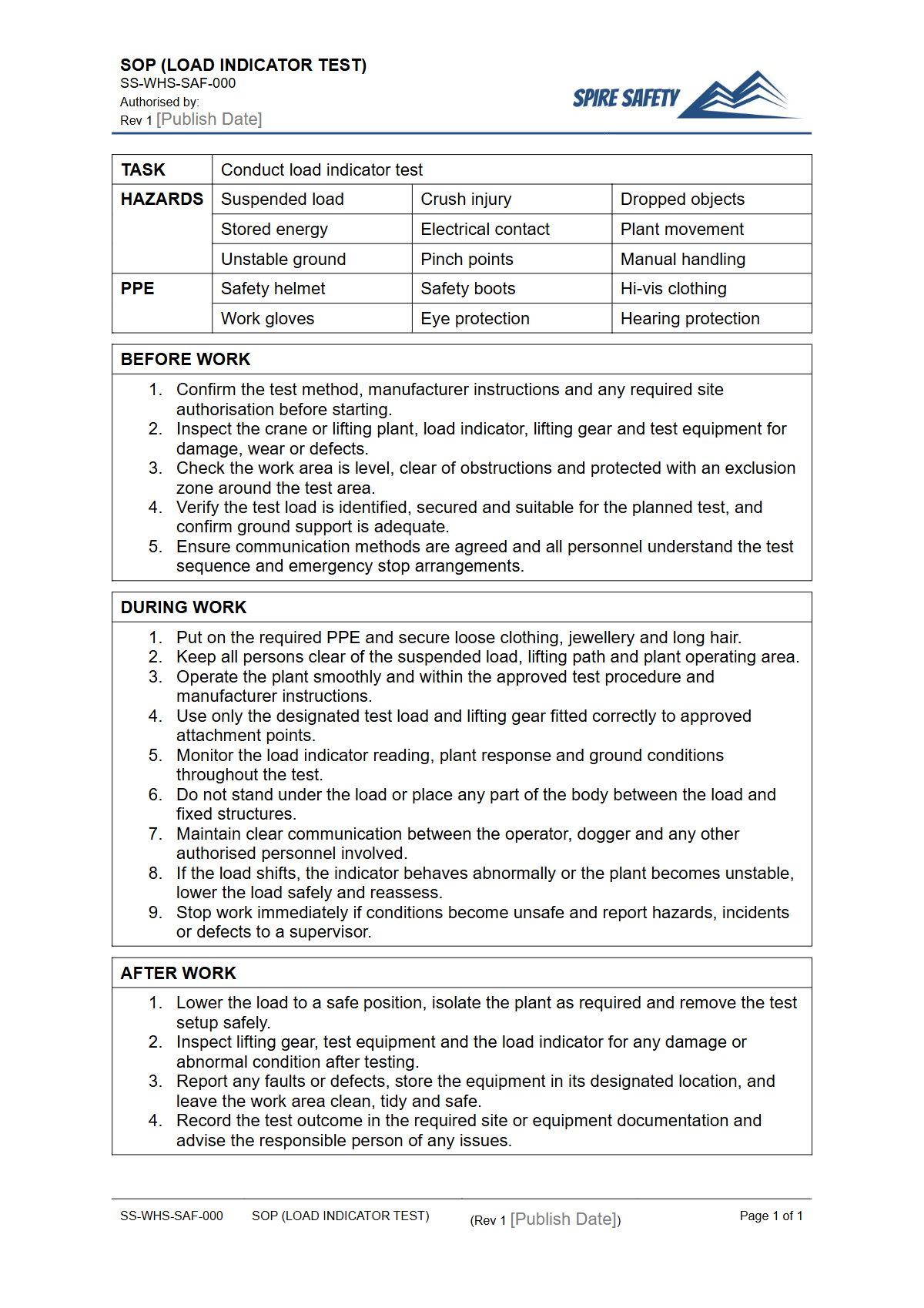
Purpose of the Free Safe Operating Procedure (Load Indicator Test) Template
This Free Safe Operating Procedure (Load Indicator Test) Template provides a structured framework for documenting the steps required to verify the functionality of load indicators on cranes and other lifting equipment. A properly functioning load indicator is a critical safety device that helps prevent overloading, a leading cause of catastrophic equipment failure and serious incidents.
Using a formal SOP ensures that tests are conducted consistently and correctly, creating a verifiable record of due diligence and promoting a safer work environment for everyone on site.
A clear SOP standardises the testing process, reducing the risk of human error and ensuring the equipment's safety systems are reliable. It forms a key part of the safe system of work for any lifting operation, similar to how a free Telehandler SOP template guides the safe use of that specific piece of plant.
Documenting this procedure helps meet duties under WHS legislation by actively managing the risks associated with high-risk plant.
Video walkthrough
How to use the Free Safe Operating Procedure (Load Indicator Test) Template
This template is designed as a starting point, aligned with Australian WHS principles. Download the DOCX or PDF and adapt it to the specific make and model of your equipment, your site conditions, and your organisation's internal procedures.
You must add details such as the specific plant involved, the required test weights, and the personnel authorised to perform the test. It is crucial to conduct a risk assessment to identify all relevant hazards before finalising the document.
Important: This is a template, not a finished document. We have provided a structured guide, but you must customise it to reflect the unique circumstances of your workplace.
Integrating this SOP into your broader safety framework is essential for it to be effective. A well-developed procedure is a cornerstone of robust WHS management systems that protect workers and the business.
Customisation Steps:
- Insert your company name, logo, and relevant site details.
- Specify the exact make and model of the crane or lifting equipment.
- Define the correct test weights and lifting radii to be used, as per manufacturer specifications.
- List the names or roles of workers deemed competent to conduct the test.
- Update the PPE section to reflect your site's specific requirements.
- Incorporate any additional steps or checks identified in your risk assessment.
- Ensure the procedure is reviewed and approved by a competent person before implementation.
When to use it
A load indicator test SOP should be used as part of a regular inspection and maintenance schedule. The test is typically required at several key intervals: before the first use of the equipment on-site (as part of pre-start checks), after any repairs or modifications to the lifting system or load indicator itself, periodically as specified by the manufacturer, and as part of any third-party inspection regime.
It's a proactive measure to verify safety-critical systems are operational before a load is ever lifted.
Documenting these checks provides a clear history of the equipment's compliance and safety status. For other types of heavy equipment, similar task-specific procedures are necessary; for example, a FREE Dozer SOP Template outlines safe operation for earthmoving tasks.
Consistent use of this SOP ensures that your lifting equipment remains fit for purpose and that any faults are identified and rectified before they can cause an incident.
Who should use it
This procedure is primarily for competent plant operators, crane crews, and qualified maintenance personnel responsible for inspecting and maintaining lifting equipment. Supervisors and safety managers should also use the document to verify that tests are being completed correctly and to ensure that records are properly maintained.
It serves as a vital training tool for new operators, clearly outlining the steps for a critical safety check.
Regularly reviewing procedures like this one is a key part of maintaining safety standards. A formal review process, which can be part of broader WHS compliance auditing, ensures your documented procedures stay current with legislative changes, manufacturer updates, and evolving site practices.
This helps maintain a cycle of continuous improvement in your safety management.
SOPs are not standalone documents; they should be integrated into your Safe Work Method Statements (SWMS) for high-risk construction work involving mobile cranes. This ensures that the verification of safety systems is formally considered and planned before work begins.
For other specialised tasks, a specific SOP like a FREE Plasma Cutter SOP Template provides similar targeted guidance, ensuring hazards are controlled at the source.
Developing and implementing robust safety procedures requires a systematic approach. If your organisation needs support in creating tailored SOPs or conducting the necessary risk assessments, seeking professional guidance from WHS consulting experts can help bridge any gaps in your internal capabilities.
This ensures your safety documentation is both practical and effective.
Building a comprehensive safety system involves creating a wide range of documents covering all plant, tasks, and hazards at your workplace. Explore our complete free WHS resources library to find more templates and guides that can help you strengthen your safety management framework.
Common mistakes
Common mistakes to avoid
- Relying solely on the indicator's reading without conducting visual inspections of the crane and rigging.
- Using incorrect or uncertified test weights, leading to an inaccurate calibration or test.
- Failing to properly document test results, faults found, and corrective actions taken.
- Neglecting to train operators on the specific warnings and limitations of the system on their machine.
Legal references
Legal considerations
The following legal requirements may be relevant to this type of work.
- Work Health and Safety Act (Harmonised) — Provides the primary duties for protecting workers and other people from work health and safety risks.
- Work Health and Safety Regulations (Harmonised) — Sets out requirements supporting the management of workplace hazards and risks.
The following codes may be relevant to this type of work.
- Managing WHS Risks Code of Practice — Provides practical guidance on identifying hazards, assessing risks and applying effective controls.
- Work Health and Safety Consultation, Cooperation and Coordination Code of Practice — Provides practical guidance on consulting workers and coordinating with other duty holders.
- Managing the Work Environment and Facilities Code of Practice — Provides practical guidance on safe work environments, workplace facilities and related controls.
Did you know
A Critical Safety Function
Modern Load Moment Indicators (LMIs) often have a 'function lock-out' capability. If the system detects a potential overload, it can automatically prevent control inputs that would worsen the situation, such as booming down or hoisting up.
Not Just for Cranes
Load indicating systems are not exclusive to large mobile or tower cranes. They are also critical safety components on telehandlers, some types of Elevated Work Platforms (EWPs), and vehicle loading cranes.
FAQ
Frequently asked questions
01What is a Rated Capacity Limiter (RCL) or Load Moment Indicator (LMI)?
02How often should load indicator tests be performed?
03Is this SOP template enough to ensure WHS compliance?
04Who is responsible for ensuring the load indicator test is done correctly?
Share this resource
Free Safe Operating Procedure (Load Indicator Test) Template
Browse Categories
How To Use It
- 1Download and open in Word or PDF.
- 2Replace the placeholders with your business details.
- 3Get it reviewed by a WHS specialist before rollout.
Need it customised?
Our WHS consultants can adapt this template to your site, run a gap analysis, or audit what you already have in place.
Book a Free Consultation WHS consulting servicesor call 1300 156 382
Related templates
- Free Safe Operating Procedure (Load Landing) Template
- Free Safe Operating Procedure (Load Manifest Check) Template
- Free Safe Operating Procedure (Load Test Setup) Template
- Free Safe Operating Procedure (Loading Bay Cleaning) Template
- Free Safe Operating Procedure (Loading Bay Inspection) Template
- Free Safe Operating Procedure (Loading Bridge Operation) Template