
Free Safe Operating Procedure (Loading Bay Inspection) Template
Download our free Safe Operating Procedure (Loading Bay Inspection) template.
Free Safe Operating Procedure (Loading Bay Inspection) Template
DOCX • 126 KB + PDF
Updated Oct 2026
No signup required
Purpose of the Free Safe Operating Procedure (Loading Bay Inspection) Template
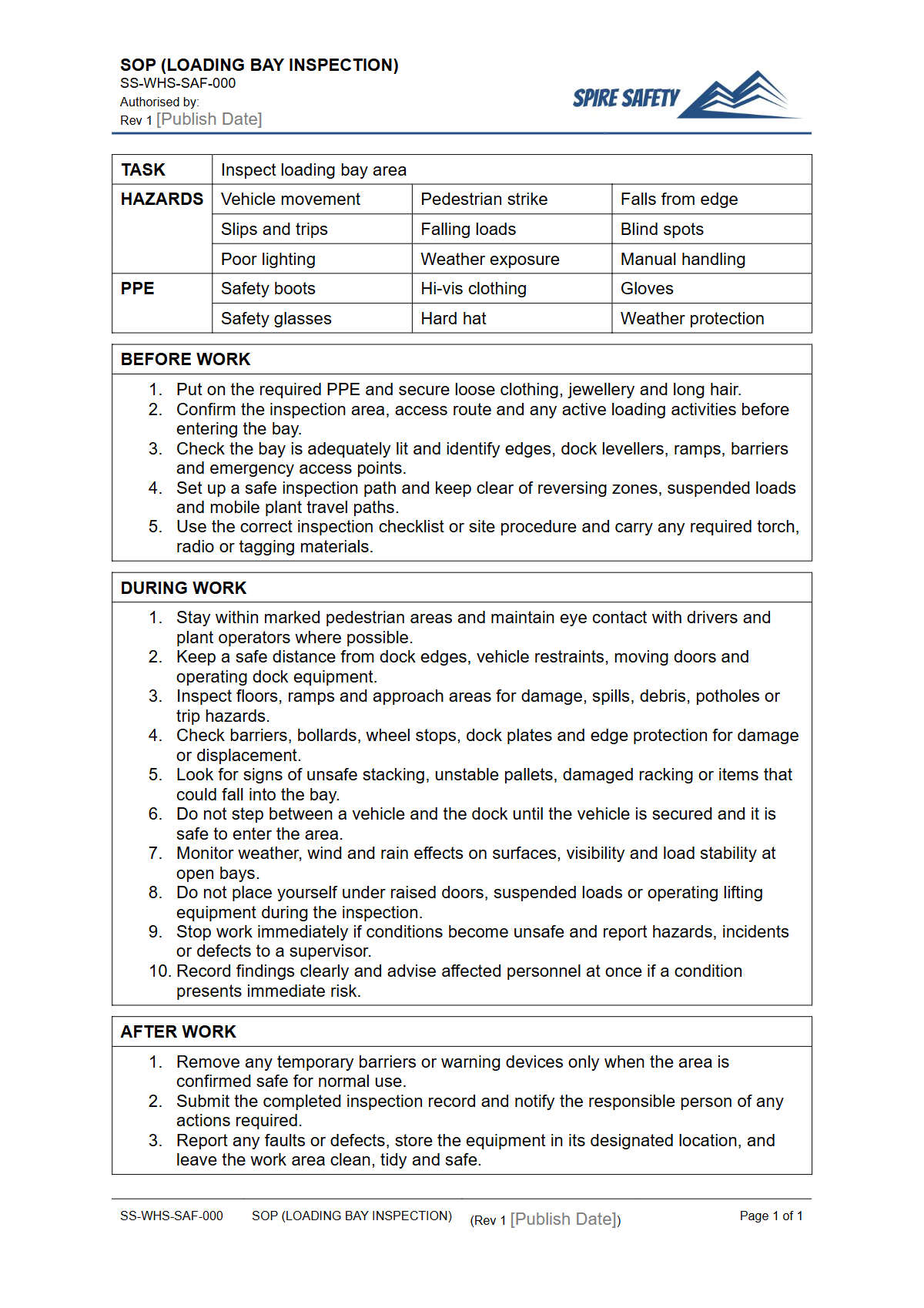
Loading bays are high-risk work environments, presenting hazards from vehicle movement, manual handling, falls from height, and shifting loads. This Free Safe Operating Procedure (Loading Bay Inspection) Template provides a structured starting point for documenting the required steps to conduct a thorough and regular inspection of your loading bay area.
A well-developed SOP is a critical tool for managing risks, ensuring consistent safety checks, and demonstrating your organisation's commitment to WHS obligations. It formalises the inspection process, helping to identify potential issues like damaged dock levellers, poor lighting, or inadequate traffic management before they lead to an incident.
Implementing a clear inspection procedure helps control common risks associated with loading bay operations. This includes managing the interaction between pedestrians and vehicles, ensuring equipment is fit for purpose, and maintaining a safe physical environment.
An effective SOP forms a key part of your overall safety management strategy, providing clarity for workers and supervisors on their responsibilities. For equipment often used in these areas, you may also need specific procedures, such as our FREE Telehandler SOP Template, to cover all operational risks.
Video walkthrough
How to use the Free Safe Operating Procedure (Loading Bay Inspection) Template
This resource is available as a fully editable DOCX file, allowing you to tailor it to your specific operational needs, and a PDF for easy printing and distribution. To get the most out of this template, download the Word document and integrate your site-specific details.
This includes the names of responsible personnel, exact models of equipment used, specific layout of your loading bay, and any unique environmental factors. A generic procedure is not enough; a site-specific SOP is essential for effective risk management.
Important: This is a template, not a finished document. To be effective, you must customise it for your workplace.
We have provided a structured framework, but it is your responsibility to ensure the content reflects your specific machinery, processes, and risk controls. We strongly recommend consultation with your workers during this customisation phase to capture valuable on-the-ground insights.
Developing comprehensive WHS management systems involves tailoring all documentation to the unique context of your business.
When to use it
A Loading Bay Inspection SOP should be a living document, used consistently as part of your daily, weekly, and monthly safety routines. It is most effective when integrated into your standard business operations.
Use this SOP to guide pre-start checks at the beginning of a shift, for more detailed weekly or monthly inspections, and as a reference tool during worker training and inductions. Following any incident, near miss, or change in the work environment—such as the introduction of new equipment or a change in layout—the SOP should be reviewed and updated to ensure it remains relevant and effective.
Regular reviews are also a core component of any internal or external WHS compliance auditing program.
Who should use it
This Safe Operating Procedure should be used by all personnel involved in or responsible for loading bay safety. This primarily includes:
- Warehouse and Logistics Managers: To establish and enforce safety standards.
- WHS/OHS Officers and Advisors: To develop, implement, and review safety procedures as part of the wider safety system.
- Supervisors: To conduct inspections, train workers, and monitor day-to-day compliance.
- Workers: To understand their responsibilities and follow the correct inspection steps to ensure their own safety and that of their colleagues.
Engaging all levels of your organisation in the use and ongoing improvement of the SOP fosters a stronger safety culture and collective ownership of workplace safety. It's also important to have procedures for other common tasks in the area, such as using ladders, for which our FREE Step Ladder SOP Template can be a useful guide.
In case of a medical emergency, having clear instructions is vital. Consider complementing your hazard-based SOPs with emergency response plans, like our Safe Operating Procedure for Defibrillator Operation, to ensure your team is prepared for any eventuality. You can find more templates like this in our complete free WHS resources library.
Common mistakes
Common mistakes to avoid
- Failing to customise the template with site-specific details, equipment, and personnel.
- Not providing adequate training to all relevant workers on the finalised SOP.
- Neglecting to review and update the SOP after an incident, a near miss, or a change in work practices.
- Poor implementation of traffic management, leading to dangerous interactions between pedestrians and vehicles.
Legal references
Legal considerations
The following legal requirements may be relevant to this type of work.
- Work Health and Safety Act (Harmonised) — Provides the primary duties for protecting workers and other people from work health and safety risks.
- Work Health and Safety Regulations (Harmonised) — Sets out requirements supporting the management of workplace hazards and risks.
The following codes may be relevant to this type of work.
- Managing WHS Risks Code of Practice — Provides practical guidance on identifying hazards, assessing risks and applying effective controls.
- Work Health and Safety Consultation, Cooperation and Coordination Code of Practice — Provides practical guidance on consulting workers and coordinating with other duty holders.
- Managing the Work Environment and Facilities Code of Practice — Provides practical guidance on safe work environments, workplace facilities and related controls.
Did you know
Loading Dock Dangers
According to Safe Work Australia, the transport, postal, and warehousing industry has one of the highest rates of serious injury claims, with incidents involving vehicles and falls from height being major contributors.
The 'Drive-Off' Hazard
A significant number of loading dock incidents occur when a truck driver unexpectedly pulls away while a forklift is still inside the trailer. This is why effective communication and vehicle restraint systems are critical components of loading bay safety.
FAQ
Frequently asked questions
01What should be included in a loading bay inspection SOP?
02How often should loading bay inspections be conducted?
03Who is responsible for enforcing a loading bay SOP?
04Is this loading bay inspection SOP template compliant with Australian WHS laws?
Share this resource
Free Safe Operating Procedure (Loading Bay Inspection) Template
Browse Categories
How To Use It
- 1Download and open in Word or PDF.
- 2Replace the placeholders with your business details.
- 3Get it reviewed by a WHS specialist before rollout.
Need it customised?
Our WHS consultants can adapt this template to your site, run a gap analysis, or audit what you already have in place.
Book a Free Consultation WHS consulting servicesor call 1300 156 382
Related templates
- Free Safe Operating Procedure (Loading Bridge Operation) Template
- Free Safe Operating Procedure (Loading Dock Gate) Template
- Free Safe Operating Procedure (Loading Dock Handover) Template
- Free Safe Operating Procedure (Loading Zone Control) Template
- Free Safe Operating Procedure (Lobby Floor Cleaning) Template
- Free Safe Operating Procedure (Lock and Key Control) Template