
Free Safe Operating Procedure (Loading Dock Gate) Template
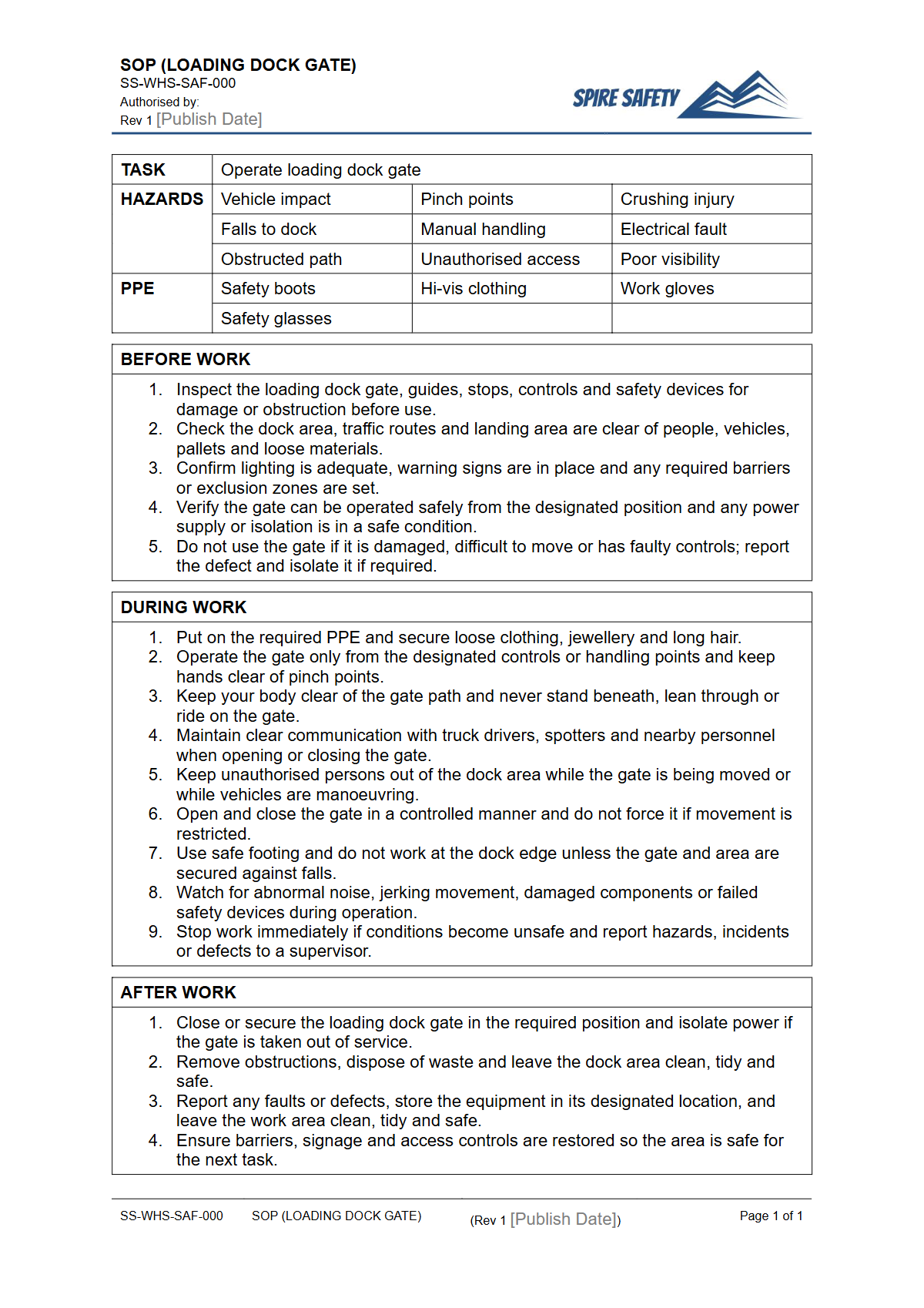
Download our free Safe Operating Procedure (Loading Dock Gate) template. This customisable DOCX & PDF provides a structured guide for safe operations.
Free Safe Operating Procedure (Loading Dock Gate) Template
DOCX • 126 KB + PDF
Updated Oct 2026
No signup required
Purpose of the Free Safe Operating Procedure (Loading Dock Gate) Template
Loading docks are high-risk environments where vehicles, machinery, and pedestrians converge. This free Safe Operating Procedure (Loading Dock Gate) template provides a structured framework for documenting the safe use of loading dock gates, which are critical control measures for preventing falls from height.
A well-drafted SOP is essential for managing the significant risks associated with loading and unloading activities, including falls, vehicle collisions, and crush injuries. By outlining clear, step-by-step instructions, you can standardise safe work practices, assist in worker training, and demonstrate a commitment to workplace safety.
This document serves as a starting point, designed to be adapted to your specific operational needs. It prompts you to consider hazards unique to your site, such as the type of gate (manual, powered, boom), the volume of traffic, and the interaction with other equipment.
Implementing a formal procedure helps ensure every team member understands their responsibilities, contributing to a safer, more organised workflow. A robust SOP is a fundamental component of effective WHS management systems, providing clarity and consistency for high-risk tasks.
What this Safe Operating Procedure covers:
- Pre-operational checks for the loading dock gate and surrounding area
- Step-by-step instructions for safe operation
- Procedures for vehicle approach, docking, and departure
- Emergency procedures and shutdown instructions
- Required Personal Protective Equipment (PPE)
Video walkthrough
How to use the Free Safe Operating Procedure (Loading Dock Gate) Template
Using this template is straightforward. Simply download the document in your preferred format (DOCX for easy editing or PDF) and begin adapting it to your workplace.
The key to an effective SOP is customisation. Generic procedures often fail to address site-specific hazards.
You must walk through the task at your location, consult with the workers who perform the job, and incorporate details about your specific loading dock gates, vehicle types, and workplace rules.
IMPORTANT: This document is a template only. It is not a complete or finished safety document.
You must customise it to reflect the specific hazards, risks, equipment, and control measures relevant to your workplace and operations. Consultation with your workers is required.
We assume no liability for the use or implementation of this document. For complex sites, engaging professional WHS consulting can help ensure all risks are adequately controlled.
When to Use a Safe Operating Procedure
A Safe Operating Procedure for a loading dock gate should be used consistently for all loading and unloading tasks involving that equipment. It is not a document to be filed away and forgotten.
It should be a live document, readily accessible to all relevant workers, including full-time staff, casuals, and contractors. Use it as a primary tool for training new employees, conducting refresher training for existing staff, and as a reference for supervisors monitoring work practices.
Furthermore, the SOP should be reviewed and updated regularly, especially after an incident or near-miss, or when new equipment or procedures are introduced. For example, if forklifts or other mobile plant are used, your SOPs should integrate with other procedures, such as a FREE Telehandler SOP Template.
Who Should Use It
This template is designed for use by individuals responsible for health and safety within an organisation. This includes WHS Managers, Safety Officers, Warehouse and Logistics Managers, and small business owners.
Supervisors should use the finalised SOP to guide their teams, enforce safe practices, and conduct toolbox talks. Workers who operate or work near loading dock gates are the end-users of the procedure and must be trained in its contents.
A comprehensive safety program may also include procedures for nearby safety equipment, such as our Safe Operating Procedure (Defibrillator Operation) template, to prepare for medical emergencies.
Ultimately, creating and implementing a robust SOP is a collaborative effort that should involve everyone from management to the workers on the floor. Regular reviews and feedback are essential for maintaining its relevance and effectiveness.
Conducting periodic checks of your safety systems, including documentation, is a key part of maintaining a safe workplace. This can be supported by a formal WHS compliance auditing process to identify any gaps.
You can find more templates and guides in our free WHS resources library to support your safety management system.
Common mistakes
Common mistakes to avoid
- Using a generic template without customising it for the specific workplace, gate type, and traffic flow.
- Failing to adequately train all relevant workers, including temporary staff and truck drivers, on the procedure.
- Neglecting to integrate the SOP with a broader traffic management plan for the site.
- Not reviewing or updating the SOP after an incident, near-miss, or change in operations.
Legal references
Legal considerations
The following legal requirements may be relevant to this type of work.
- Work Health and Safety Act (Harmonised) — Provides the primary duties for protecting workers and other people from work health and safety risks.
- Work Health and Safety Regulations (Harmonised) — Sets out requirements supporting the management of workplace hazards and risks.
The following codes may be relevant to this type of work.
- Managing WHS Risks Code of Practice — Provides practical guidance on identifying hazards, assessing risks and applying effective controls.
- Work Health and Safety Consultation, Cooperation and Coordination Code of Practice — Provides practical guidance on consulting workers and coordinating with other duty holders.
- Managing the Work Environment and Facilities Code of Practice — Provides practical guidance on safe work environments, workplace facilities and related controls.
Did you know
A Significant Fall Hazard
According to Safe Work Australia, falls from a height are a leading cause of workplace fatalities and serious injuries. A fall from a typical loading dock height of just 1.2 metres can result in severe or fatal injuries.
FAQ
Frequently asked questions
01What is a Safe Operating Procedure for a loading dock gate?
02Why is a specific SOP needed for a loading dock gate?
03Who is responsible for creating and enforcing the loading dock gate SOP?
04How often should a loading dock gate SOP be reviewed?
Share this resource
Free Safe Operating Procedure (Loading Dock Gate) Template
Browse Categories
How To Use It
- 1Download and open in Word or PDF.
- 2Replace the placeholders with your business details.
- 3Get it reviewed by a WHS specialist before rollout.
Need it customised?
Our WHS consultants can adapt this template to your site, run a gap analysis, or audit what you already have in place.
Book a Free Consultation WHS consulting servicesor call 1300 156 382
Related templates
- Free Safe Operating Procedure (Loading Dock Handover) Template
- Free Safe Operating Procedure (Loading Zone Control) Template
- Free Safe Operating Procedure (Lobby Floor Cleaning) Template
- Free Safe Operating Procedure (Lock and Key Control) Template
- Free Safe Operating Procedure (Locker Room Cleaning) Template
- Free Safe Operating Procedure (Lockformer Machine) Template