
Free Safe Operating Procedure (Lockformer Machine) Template
Download our free Safe Operating Procedure (Lockformer Machine) template. This customisable DOCX & PDF helps manage risks for sheet metal work.
Free Safe Operating Procedure (Lockformer Machine) Template
DOCX • 126 KB + PDF
Updated Oct 2026
No signup required
Purpose of the Free Safe Operating Procedure (Lockformer Machine) Template
Operating a lockformer machine presents significant risks, including entanglement, cuts, and crushing injuries. This Free Safe Operating Procedure (Lockformer Machine) Template provides a structured framework for documenting the safest way to perform tasks using this equipment.
It is designed to help your organisation control hazards and establish clear, repeatable steps for workers to follow, forming a critical component of your overall safety management system.
A well-drafted Safe Operating Procedure (SOP) is more than just a document; it's a vital training tool and a reference point for competent operators. By formally outlining pre-operational checks, step-by-step instructions, and emergency responses, you create a safer working environment.
This template, aligned with Australian WHS principles, helps businesses meet their primary duty of care. Integrating clear procedures like this one is a fundamental part of building robust WHS management systems that protect workers and ensure operational consistency.
Video walkthrough
How to use the Free Safe Operating Procedure (Lockformer Machine) Template
This resource is available as a fully editable DOCX file and a print-ready PDF. After downloading, you can immediately begin adapting it to your specific operational context.
It guides you through identifying hazards, defining controls, and listing required Personal Protective Equipment (PPE).
Important: This template is a starting point. To be effective, you must customise it to reflect the specific model of lockformer, materials used, and unique environmental conditions of your workshop.
We strongly advise you to conduct a site-specific risk assessment and consult with the machine operators and supervisors who will be using the procedure. Their hands-on experience is invaluable for creating a practical and effective document. You may also need procedures for similar fabrication equipment, such as our FREE Plasma Cutter SOP (Safe Operating Procedure) Template.
When to use a Lockformer Machine SOP
A Safe Operating Procedure for a lockformer should be a living document, used consistently throughout your operations. Its primary uses include:
- Worker Training and Induction: Use the SOP as the foundation for training new operators and verifying their competency before they are authorised to use the machine unsupervised.
- Refresher Training: Revisit the SOP during regular safety meetings or toolbox talks to reinforce safe work practices and address any complacency.
- Pre-start and Operational Checks: The procedure serves as a daily checklist for operators to ensure the machine is safe to use before commencing work.
- Incident Investigation: Following a near miss or incident, the SOP should be reviewed to determine if the procedure was followed and if it needs to be updated to prevent a recurrence.
- Audits and Reviews: This document is a key piece of evidence during internal or external safety audits. Regular WHS compliance auditing helps confirm that documented procedures are being implemented correctly on the workshop floor.
Who should use this SOP
This template is designed for a variety of roles within a business that uses sheet metal fabrication equipment:
- Persons Conducting a Business or Undertaking (PCBUs): Business owners can use this template to fulfil their duty of care to provide safe systems of work.
- WHS Managers and Safety Advisors: Safety professionals can use this as a robust starting point to standardise procedures across the workshop, ensuring a consistent approach to machine safety.
- Workshop Managers and Supervisors: Those directly responsible for overseeing operations can use the SOP to train staff, monitor performance, and enforce safety standards on the floor. While this SOP covers lockformers, you may also need procedures for other workshop equipment, like our Free Air Compressor SOP Template.
- Operators: The final document should be readily accessible to all workers who operate the lockformer, serving as a constant reference for safe operation.
What's in the Safe Operating Procedure Template?
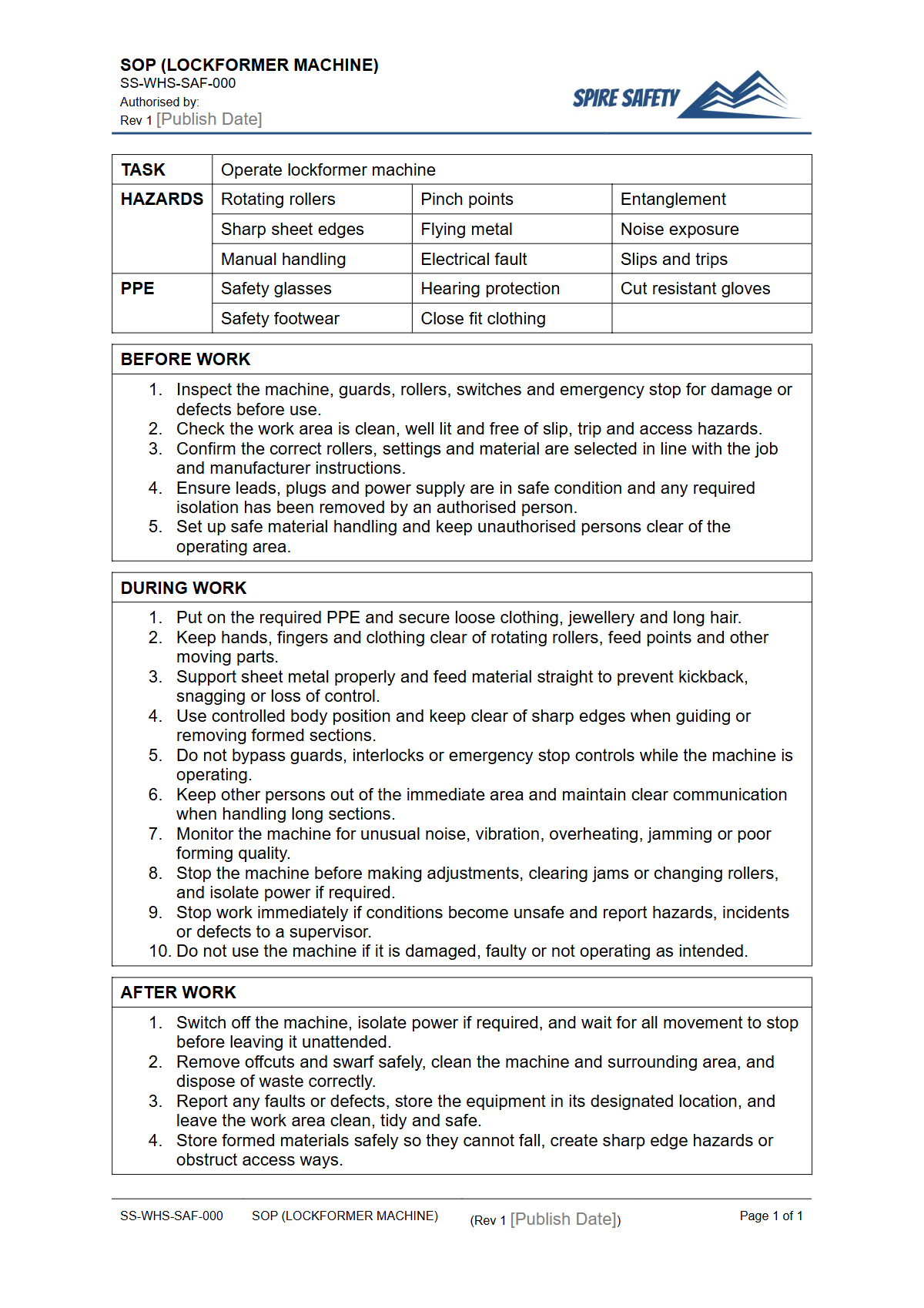
Our template is logically structured to be clear and easy to follow. Key sections include:
- Details of the plant/equipment
- Required Personal Protective Equipment (PPE)
- A checklist for pre-operational safety checks
- Step-by-step instructions for operating the lockformer safely
- Procedures for shutting down, cleaning, and maintenance
- Emergency stop and first aid instructions
- A section for worker sign-off and review scheduling
This structured format can be easily adapted for other machinery in your workshop, similar to our FREE Circular Saw SOP (Safe Operating Procedure) Template. For more documentation to support your safety system, explore our entire free WHS resources library.
Common mistakes
Common mistakes to avoid
- Wearing gloves, which can be caught in the rollers and pull the operator's hand into the machine.
- Attempting to clear a metal jam without first isolating the machine from all energy sources (lockout/tagout).
- Operating the machine with guards removed or disabled.
- Failing to keep the work area clear of offcuts and debris, creating trip hazards around the machine.
Legal references
Legal considerations
The following legal requirements may be relevant to this type of work.
- Work Health and Safety Act (Harmonised) — Provides the primary duties for protecting workers and other people from work health and safety risks.
- Work Health and Safety Regulations (Harmonised) — Sets out requirements supporting the management of workplace hazards and risks.
The following codes may be relevant to this type of work.
- Managing WHS Risks Code of Practice — Provides practical guidance on identifying hazards, assessing risks and applying effective controls.
- Work Health and Safety Consultation, Cooperation and Coordination Code of Practice — Provides practical guidance on consulting workers and coordinating with other duty holders.
- Managing the Work Environment and Facilities Code of Practice — Provides practical guidance on safe work environments, workplace facilities and related controls.
Did you know
The Pittsburgh Lock
The 'Pittsburgh lock' seam, one of the most common profiles created by lockformers, was invented in the late 19th century. Its invention revolutionised the production of metal ductwork, making it faster, stronger, and more consistent than previous hand-forming methods.
Machine Guarding
According to Safe Work Australia, machinery and equipment are consistently one of the leading causes of workplace injury. Inadequate machine guarding is a primary factor in many of these preventable incidents, highlighting the need for robust procedures and checks.
FAQ
Frequently asked questions
01What is a lockformer machine?
02Why is a Safe Operating Procedure critical for a lockformer?
03Is this lockformer SOP template suitable for any brand or model?
04What PPE is typically required when using a lockformer?
Share this resource
Free Safe Operating Procedure (Lockformer Machine) Template
Browse Categories
How To Use It
- 1Download and open in Word or PDF.
- 2Replace the placeholders with your business details.
- 3Get it reviewed by a WHS specialist before rollout.
Need it customised?
Our WHS consultants can adapt this template to your site, run a gap analysis, or audit what you already have in place.
Book a Free Consultation WHS consulting servicesor call 1300 156 382
Related templates
- Free Safe Operating Procedure (Lockout Tagout) Template
- Free Safe Operating Procedure (Log Grapple) Template
- Free Safe Operating Procedure (Log Loader) Template
- Free Safe Operating Procedure (Log Loading) Template
- Free Safe Operating Procedure (Log Splitter) Template
- Free Safe Operating Procedure (Log Trailer) Template