
Free Safe Operating Procedure (Lockout Tagout) Template
Download our free Safe Operating Procedure (Lockout Tagout) template.
Free Safe Operating Procedure (Lockout Tagout) Template
DOCX • 126 KB + PDF
Updated Oct 2026
No signup required
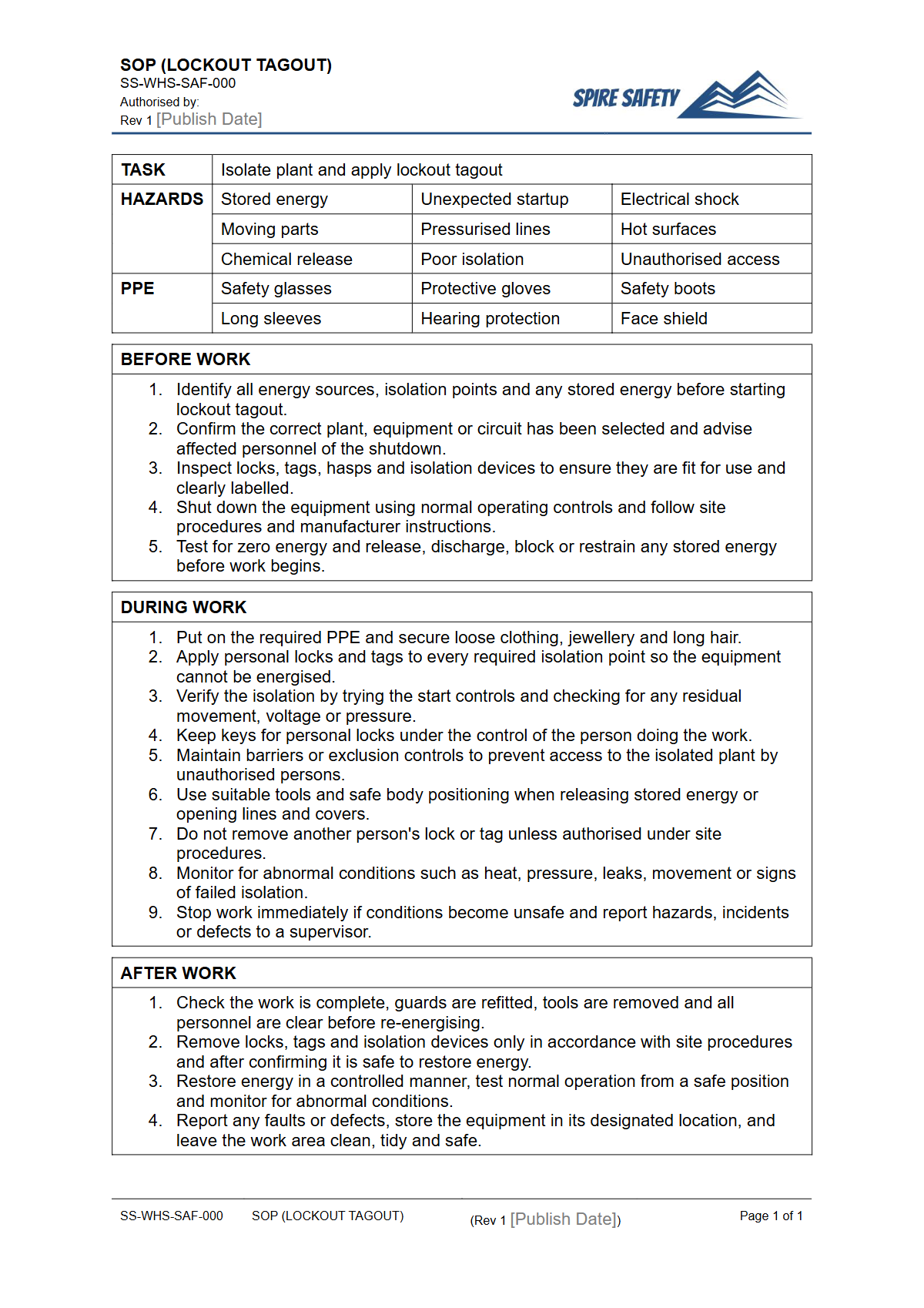
Purpose of the Free Safe Operating Procedure (Lockout Tagout) Template
Effectively managing hazardous energy is a critical part of workplace safety, especially during maintenance, servicing, or cleaning of machinery and equipment. This Free Safe Operating Procedure (Lockout Tagout) Template provides a structured framework for documenting the specific steps required to isolate and de-energise equipment, preventing its unexpected start-up.
The goal is to protect workers from injuries caused by the uncontrolled release of energy, whether it be electrical, mechanical, hydraulic, pneumatic, or other forms. Using a formal SOP ensures that isolation processes are performed consistently and correctly every time.
A documented lockout-tagout (LOTO) procedure forms an essential component of your overall safety framework. It serves as a clear guide for workers and a training tool for new personnel, demonstrating your organisation's commitment to proactive risk management.
Integrating such procedures is a key element in developing robust WHS management systems that are aligned with Australian WHS principles and protect your team from harm.
Video walkthrough
How to use the Free Safe Operating Procedure (Lockout Tagout) Template
This downloadable document provides a solid starting point, but it must be adapted to your specific operational context. Download the DOCX file and begin by filling in the details for a particular piece of plant or equipment in your workplace.
Identify all energy sources, the exact steps for isolation, the devices to be used (e.g., specific padlocks, hasps, valve covers), and the procedure for verifying that a zero energy state has been achieved. The process for specific equipment like a plasma cutter, for instance, will have unique isolation points, which you can document using our free plasma cutter SOP as a guide for machine-specific detail.
Important: This is a template, not a finished document. We must stress that you have a duty to customise this Safe Operating Procedure to reflect the unique hazards, equipment, and control measures present in your workplace.
You must consult with your workers and other relevant stakeholders during this process to ensure the procedure is practical, understood, and effective. The final SOP should be a clear, unambiguous guide for safely performing lockout-tagout on your site.
When to use a Lockout Tagout Safe Operating Procedure
A LOTO procedure should be implemented whenever a worker is required to place any part of their body into a position where they could be injured by the unexpected start-up of machinery or the release of stored energy. This is not limited to major repairs; it applies to a wide range of activities.
Common scenarios requiring a LOTO SOP include:
- Servicing and Maintenance: Tasks like lubricating, cleaning, or replacing parts.
- Repairs and Adjustments: Any work that requires bypassing or removing guards or other safety devices.
- Clearing Jams or Blockages: Where machinery needs to be accessed to clear materials.
- Inspections: When an inspection requires close proximity to potentially hazardous moving parts.
These procedures are fundamental to preventing serious incidents and are often a key focus area during WHS compliance auditing activities. For equipment-specific examples, a procedure like our air compressor SOP template details maintenance tasks where isolation would be mandatory.
Who should use this Safe Operating Procedure
This Safe Operating Procedure is intended for all personnel involved in the lifecycle of maintaining and operating machinery. This includes:
- Authorised Workers: Trained and competent individuals responsible for performing the servicing or maintenance and applying the lockout devices.
- Affected Workers: Operators or other personnel whose work is affected by the isolation of the equipment. They must be notified before and after the LOTO procedure is performed.
- WHS Managers and Supervisors: Those responsible for developing, implementing, and overseeing the lockout-tagout program, as well as providing training and verifying competency.
Proper training is essential. Workers must understand the purpose of the procedure, recognise hazardous energy sources, and know the specific steps for isolation and re-energisation. It's one of many procedures, like the SOP for defibrillator operation, that requires specific training and authorisation to ensure it is used correctly and safely. You can find more templates to support your operational safety in our free WHS resources library.
Common mistakes
Common mistakes to avoid
- Assuming turning off a switch is sufficient without verifying the absence of energy.
- Failing to account for and dissipate stored energy (e.g., in capacitors, springs, or hydraulic systems).
- Using tags alone as a control measure when a physical lockout device could have been used.
- Poor communication during shift handovers, leading to premature or unsafe re-energisation of equipment.
Legal references
Legal considerations
The following legal requirements may be relevant to this type of work.
- Work Health and Safety Act (Harmonised) — Provides the primary duties for protecting workers and other people from work health and safety risks.
- Work Health and Safety Regulations (Harmonised) — Sets out requirements supporting the management of workplace hazards and risks.
The following codes may be relevant to this type of work.
- Managing WHS Risks Code of Practice — Provides practical guidance on identifying hazards, assessing risks and applying effective controls.
- Work Health and Safety Consultation, Cooperation and Coordination Code of Practice — Provides practical guidance on consulting workers and coordinating with other duty holders.
- Managing the Work Environment and Facilities Code of Practice — Provides practical guidance on safe work environments, workplace facilities and related controls.
Did you know
Zero Energy State
The ultimate goal of any lockout-tagout procedure is to achieve a 'zero energy state' before work begins. This means all sources of hazardous energy have been isolated, blocked, or safely dissipated.
The 'Fatal Five'
In many heavy industries, 'uncontrolled release of energy' is considered one of the 'Fatal Five' high-potential hazards. This highlights the critical importance of having effective isolation procedures in place.
FAQ
Frequently asked questions
01What is the difference between lockout and tagout?
02Does this template cover all types of hazardous energy?
03Who is authorised to remove a lockout or tagout device?
04Is a lockout-tagout procedure a legal requirement in Australia?
Share this resource
Free Safe Operating Procedure (Lockout Tagout) Template
Browse Categories
How To Use It
- 1Download and open in Word or PDF.
- 2Replace the placeholders with your business details.
- 3Get it reviewed by a WHS specialist before rollout.
Need it customised?
Our WHS consultants can adapt this template to your site, run a gap analysis, or audit what you already have in place.
Book a Free Consultation WHS consulting servicesor call 1300 156 382
Related templates
- Free Safe Operating Procedure (Log Grapple) Template
- Free Safe Operating Procedure (Log Loader) Template
- Free Safe Operating Procedure (Log Loading) Template
- Free Safe Operating Procedure (Log Splitter) Template
- Free Safe Operating Procedure (Log Trailer) Template
- Free Safe Operating Procedure (Log Unloading) Template