
Free Safe Operating Procedure (Log Unloading) Template
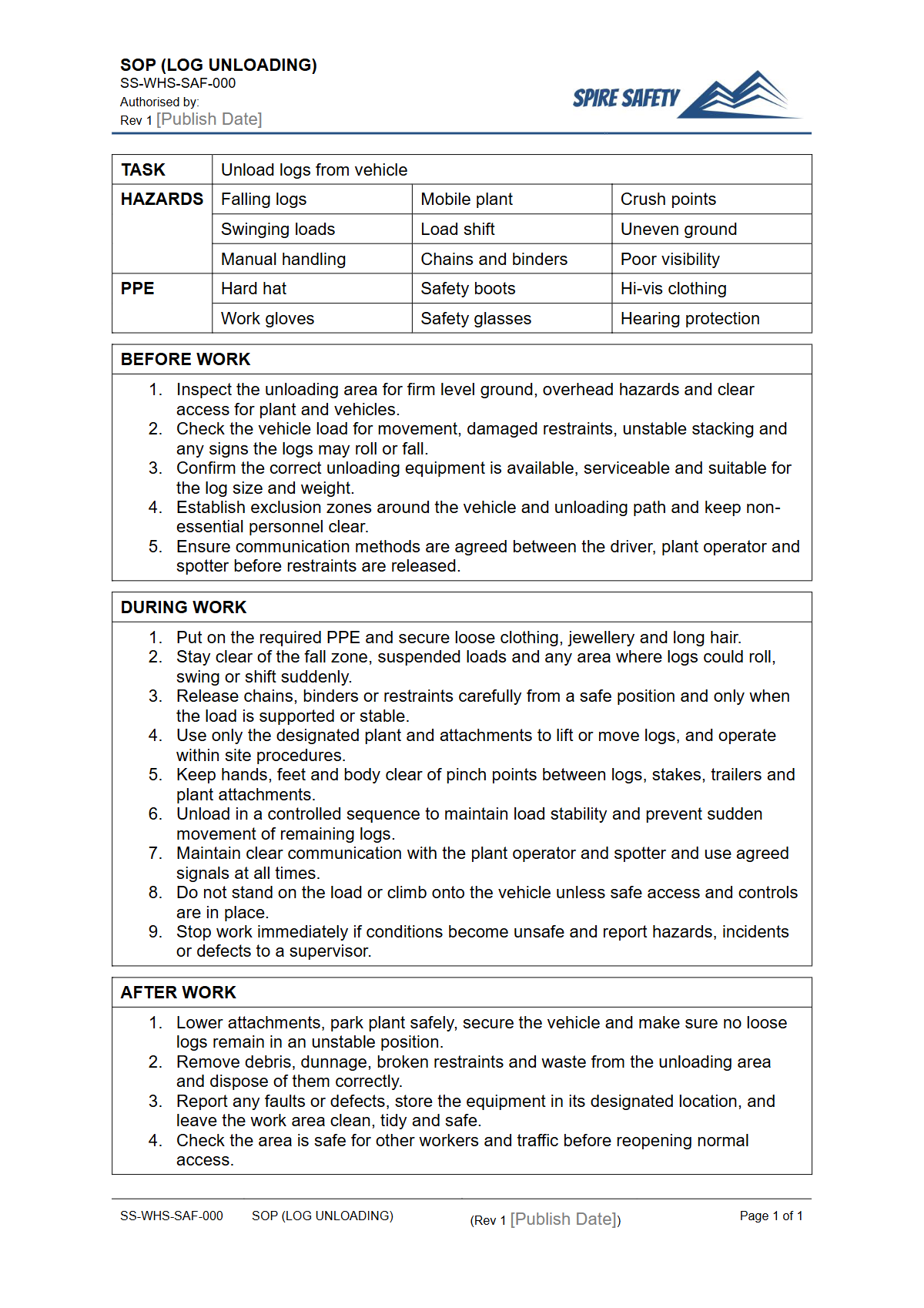
Download our Free Safe Operating Procedure (Log Unloading) Template. This customisable DOCX & PDF resource helps define safe work steps for log unloading.
Free Safe Operating Procedure (Log Unloading) Template
DOCX • 126 KB + PDF
Updated Oct 2026
No signup required
Purpose of the Free Safe Operating Procedure (Log Unloading) Template
Effectively managing the risks associated with unloading logs is critical in industries like forestry, transport, and timber processing. This Free Safe Operating Procedure (Log Unloading) Template provides a structured starting point for documenting the step-by-step process required to perform this high-risk task safely.
The goal of a Safe Operating Procedure (SOP) is to minimise the risk of incidents, such as workers being struck by falling logs, caught between vehicles, or injured by machinery. By clearly defining control measures, pre-start checks, communication protocols, and emergency responses, this template helps organisations fulfil their duty of care under Australian WHS regulations.
A comprehensive SOP is a key administrative control that supports other risk management strategies. It standardises the unloading process, ensuring every worker follows the same approved, safe method every time.
This consistency is vital for tasks involving heavy vehicles and powerful lifting equipment. For example, if your site uses specific machinery for this task, you might supplement this procedure with a machine-specific guide, such as our FREE Telehandler SOP Template, to cover detailed operational checks.
Video walkthrough
How to use the Free Safe Operating Procedure (Log Unloading) Template
This resource is available as a fully editable DOCX file and a ready-to-print PDF. To get the most value, you should download the DOCX version and adapt it to the specific context of your workplace.
A generic procedure is not sufficient for compliance or safety; it must reflect your unique site conditions, machinery, load types, and personnel. The document includes sections for you to detail site-specific hazards, control measures, required Personal Protective Equipment (PPE), and operator competencies.
Important: This is a template only. We have provided a comprehensive framework, but you must customise this Safe Operating Procedure with your own site-specific details.
You are responsible for ensuring the final document is accurate, reflects your operational risks, and is understood by your workers. Integrating this procedure into your broader WHS management systems ensures it is properly implemented, reviewed, and maintained as part of your overall safety framework.
When to use a Log Unloading SOP
A specific SOP for log unloading should be developed and implemented wherever this task occurs. This is particularly crucial in environments such as sawmills, timber yards, transport depots, port facilities, and land-clearing or forestry operations.
It should be used as the primary reference document for training new operators and as a refresher for experienced workers. It also serves as a benchmark for workplace inspections and safety observations, allowing supervisors to confirm that the agreed-upon safe work method is being followed consistently.
In dynamic environments like construction or forestry sites, where ground conditions can change, the SOP provides a stable set of rules. For instance, the procedure should specify requirements for level, stable ground at the unloading area, a task that might involve equipment detailed in a resource like our FREE Dozer SOP Template for site preparation.
Who should use this Safe Operating Procedure
This SOP is intended for several key roles within an organisation:
- Plant Operators and Truck Drivers: The primary users who must follow the procedure to unload logs safely.
- Supervisors and Team Leaders: Responsible for ensuring workers are trained on the SOP and adhere to it during operations. They use it as a tool for instruction, monitoring, and enforcement.
- WHS Managers and Advisors: Responsible for developing, reviewing, and updating the SOP as part of the site's overall safety system. They ensure it aligns with risk assessments and legislative requirements.
- Site or Operations Managers: Accountable for providing the resources (e.g., safe equipment, time, training) necessary to implement the procedure effectively.
Regular verification is key to ensuring procedures remain effective and are being followed correctly on the ground. A formal process like WHS compliance auditing can help identify gaps between documented procedures and actual work practices, providing valuable feedback for continuous improvement.
Key elements of a robust Log Unloading SOP
Beyond the basic steps, a strong procedure should incorporate several critical safety elements. This includes establishing clearly marked exclusion zones (or 'no-go zones') to keep pedestrians and other personnel away from the active unloading area.
It should also mandate pre-start inspections of all lifting equipment, chains, slings, and vehicle load restraints. Communication is another vital component, requiring confirmed signals between the truck driver and the plant operator before any restraining devices are released or logs are lifted.
Documenting these fine details transforms a basic checklist into a powerful tool for preventing incidents. You can find more examples of task-specific procedures in our free WHS resources library, which covers a wide range of plant and equipment.
Common mistakes
Common mistakes to avoid
- Using a generic template without customising it for specific site conditions and equipment.
- Failing to establish and enforce clearly defined exclusion zones for all personnel not directly involved in the unloading.
- Inadequate inspection of vehicle restraints, chains, slings, and other lifting gear before use.
- Poor communication between the truck driver and the machinery operator, especially regarding the release of load binders.
Legal references
Legal considerations
The following legal requirements may be relevant to this type of work.
- Work Health and Safety Act (Harmonised) — Provides the primary duties for protecting workers and other people from work health and safety risks.
- Work Health and Safety Regulations (Harmonised) — Sets out requirements supporting the management of workplace hazards and risks.
The following codes may be relevant to this type of work.
- Managing WHS Risks Code of Practice — Provides practical guidance on identifying hazards, assessing risks and applying effective controls.
- Work Health and Safety Consultation, Cooperation and Coordination Code of Practice — Provides practical guidance on consulting workers and coordinating with other duty holders.
- Managing the Work Environment and Facilities Code of Practice — Provides practical guidance on safe work environments, workplace facilities and related controls.
Did you know
Stored Energy
A single hardwood log can weigh several tonnes. The potential energy stored in a stacked load of logs is immense, and its uncontrolled release is a primary cause of fatalities in the forestry and transport industries.
Exclusion Zones
According to Safe Work Australia, the most effective way to protect workers on the ground during lifting operations is to enforce strict exclusion zones. The size of the zone should be based on a risk assessment that considers how far a load could fall or deflect.
FAQ
Frequently asked questions
01What are the main hazards involved in unloading logs?
02Does a Safe Operating Procedure for log unloading replace a risk assessment?
03Who is responsible for creating a log unloading SOP?
04How often should an SOP for log unloading be reviewed?
Share this resource
Free Safe Operating Procedure (Log Unloading) Template
Browse Categories
How To Use It
- 1Download and open in Word or PDF.
- 2Replace the placeholders with your business details.
- 3Get it reviewed by a WHS specialist before rollout.
Need it customised?
Our WHS consultants can adapt this template to your site, run a gap analysis, or audit what you already have in place.
Book a Free Consultation WHS consulting servicesor call 1300 156 382
Related templates
- Free Safe Operating Procedure (Loop Impedance Test) Template
- Free Safe Operating Procedure (Lounge Chair Cleaning) Template
- Free Safe Operating Procedure (Louvre Cleaning) Template
- Free Safe Operating Procedure (LPG Cylinder Filling) Template
- Free Safe Operating Procedure (Lubricant Dispensing) Template
- Free Safe Operating Procedure (Luggage Cart Handling) Template