
Free Safe Operating Procedure (Loop Impedance Test) Template
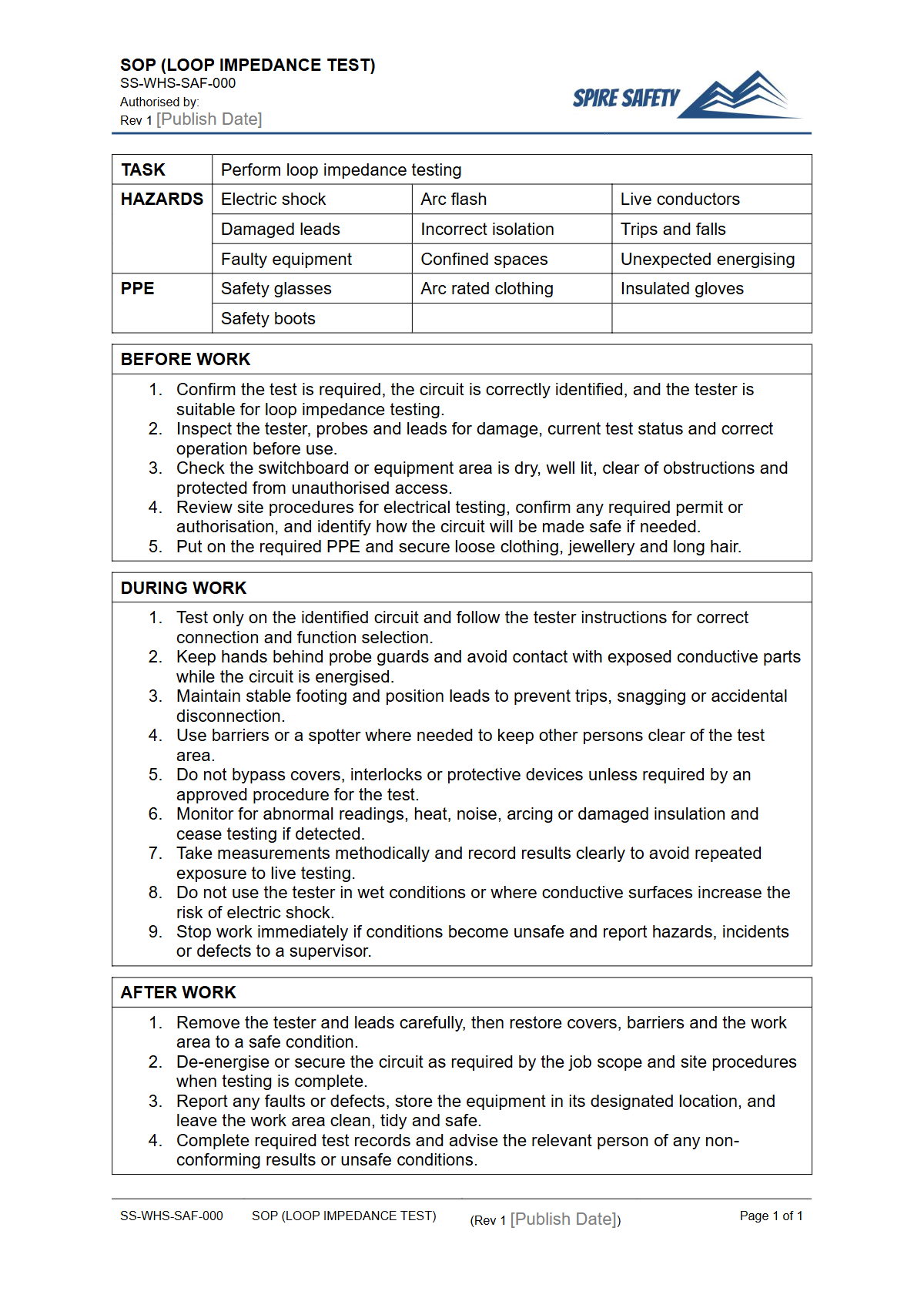
Download our free Safe Operating Procedure (Loop Impedance Test) Template. This customisable DOCX and PDF helps define safe work steps for electrical testing.
Free Safe Operating Procedure (Loop Impedance Test) Template
DOCX • 126 KB + PDF
Updated Oct 2026
No signup required
Purpose of the Free Safe Operating Procedure (Loop Impedance Test) Template
This downloadable Safe Operating Procedure (Loop Impedance Test) Template provides a structured framework for electricians and competent persons to perform this critical electrical safety test safely and consistently. An earth fault loop impedance test verifies that if a fault occurs, the protective device (like a circuit breaker or fuse) will disconnect the electricity supply fast enough to prevent harm.
Our free template, available in DOCX for easy editing and PDF for straightforward printing, helps organisations document the required steps, hazards, and controls for this high-risk task.
The primary purpose of this Free Safe Operating Procedure (Loop Impedance Test) Template is to manage the significant risks associated with electrical testing. By standardising the procedure, you ensure that every test is conducted with the same high level of safety awareness.
It formalises pre-start checks, the testing sequence, and result interpretation, minimising the risk of electric shock, arc flash, or equipment damage. A documented SOP is a key component in demonstrating due diligence and forms an essential part of broader, comprehensive WHS management systems that protect workers and ensure operational integrity.
Video walkthrough
How to use the Free Safe Operating Procedure (Loop Impedance Test) Template
To use this template, simply download the DOCX file and open it in your preferred word processor. The document is structured with clear headings for you to fill in details specific to your workplace.
This includes the exact models of test equipment used, specific site hazards, and the names or roles of responsible personnel.
Important Note: This document is a template and must be customised to your specific workplace, equipment, and local WHS regulations. We recommend a competent person reviews and approves the final document before implementation.
Integrating this SOP with other electrical safety documents, such as a defibrillator operation SOP, creates a more robust electrical safety program.
What a Good SOP Includes
A comprehensive SOP for loop impedance testing should go beyond a simple checklist. Our template prompts you to consider several critical elements to create a truly effective safety document.
This includes identifying potential hazards like live conductors, incorrect connections, and environmental factors. It also guides you in outlining specific risk control measures, such as the use of personal protective equipment (PPE), de-energisation and lockout/tagout procedures where applicable, and ensuring a safe work area.
The procedure itself should be a clear, step-by-step guide from initial equipment inspection to the final recording of results. A section on emergency procedures, detailing responses to electric shock or equipment failure, is also essential.
For businesses needing assistance in developing such detailed procedures, our WHS consulting services can provide expert guidance.
When to use this Safe Operating Procedure
This Safe Operating Procedure should be used whenever an earth fault loop impedance test is required. According to Australian standards and best practice, this typically occurs at several key points.
It is mandatory for new electrical installations to verify they meet the standards outlined in AS/NZS 3000. It is also required after any alteration or addition to an existing circuit that could affect the fault loop.
Furthermore, periodic testing is crucial for ongoing safety verification, with the frequency determined by the nature of the workplace and legislative requirements. These procedures are often reviewed as part of regular WHS compliance auditing schedules to ensure they remain current and effective.
Who should use this SOP
This SOP is intended for use only by competent and authorised personnel. In Australia, this means a licensed electrician or a person who has received the necessary training and has been deemed competent by their employer to perform this specific task.
The user must be proficient in using the loop impedance tester, understand how to interpret the results against the Wiring Rules, and be fully aware of the electrical hazards involved. This procedure is not for untrained individuals or apprentices working without direct supervision.
Having documented procedures for all high-risk tasks, from electrical testing to using powered equipment as detailed in our free circular saw SOP, is a hallmark of a mature safety culture.
Common mistakes
Common mistakes to avoid
- Using uncalibrated, damaged, or incorrect testing equipment for the job.
- Failing to verify the tester is functioning correctly before use (e.g., against a known source).
- Misinterpreting test results or comparing them against outdated standards.
- Not properly customising a generic SOP to account for site-specific hazards and equipment.
Legal references
Legal considerations
The following legal requirements may be relevant to this type of work.
- Work Health and Safety Act (Harmonised) — Provides the primary duties for protecting workers and other people from work health and safety risks.
- Work Health and Safety Regulations (Harmonised) — Sets out requirements supporting the management of workplace hazards and risks.
The following codes may be relevant to this type of work.
- Managing WHS Risks Code of Practice — Provides practical guidance on identifying hazards, assessing risks and applying effective controls.
- Work Health and Safety Consultation, Cooperation and Coordination Code of Practice — Provides practical guidance on consulting workers and coordinating with other duty holders.
- Managing the Work Environment and Facilities Code of Practice — Provides practical guidance on safe work environments, workplace facilities and related controls.
Did you know
The Wiring Rules
The maximum allowable loop impedance values are specified in AS/NZS 3000, also known as the Australian/New Zealand Wiring Rules. The test result must be lower than this value for the installation to be considered safe.
Calibration is Key
Loop impedance testers must be regularly calibrated according to the manufacturer's specifications. Using an uncalibrated instrument can lead to inaccurate readings, creating a false sense of security and potentially non-compliant work.
FAQ
Frequently asked questions
01What is an earth fault loop impedance test?
02Why is a Safe Operating Procedure necessary for loop impedance testing?
03Who is considered a competent person to perform a loop impedance test?
04How often should loop impedance testing be performed in Australia?
Share this resource
Free Safe Operating Procedure (Loop Impedance Test) Template
Browse Categories
How To Use It
- 1Download and open in Word or PDF.
- 2Replace the placeholders with your business details.
- 3Get it reviewed by a WHS specialist before rollout.
Need it customised?
Our WHS consultants can adapt this template to your site, run a gap analysis, or audit what you already have in place.
Book a Free Consultation WHS consulting servicesor call 1300 156 382
Related templates
- Free Safe Operating Procedure (Lounge Chair Cleaning) Template
- Free Safe Operating Procedure (Louvre Cleaning) Template
- Free Safe Operating Procedure (LPG Cylinder Filling) Template
- Free Safe Operating Procedure (Lubricant Dispensing) Template
- Free Safe Operating Procedure (Luggage Cart Handling) Template
- Free Safe Operating Procedure (Luggage Trolley Use) Template