
Free Safe Operating Procedure (Luggage Trolley Use) Template
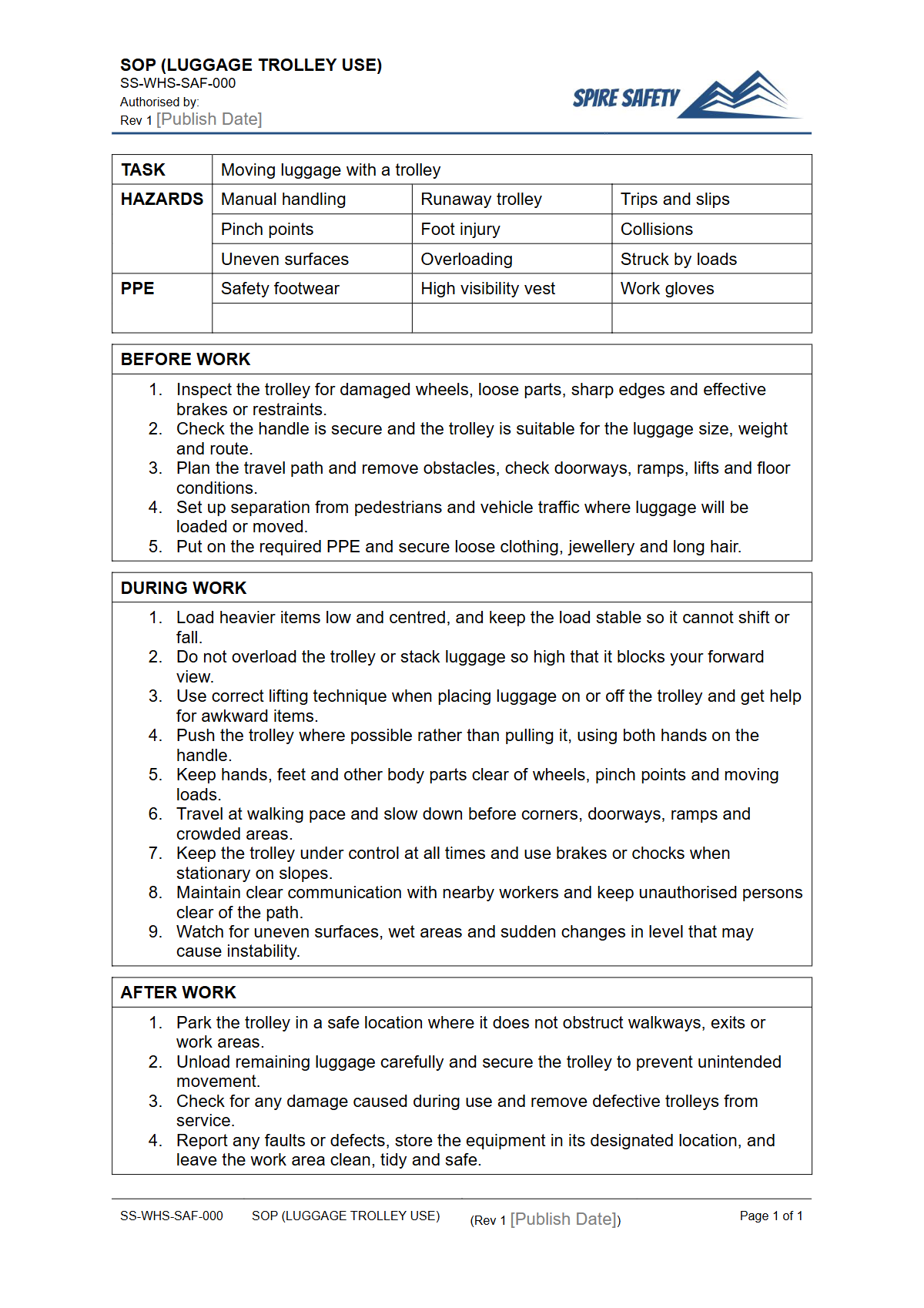
Download our free Safe Operating Procedure (Luggage Trolley Use) Template. This customisable DOCX & PDF helps you document safe work practices.
Free Safe Operating Procedure (Luggage Trolley Use) Template
DOCX • 126 KB + PDF
Updated Oct 2026
No signup required
Purpose of the Free Safe Operating Procedure (Luggage Trolley Use) Template
Using a luggage trolley might seem straightforward, but it involves significant manual handling risks that can lead to serious musculoskeletal injuries. This Free Safe Operating Procedure (Luggage Trolley Use) Template provides a structured framework for documenting the safest way to handle this common piece of equipment in workplaces like hotels, airports, and transport hubs.
Formalising your process helps ensure every worker understands the expected safe behaviours, from pre-operational checks to correct loading and movement techniques.
An SOP is a fundamental tool for risk management. By defining and communicating the correct procedure, your organisation can minimise the risk of sprains, strains, and other injuries associated with pushing and pulling heavy, awkward loads.
This document serves as a critical component of a comprehensive WHS management system, demonstrating a commitment to proactive safety management and providing a clear standard for training and supervision.
Video walkthrough
How to use the Free Safe Operating Procedure (Luggage Trolley Use) Template
This Safe Operating Procedure is provided as a fully editable DOCX file and a print-ready PDF. To get started, download the template and begin adapting it to your specific operational needs.
The document is pre-filled with common steps and safety considerations relevant to luggage trolley use, providing a solid foundation to build upon.
It is crucial to involve your workers in the customisation process. Consult with baggage handlers, porters, and supervisors to ensure the final procedure reflects the realities of their tasks and environment.
This collaborative approach not only results in a more effective SOP but also fosters a stronger safety culture within the team. The same principle of customisation applies when developing other equipment procedures, such as an SOP for step ladder use, where site-specific risks are paramount.
Please note: This document is a template and must be customised to suit the specific equipment, environment, and operational context of your workplace. We recommend a thorough consultation process with your team to ensure the final SOP is practical and effective.
When to use a Luggage Trolley Safe Operating Procedure
A documented SOP for luggage trolleys should be a living document, integrated into several key business processes. It is essential for inducting new employees, ensuring they learn the correct methods from day one.
It should also be used for regular refresher training to reinforce safe work habits and address any complacency that may develop over time.
Furthermore, this procedure should be reviewed and referenced following any incident or near miss involving a trolley. An investigation may reveal gaps in the procedure that need to be addressed.
The SOP also serves as a benchmark during safety observations and can be a key document reviewed during regular WHS compliance audits to verify that safe work systems are being implemented effectively.
Who should use this Safe Operating Procedure
This SOP is designed for a range of personnel. Primarily, it is for the workers who operate the luggage trolleys daily, including hotel concierges and porters, airport baggage handlers, and delivery personnel.
For these front-line employees, the SOP is a direct guide to performing their tasks safely.
Supervisors and managers should also use the document to train staff, monitor performance, and conduct safety checks. WHS managers and safety officers will find the template invaluable for establishing baseline safety standards and integrating them into the broader safety management system.
If your organisation needs assistance with implementing such procedures, professional WHS consulting services can provide expert guidance.
Key Elements Included in the Template
Our template provides a logical structure covering the full work cycle of using a luggage trolley. Key sections prompt you to detail your specific requirements for:
- Pre-Operational Checks: Instructions for inspecting wheels for damage or debris, checking the structural integrity of the frame, and ensuring handles are secure.
- Safe Loading Practices: Guidelines on even weight distribution, placing heavier items at the bottom, and adhering to the trolley's maximum load capacity.
- Movement and Navigation: Documenting correct techniques for pushing (not pulling), maintaining clear visibility, and safely navigating ramps, doorways, lifts, and different floor surfaces.
- Unloading Procedures: Steps for safely removing luggage to prevent items from falling or causing strain.
- Emergency Procedures: What to do if a load becomes unstable, the trolley tips, or an injury occurs. This is just as critical as having an SOP for defibrillator operation for medical emergencies.
- Storage and Maintenance: Outlining requirements for proper storage to prevent tripping hazards and scheduling routine maintenance.
By thoroughly completing each section, you create a comprehensive and practical tool for your workplace. This SOP, along with other procedural documents, can be found in our library of free WHS resources.
Common mistakes
Common mistakes to avoid
- Overloading the trolley beyond its rated weight capacity.
- Stacking luggage too high, which obstructs the operator's vision.
- Failing to perform pre-use checks on wheels, handles, and the frame.
- Pulling the trolley from behind instead of pushing it forward with a clear line of sight.
Legal references
Legal considerations
The following legal requirements may be relevant to this type of work.
- Work Health and Safety Act (Harmonised) — Provides the primary duties for protecting workers and other people from work health and safety risks.
- Work Health and Safety Regulations (Harmonised) — Sets out requirements supporting the management of workplace hazards and risks.
The following codes may be relevant to this type of work.
- Managing WHS Risks Code of Practice — Provides practical guidance on identifying hazards, assessing risks and applying effective controls.
- Work Health and Safety Consultation, Cooperation and Coordination Code of Practice — Provides practical guidance on consulting workers and coordinating with other duty holders.
- Managing the Work Environment and Facilities Code of Practice — Provides practical guidance on safe work environments, workplace facilities and related controls.
Did you know
Pushing vs. Pulling
Pushing a trolley is generally safer than pulling it. Pushing uses the body's larger muscle groups and allows for better forward visibility, reducing the risk of both musculoskeletal strain and collisions.
Wheel Maintenance
Worn or damaged trolley wheels can increase the force needed to move a load by over 30%, significantly raising the risk of overexertion injuries. Regular wheel checks are a critical part of pre-use inspections.
FAQ
Frequently asked questions
01What are the main hazards of using a luggage trolley?
02How often should we review our Luggage Trolley SOP?
03Is training required to use a luggage trolley safely?
04Can this template be used for other types of trolleys?
Share this resource
Free Safe Operating Procedure (Luggage Trolley Use) Template
Browse Categories
How To Use It
- 1Download and open in Word or PDF.
- 2Replace the placeholders with your business details.
- 3Get it reviewed by a WHS specialist before rollout.
Need it customised?
Our WHS consultants can adapt this template to your site, run a gap analysis, or audit what you already have in place.
Book a Free Consultation WHS consulting servicesor call 1300 156 382
Related templates
- Free Safe Operating Procedure (Machine Cleaning) Template
- Free Safe Operating Procedure (Machine Guard Removal) Template
- Free Safe Operating Procedure (Machine Lubrication) Template
- Free Safe Operating Procedure (Mag Drill) Template
- Free Safe Operating Procedure (Magnetic Particle Test) Template
- Free Safe Operating Procedure (Magnetic Separator) Template