
Free Safe Operating Procedure (Mag Drill) Template
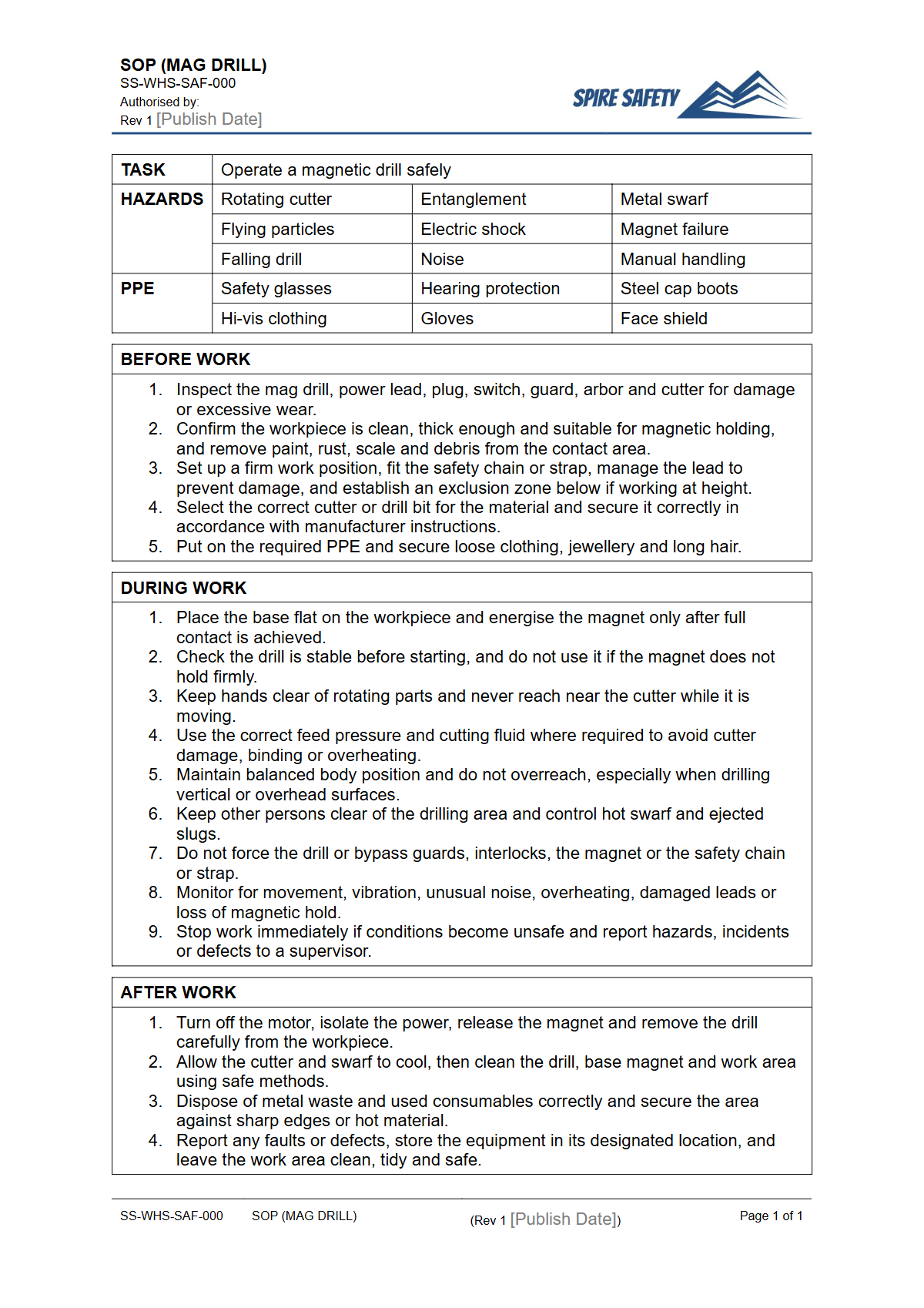
Download our free Safe Operating Procedure (Mag Drill) template. This customisable DOCX & PDF helps document safe work methods for magnetic drills.
Free Safe Operating Procedure (Mag Drill) Template
DOCX • 126 KB + PDF
Updated Oct 2026
No signup required
Purpose of the Free Safe Operating Procedure (Mag Drill) Template
Operating a magnetic drill (mag drill) involves significant hazards, including entanglement, electric shock, projectiles, and exposure to sharp metal swarf. This Free Safe Operating Procedure (Mag Drill) Template provides a structured framework for documenting and communicating the required safety measures for using this equipment.
An effective SOP is a critical control measure that forms part of a safe system of work. It helps your organisation meet its duty of care under Australian WHS laws by clearly outlining expectations for pre-operational checks, safe operation, and post-operational tasks.
By implementing a specific procedure for mag drills, you formalise the steps needed to manage risks associated with the equipment's powerful motor and magnetic base. This document serves as a vital tool for operator training, competency verification, and risk management.
It is designed to be adapted to your specific workplace, ensuring the controls are relevant and effective for your team. Using a standardised template for various equipment, like our circular saw SOP template, helps create consistency across your safety documentation.
Video walkthrough
How to use the Free Safe Operating Procedure (Mag Drill) Template
This resource is available for immediate download as a DOCX file, allowing for easy editing and customisation in Microsoft Word or other compatible programs. A PDF version is also provided for straightforward printing and distribution.
To use the template effectively, you should systematically work through each section and populate it with information specific to your operational context.
Important Customisation Note
This document is a template only. We have provided a structured starting point aligned with Australian WHS best practices, but you must customise it to reflect the specific mag drill models, tasks, and unique environment of your workplace.
Generic procedures are not sufficient for ensuring safety. You must conduct a site-specific risk assessment and incorporate your findings into the final SOP.
Integrating such procedures is a fundamental part of developing robust WHS management systems that protect workers and ensure operational continuity.
Key Sections to Customise
- PPE Requirements: Specify the exact Personal Protective Equipment required, such as specific types of eye and hearing protection. Note any contraindications, like the entanglement risk posed by certain types of gloves.
- Pre-Operational Checks: Detail the inspection steps for your specific mag drill models, including checking the power cord, magnetic base, switches, and drill bits.
- Operating Steps: Document the sequence of tasks for setting up and using the drill, from positioning and engaging the magnet to drilling and disengaging. Include details on using coolant and safety chains where applicable.
- Post-Operational Checks: Outline clean-up procedures, such as safely removing swarf, inspecting the equipment for damage, and correct storage.
When to use a Mag Drill Safe Operating Procedure
A Safe Operating Procedure for a magnetic drill should be a readily accessible document used in several key situations. It is not a document to be filed away and forgotten.
Use it during new worker inductions to introduce them to the equipment and your safety expectations. It is an essential reference during task-specific training sessions for any operator authorised to use a mag drill.
Supervisors should use it as a checklist for conducting competency assessments before allowing an operator to work independently. Furthermore, the SOP should be referenced during pre-start meetings for jobs involving the mag drill and used as a guide during incident investigations to identify any procedural gaps or non-conformance.
The SOP is also a practical tool for everyday use. Operators should review it before starting a task if they are unsure about any step, especially for non-routine jobs.
For instance, when setting up in a complex or elevated position, referring to the SOP ensures no safety checks are missed. While this SOP covers the drill itself, remember to consider the entire work environment, including tasks that may require other procedures, such as those detailed in our FREE Step Ladder SOP Template.
Who should use this Safe Operating Procedure
This Safe Operating Procedure is intended for a broad audience within an organisation. Primarily, it is for Operators who physically use the magnetic drill, providing them with clear, step-by-step instructions for safe use.
Supervisors and Managers are also key users; they are responsible for implementing the SOP, ensuring operators are trained and competent, and enforcing the documented procedures. During routine checks, a supervisor can use the SOP as a benchmark for observing work practices. This process of verification is a core part of safety management and can be formalised through routine WHS compliance auditing.
Persons Conducting a Business or Undertaking (PCBUs) should ensure such procedures are developed, implemented, and reviewed as part of their primary duty of care. Finally, Health and Safety Representatives (HSRs) and safety committee members should be familiar with the SOP to participate effectively in consultation about workplace safety. A comprehensive approach ensures everyone understands the risks and controls associated with workshop equipment, similar to what you might document in an air compressor SOP. For a broader selection of procedural documents, you can explore our free WHS resources library.
Common mistakes
Common mistakes to avoid
- Using the drill on thin, uneven, or non-ferrous surfaces where the magnet cannot secure properly.
- Wearing loose clothing, jewellery, or standard gloves that can become entangled in the rotating chuck or drill bit.
- Failing to use a safety chain or strap as a secondary securing method, especially when working at heights or in inverted positions.
- Neglecting to clear sharp metal swarf (chips) with a brush or magnetic tool, instead of by hand, leading to severe cuts.
Legal references
Legal considerations
The following legal requirements may be relevant to this type of work.
- Work Health and Safety Act (Harmonised) — Provides the primary duties for protecting workers and other people from work health and safety risks.
- Work Health and Safety Regulations (Harmonised) — Sets out requirements supporting the management of workplace hazards and risks.
The following codes may be relevant to this type of work.
- Managing WHS Risks Code of Practice — Provides practical guidance on identifying hazards, assessing risks and applying effective controls.
- Work Health and Safety Consultation, Cooperation and Coordination Code of Practice — Provides practical guidance on consulting workers and coordinating with other duty holders.
- Managing the Work Environment and Facilities Code of Practice — Provides practical guidance on safe work environments, workplace facilities and related controls.
Did you know
A Force for Stability
The electromagnetic base of a mag drill can generate a clamping force of over 10,000 Newtons. This powerful grip provides the stability required for precise, heavy-duty drilling that would be impossible with a standard handheld drill.
FAQ
Frequently asked questions
01Is a Safe Operating Procedure legally required for a mag drill in Australia?
02What PPE is required when using a magnetic drill?
03How often should a mag drill SOP be reviewed?
04Can a mag drill be used on non-ferrous materials like aluminium?
Share this resource
Free Safe Operating Procedure (Mag Drill) Template
Browse Categories
How To Use It
- 1Download and open in Word or PDF.
- 2Replace the placeholders with your business details.
- 3Get it reviewed by a WHS specialist before rollout.
Need it customised?
Our WHS consultants can adapt this template to your site, run a gap analysis, or audit what you already have in place.
Book a Free Consultation WHS consulting servicesor call 1300 156 382
Related templates
- Free Safe Operating Procedure (Magnetic Particle Test) Template
- Free Safe Operating Procedure (Magnetic Separator) Template
- Free Safe Operating Procedure (Magnetic Stirrer) Template
- Free Safe Operating Procedure (Mandoline Slicer) Template
- Free Safe Operating Procedure (Mandrel Reel) Template
- Free Safe Operating Procedure (Manhole Cover Check) Template