
Free Safe Operating Procedure (Magnetic Separator) Template
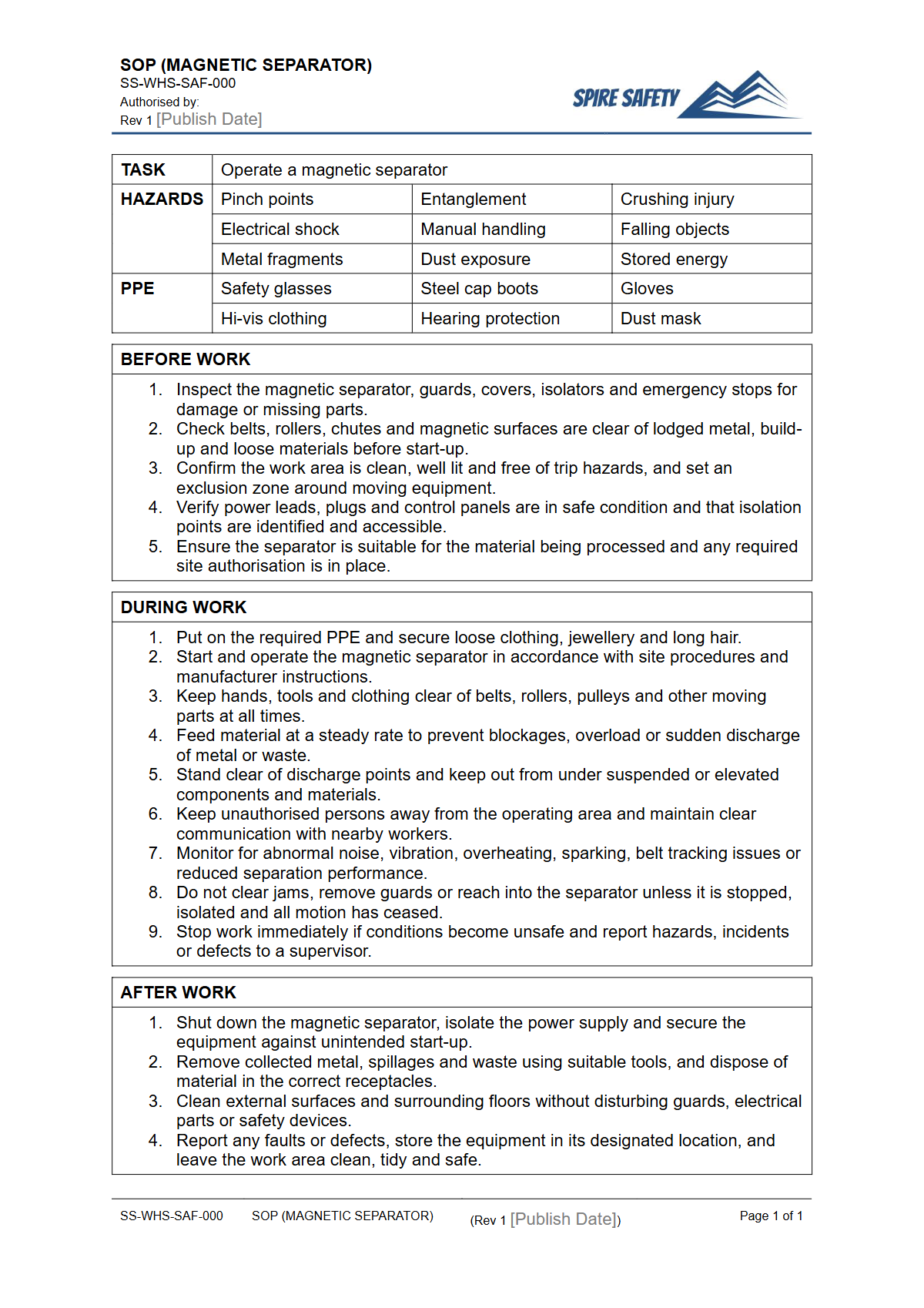
Download our free Safe Operating Procedure (Magnetic Separator) template (DOCX & PDF). A structured starting point for managing magnetic separator risks.
Free Safe Operating Procedure (Magnetic Separator) Template
DOCX • 126 KB + PDF
Updated Oct 2026
No signup required
Purpose of the Free Safe Operating Procedure (Magnetic Separator) Template
Operating industrial magnetic separators involves significant risks, including powerful magnetic fields, pinch points, and entanglement hazards. This free Safe Operating Procedure (Magnetic Separator) template provides a structured starting point for documenting a safe system of work.
Its purpose is to clearly outline the step-by-step process for operating, cleaning, and maintaining magnetic separators, helping to minimise the risk of injury to workers. A well-developed SOP is a critical component of effective WHS management systems, serving as a key training and reference tool for operators and supervisors.
This document helps your organisation meet its duty of care by formalising procedures and ensuring consistent, safe practices are followed. It guides users through identifying necessary personal protective equipment (PPE), pre-operational safety checks, operational steps, and emergency shutdown procedures.
It is designed to be adapted to various types of magnetic separators, such as overband, drum, plate, or grate models used in recycling, mining, or food processing industries.
Video walkthrough
How to use the Free Safe Operating Procedure (Magnetic Separator) Template
To use this template, simply download the DOCX file and begin editing. The document is organised into logical sections that you can populate with details specific to your equipment and workplace.
These sections include Hazard Identification, Pre-operational Checks, Operational Sequence, and Emergency Procedures. You should conduct a thorough risk assessment of your magnetic separator to ensure all specific hazards and control measures are captured in the final document.
Please note: This is a template and must be customised to your specific workplace, equipment, processes, and legislative requirements. We strongly recommend a consultation process involving the workers who operate the equipment to ensure the SOP is practical and effective.
Incorporating operator feedback is essential for creating a document that reflects real-world practices and challenges. For guidance on customising documents and implementing safe work systems, you may benefit from expert WHS consulting.
Integrating this SOP with other safety documents creates a more robust safety framework. For instance, the principles of documenting step-by-step instructions for hazardous equipment are similar across various tools, as seen in our free Circular Saw SOP. By maintaining a consistent approach to all your procedures, you simplify training and improve overall safety comprehension within your team.
When to use a Safe Operating Procedure
A Safe Operating Procedure for a magnetic separator should be used consistently as part of daily operations. It is not a document to be filed away and forgotten.
It should be readily accessible to operators at or near the equipment. Key times to use the SOP include:
- Worker Training and Induction: All new operators must be trained using the SOP before they are authorised to use the magnetic separator.
- Pre-operational Checks: Operators should reference the SOP daily before starting the machine to ensure all safety guards and features are in place and functioning correctly.
- Refresher Training: The SOP should be used for periodic refresher training to reinforce safe work habits.
- Post-Incident Reviews: Following any incident or near miss involving the equipment, the SOP should be reviewed and updated to prevent a recurrence.
These procedures are fundamental for tasks involving various types of heavy machinery, not just separators. A similar structured approach is vital when documenting processes for other plant, such as those outlined in our FREE Telehandler SOP Template, to ensure operational consistency and safety across all site equipment.
Who should use this Safe Operating Procedure
This SOP is intended for several key roles within an organisation to ensure a holistic approach to safety:
- Equipment Operators: As the primary users, operators must follow the SOP for every task to ensure their safety and the safety of those around them.
- Supervisors and Managers: Supervisors are responsible for ensuring operators are trained on the SOP and adhere to its procedures. They use it as a tool for monitoring compliance and coaching staff.
- WHS/HSE Personnel: Safety professionals use the SOP as a cornerstone document for risk assessments, incident investigations, and training program development.
- Maintenance Staff: A dedicated section should be customised for maintenance personnel, outlining safe isolation, lock-out tag-out (LOTO), and cleaning procedures.
Comprehensive and well-maintained SOPs are also a key piece of evidence reviewed during safety audits. They demonstrate that the organisation has a formalised system for managing operational risks.
You can find more templates like this in our free WHS resources library to build out your safety documentation.
Common mistakes
Common mistakes to avoid
- Failing to customise the template for the specific machine model, workplace, and materials being processed.
- Neglecting to include detailed procedures for cleaning and maintenance, where many injuries occur due to unexpected energy release or moving parts.
- Not consulting with the equipment operators when drafting the SOP, resulting in a procedure that is impractical or misses key steps.
- Treating the SOP as a one-time task instead of a 'living document' that requires regular review and updates.
Legal references
Legal considerations
The following legal requirements may be relevant to this type of work.
- Work Health and Safety Act (Harmonised) — Provides the primary duties for protecting workers and other people from work health and safety risks.
- Work Health and Safety Regulations (Harmonised) — Sets out requirements supporting the management of workplace hazards and risks.
The following codes may be relevant to this type of work.
- Managing WHS Risks Code of Practice — Provides practical guidance on identifying hazards, assessing risks and applying effective controls.
- Work Health and Safety Consultation, Cooperation and Coordination Code of Practice — Provides practical guidance on consulting workers and coordinating with other duty holders.
- Managing the Work Environment and Facilities Code of Practice — Provides practical guidance on safe work environments, workplace facilities and related controls.
Did you know
Incredible Strength
Industrial magnetic separators often use rare-earth magnets, like neodymium, which can be thousands of times stronger than a standard fridge magnet, posing significant health and safety risks if not managed correctly.
Beyond Recycling
Magnetic separators are critical in the food processing and pharmaceutical industries to remove fine metallic contaminants, protecting consumer health and ensuring product purity.
FAQ
Frequently asked questions
01What are the main hazards of a magnetic separator?
02Is a Safe Operating Procedure a legal requirement in Australia?
03How often should a magnetic separator SOP be reviewed?
04Can this template be used for all types of magnetic separators?
Share this resource
Free Safe Operating Procedure (Magnetic Separator) Template
Browse Categories
How To Use It
- 1Download and open in Word or PDF.
- 2Replace the placeholders with your business details.
- 3Get it reviewed by a WHS specialist before rollout.
Need it customised?
Our WHS consultants can adapt this template to your site, run a gap analysis, or audit what you already have in place.
Book a Free Consultation WHS consulting servicesor call 1300 156 382
Related templates
- Free Safe Operating Procedure (Magnetic Stirrer) Template
- Free Safe Operating Procedure (Mandoline Slicer) Template
- Free Safe Operating Procedure (Mandrel Reel) Template
- Free Safe Operating Procedure (Manhole Cover Check) Template
- Free Safe Operating Procedure (Manhole Cover Lifting) Template
- Free Safe Operating Procedure (Manifest Reconciliation) Template