
Free Safe Operating Procedure (Manifest Reconciliation) Template
Download our free Safe Operating Procedure (Manifest Reconciliation) Template.
Free Safe Operating Procedure (Manifest Reconciliation) Template
DOCX • 126 KB + PDF
Updated Oct 2026
No signup required
Purpose of the Free Safe Operating Procedure (Manifest Reconciliation) Template
A manifest is a critical document that tracks the transportation of controlled substances, most commonly hazardous waste or dangerous goods, from the point of generation to its final disposal or treatment facility. Manifest reconciliation is the administrative process of verifying that the information on this document is accurate and complete.
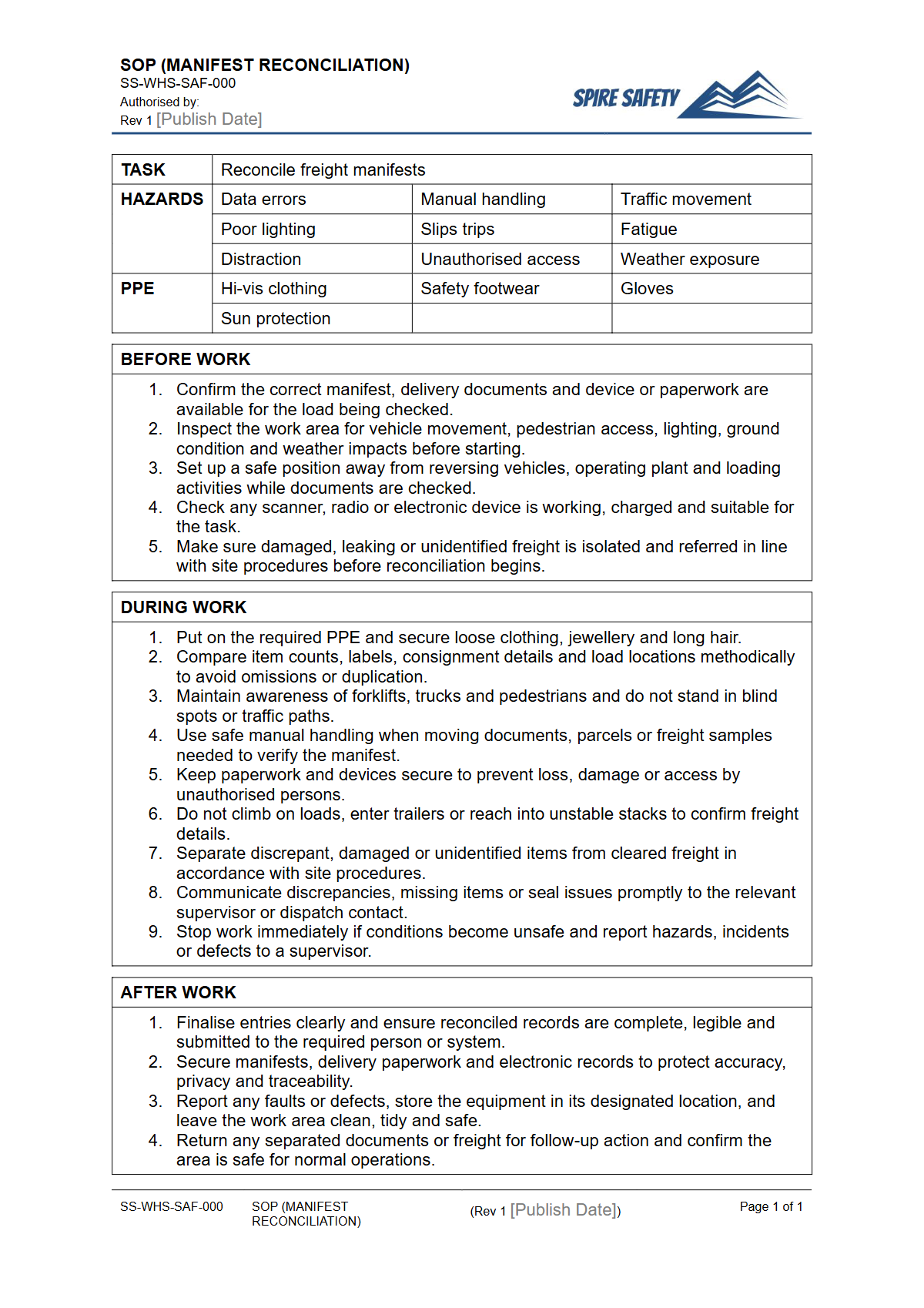
This free Safe Operating Procedure (Manifest Reconciliation) Template provides a structured framework for ensuring every consignment is correctly documented, accounted for, and closed out.
Using a standardised procedure helps your organisation meet its regulatory obligations under environmental protection and WHS laws. It ensures consistency, minimises the risk of human error, and creates a clear, auditable record of all waste movements.
This documented process is a fundamental component of effective WHS management systems, demonstrating due diligence in handling regulated materials.
The primary goal of this SOP is to formalise the steps required to compare the manifest documentation against the actual materials received or dispatched. It confirms that the type of material, quantity, packaging, and handler details are all correct.
A robust reconciliation process prevents costly compliance breaches and protects workers and the environment from the risks associated with mismanaged materials.
Video walkthrough
How to use the Free Safe Operating Procedure (Manifest Reconciliation) Template
This document is a template designed as a starting point. It must be customised to reflect the specific operations, materials, and regulatory environment of your workplace.
Download the DOCX file and adapt it by incorporating your company name, logo, site-specific details, and the roles responsible for each step in the process. The procedure should detail the exact types of manifests your business handles (e.g., state EPA waste tracking forms, dangerous goods declarations).
Important: We have developed this template based on established Australian WHS principles and the model WHS framework. However, to ensure it is effective for your business, you must consult the relevant legislation, codes of practice, and standards applicable to your industry and state.
You are responsible for adapting this document to your specific needs to control hazards and supports your compliance efforts.
Consider how this SOP fits within your broader safety framework. A documented procedure is as vital for critical administrative tasks like this as it is for physical equipment use, which might be covered in a free Air Compressor SOP. When customising the template, detail your specific procedure for managing discrepancies, record-keeping requirements, and the required retention period for completed manifests.
When to use it
This Safe Operating Procedure should be actioned every time a consignment of controlled waste or dangerous goods is either dispatched from or received at your site. The reconciliation process is the final administrative control that closes the loop on a specific transport event.
For waste producers (consignors), this means confirming the receiving facility has accepted the load as described. For receiving facilities, it means verifying the incoming load matches what the producer declared on the manifest.
The procedure should be initiated as soon as the transport vehicle arrives or once notification of receipt is received from the destination facility. Prompt reconciliation is crucial; delaying the process increases the risk of paperwork being lost or discrepancies being overlooked.
It should be a routine part of your organisation's logistics and environmental compliance activities. You may also reference the procedure during internal and external audits, incident investigations, or when training new personnel.
Who should use it
This SOP is intended for personnel directly involved in the logistics, administration, and compliance aspects of handling regulated materials. This can include a range of roles depending on the size and structure of the organisation:
- Environmental Officers or Managers: Responsible for overall environmental compliance and reporting.
- Logistics and Warehouse Coordinators: Manage the physical dispatch and receival of goods and associated paperwork.
- Site Supervisors: Oversee operations and ensure procedures are followed correctly on the ground.
- WHS Advisors: Ensure the process aligns with the organisation's safety management system.
- Administration Staff: Tasked with record-keeping and data entry for compliance purposes.
All personnel assigned these tasks must be trained in this specific procedure to understand their responsibilities, particularly regarding how to identify and report discrepancies. The documented steps in the SOP form a key piece of evidence during any WHS compliance auditing activities, proving a systematic approach is in place.
Common mistakes
Common mistakes to avoid
- Failing to physically check quantities (e.g., weight, volume, or container count) against the figures listed on the manifest.
- Accepting a consignment with incomplete, illegible, or unsigned paperwork without raising an immediate query.
- Not having a formally documented procedure for reporting, investigating, and resolving discrepancies found during reconciliation.
- Delaying the reconciliation process, which can lead to lost documents, faded memories, and an incomplete audit trail.
Legal references
Legal considerations
The following legal requirements may be relevant to this type of work.
- Work Health and Safety Act (Harmonised) — Provides the primary duties for protecting workers and other people from work health and safety risks.
- Work Health and Safety Regulations (Harmonised) — Sets out requirements supporting the management of workplace hazards and risks.
The following codes may be relevant to this type of work.
- Managing WHS Risks Code of Practice — Provides practical guidance on identifying hazards, assessing risks and applying effective controls.
- Work Health and Safety Consultation, Cooperation and Coordination Code of Practice — Provides practical guidance on consulting workers and coordinating with other duty holders.
- Managing the Work Environment and Facilities Code of Practice — Provides practical guidance on safe work environments, workplace facilities and related controls.
Did you know
A Costly Mistake
In many Australian states, environmental protection agencies (EPAs) can issue significant fines for incomplete or inaccurate waste transport documentation, making manifest reconciliation a critical compliance activity.
More Than Just Chemicals
Waste manifests aren't just for highly toxic substances. They are often required for a range of controlled materials, including clinical and medical waste, asbestos, grease trap waste, and certain industrial by-products.
FAQ
Frequently asked questions
01What is manifest reconciliation in the context of WHS?
02Why is a Safe Operating Procedure for manifest reconciliation important?
03Who is typically responsible for signing a manifest?
04What should happen if a discrepancy is found during reconciliation?
Share this resource
Free Safe Operating Procedure (Manifest Reconciliation) Template
Browse Categories
How To Use It
- 1Download and open in Word or PDF.
- 2Replace the placeholders with your business details.
- 3Get it reviewed by a WHS specialist before rollout.
Need it customised?
Our WHS consultants can adapt this template to your site, run a gap analysis, or audit what you already have in place.
Book a Free Consultation WHS consulting servicesor call 1300 156 382
Related templates
- Free Safe Operating Procedure (Mannequin Handling) Template
- Free Safe Operating Procedure (Manometer) Template
- Free Safe Operating Procedure (Manual Order Picking) Template
- Free Safe Operating Procedure (Manual Weed Removal) Template
- Free Safe Operating Procedure (Manure Handling) Template
- Free Safe Operating Procedure (Marina Bin Collection) Template