
Free Safe Operating Procedure (Manual Weed Removal) Template
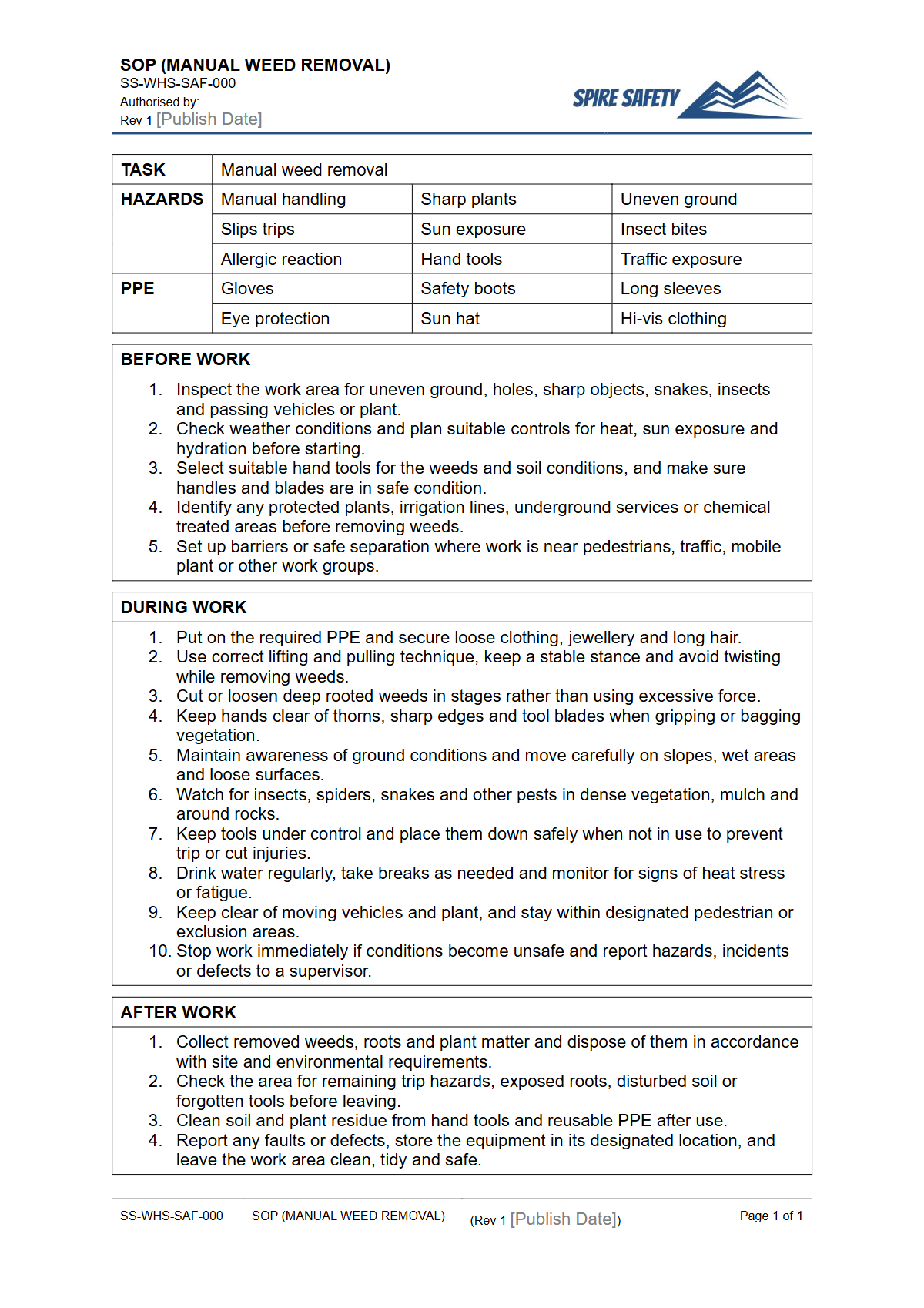
Download our free Safe Operating Procedure for Manual Weed Removal. This template (DOCX & PDF) helps you document safe work practices for groundskeeping tasks.
Free Safe Operating Procedure (Manual Weed Removal) Template
DOCX • 126 KB + PDF
Updated Oct 2026
No signup required
Purpose of the Free Safe Operating Procedure (Manual Weed Removal) Template
Manual weed removal is a common task in landscaping, agriculture, and grounds maintenance. While it may seem straightforward, it carries significant risks, including musculoskeletal injuries, sun exposure, and lacerations.
This free Safe Operating Procedure (Manual Weed Removal) Template provides a structured framework for documenting the safest way to perform this work. A clear SOP helps your organisation meet its duty of care, reduces the risk of injury, and provides a consistent training tool for workers.
It formalises pre-start checks, required PPE, and emergency procedures, ensuring every person undertaking the task understands the recognised hazards and controls.
Video walkthrough
How to use the Free Safe Operating Procedure (Manual Weed Removal) Template
This resource is available as a fully editable DOCX file and a print-ready PDF. After downloading, you must customise the document to reflect the specific hazards, tools, equipment, and environmental conditions of your worksite.
A generic procedure is not enough; effective safety management requires site-specific details.
Important: This is a template, not a finished document. We've designed it as a starting point, but you are responsible for ensuring it is adapted to your unique operational context.
A critical part of this process is consulting with the workers who actually perform the task. Their direct experience is invaluable for identifying practical risks and effective controls.
Finalising your SOP is a key step in developing robust WHS management systems that protect your team.
When to use a Manual Weeding SOP
A Safe Operating Procedure for manual weed removal should be a core part of your daily operations. It is used to train new employees or induct contractors, ensuring they are aware of the established safe work method before they begin.
It also serves as an excellent reference document for pre-start meetings or toolbox talks, reinforcing key safety messages. Following any incident, near miss, or change in equipment (like introducing new ergonomic tools), the SOP should be reviewed and updated to reflect new learnings or procedures.
It should be treated as a live document, not a one-time compliance exercise.
Who should use this SOP
This SOP is intended for a broad audience within an organisation. Persons Conducting a Business or Undertaking (PCBUs) and their managers can use it to fulfil their primary duty of care.
Supervisors and team leaders should use it to induct, train, and supervise workers effectively. WHS advisors and safety officers will find it a useful starting point for building out their procedural documentation.
Finally, workers themselves should be familiar with the SOP, as it clearly outlines the steps they must take to keep themselves and their colleagues safe. Just as you would have procedures for specific equipment, like our free Trencher SOP template, manual tasks also require formal guidance.
Key Hazards in Manual Weed Removal
Identifying hazards is the first step in managing risk. Manual weeding presents several common hazards that your SOP must address:
- Musculoskeletal Disorders (MSDs): These are the most significant risk, arising from repetitive movements (pulling, digging), awkward postures (bending, kneeling for long periods), and forceful exertions.
- Slips, Trips, and Falls: Uneven ground, concealed holes, wet surfaces, and discarded tools or vegetation can all lead to falls.
- Hazardous Manual Tasks: Lifting and carrying heavy bags of green waste, rocks, or equipment can cause back injuries.
- Environmental Exposure: Working outdoors exposes workers to UV radiation (sunburn, skin cancer risk), heat stress, and adverse weather. Our SOP for defibrillator operation is a complementary resource for emergency preparedness in case of medical events like heat stroke.
- Cuts and Lacerations: Hand tools like hoes, trowels, and hori-horis can cause injury if used improperly. Sharp objects hidden in the soil or thorny plants also pose a risk.
- Biological Hazards: Workers may encounter snakes, spiders, insects (bees, wasps), and poisonous or irritating plants.
Implementing Control Measures
Your SOP should detail the control measures used to mitigate the identified risks, following the hierarchy of controls. For example, instead of only relying on PPE, consider if you can eliminate the hazard by using ground cover fabrics to prevent weed growth.
For tasks requiring work at a slight elevation, such as on terraced gardens, ensure procedures like those found in our free Step Ladder SOP template are considered. Administrative controls are vital and include job rotation to reduce repetitive strain, providing adequate rest breaks, and conducting thorough training.
If you need assistance developing a comprehensive risk management strategy, consider engaging expert WHS consulting services. Providing ergonomic, long-handled tools is an engineering control that reduces the need for bending and kneeling.
This systematic approach ensures risks are managed as effectively as possible.
This document is one of many tools available to help you build a safer workplace. For more templates, checklists, and guides covering a wide range of tasks and equipment, browse our complete free WHS resources library.
Common mistakes
Common mistakes to avoid
- Using a generic SOP without customising it for the specific workplace and task.
- Failing to consult with workers who perform the weeding tasks when drafting the procedure.
- Not reviewing and updating the SOP after an incident, near miss, or when new equipment is introduced.
- Treating the SOP as a document that just sits on a shelf, rather than an active tool for training and supervision.
Legal references
Legal considerations
The following legal requirements may be relevant to this type of work.
- Work Health and Safety Act (Harmonised) — Provides the primary duties for protecting workers and other people from work health and safety risks.
- Work Health and Safety Regulations (Harmonised) — Sets out requirements supporting the management of workplace hazards and risks.
The following codes may be relevant to this type of work.
- Managing WHS Risks Code of Practice — Provides practical guidance on identifying hazards, assessing risks and applying effective controls.
- Work Health and Safety Consultation, Cooperation and Coordination Code of Practice — Provides practical guidance on consulting workers and coordinating with other duty holders.
- Managing the Work Environment and Facilities Code of Practice — Provides practical guidance on safe work environments, workplace facilities and related controls.
Did you know
A Common Injury
According to Safe Work Australia, body stressing, which includes injuries from repetitive manual tasks, is the leading cause of serious workers' compensation claims in Australia.
Consultation is Key
The model WHS Act legally requires a PCBU to consult with workers on matters relating to their health and safety. Developing an SOP is a key opportunity for this consultation.
FAQ
Frequently asked questions
01What is a Safe Operating Procedure (SOP)?
02Why is an SOP important for a task like manual weeding?
03Is this Manual Weed Removal SOP template ready to use immediately?
04Who is responsible for implementing the SOP?
Share this resource
Free Safe Operating Procedure (Manual Weed Removal) Template
Browse Categories
How To Use It
- 1Download and open in Word or PDF.
- 2Replace the placeholders with your business details.
- 3Get it reviewed by a WHS specialist before rollout.
Need it customised?
Our WHS consultants can adapt this template to your site, run a gap analysis, or audit what you already have in place.
Book a Free Consultation WHS consulting servicesor call 1300 156 382
Related templates
- Free Safe Operating Procedure (Manure Handling) Template
- Free Safe Operating Procedure (Marina Bin Collection) Template
- Free Safe Operating Procedure (Marina Pontoon Cleaning) Template
- Free Safe Operating Procedure (Marina Waste Handling) Template
- Free Safe Operating Procedure (Marine Battery Change) Template
- Free Safe Operating Procedure (Marine Deck Inspection) Template