
Free Safe Operating Procedure (Marine Deck Inspection) Template
Download our free Safe Operating Procedure (Marine Deck Inspection) Template.
Free Safe Operating Procedure (Marine Deck Inspection) Template
DOCX • 126 KB + PDF
Updated Oct 2026
No signup required
Purpose of the Free Safe Operating Procedure (Marine Deck Inspection) Template
Regular inspections are fundamental to maintaining a safe working environment on any vessel. The maritime industry presents unique hazards, from unpredictable weather to the constant motion of the vessel and the presence of heavy machinery.
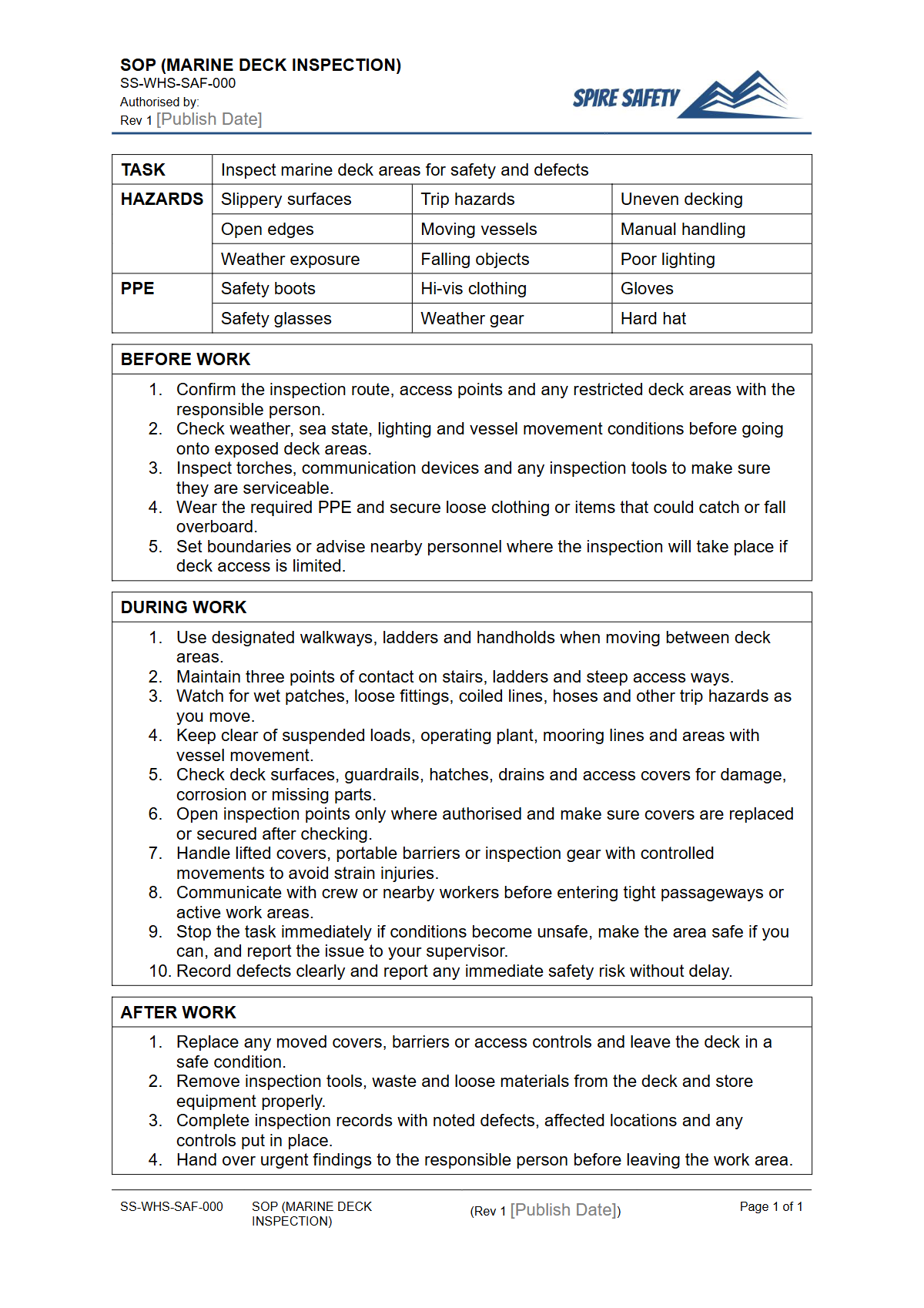
This free Safe Operating Procedure (Marine Deck Inspection) Template provides a structured starting point for documenting the required steps to conduct thorough and systematic inspections of a vessel's deck areas. It is designed to help your organisation identify potential hazards like slippery surfaces, trip hazards, unsecured equipment, and structural wear and tear before they lead to incidents.
Using a formal SOP helps standardise the inspection process across different crew members and shifts, ensuring consistency and accountability. It prompts a systematic review of critical safety elements, including guardrails, access points, lighting, and emergency equipment.
This process is a vital component of proactive risk management, forming a key part of your broader WHS management systems and demonstrating a commitment to health and safety on board.
Video walkthrough
How to use the Free Safe Operating Procedure (Marine Deck Inspection) Template
This document provides a comprehensive framework, but it is not a complete, off-the-shelf solution. To be effective, it must be adapted to the specific context of your vessel and its operations.
Start by downloading the template in your preferred format (DOCX or PDF). Next, conduct a risk assessment for the specific deck areas and tasks involved, consulting directly with the deck crew, officers, and any relevant safety personnel who perform these duties.
Use their feedback to add, remove, or modify sections to reflect the unique layout, equipment, and operational risks of your vessel. This could include specific checks for mooring equipment, cargo lashing points, or specialised machinery.
Remember, we've created this as a guide; you must customise it to your workplace to ensure it is relevant and effective. An SOP developed in isolation without worker input is rarely successful. Proper implementation is as critical as the document itself, which can be verified through processes like WHS compliance auditing.
When to use it
A Safe Operating Procedure for marine deck inspections should be used as a primary reference tool in several scenarios. It is essential for conducting pre-departure checks, routine daily or weekly safety walks, and more detailed periodic inspections as part of a planned maintenance system.
The SOP also serves as an invaluable training aid for new crew members, ensuring they understand the standards and procedures from their first day on board. Following any near-miss, incident, or change in vessel equipment or layout, the SOP should be reviewed and updated to incorporate any learnings or new control measures.
Who should use it
This SOP is intended for all personnel with responsibilities for safety and operations on deck. This includes the Ship's Master, Chief Officer, Deck Officers, Bosun, and Able Seafarers (ABs) who conduct the physical inspections.
WHS managers and safety officers will use it to establish and monitor safety protocols and ensure procedural consistency. Even when simple equipment is involved in an inspection, such as accessing a raised platform, a documented process is critical; our free Step Ladder SOP Template provides an example of documenting procedures for common equipment.
Furthermore, the information within the SOP is crucial for emergency preparedness. Clearly identifying the location and status of safety equipment during an inspection is a core task. For instance, ensuring automated external defibrillators (AEDs) are accessible and functional is a critical check, a process that can be detailed further using a specific Safe Operating Procedure for Defibrillator Operation.
By implementing this procedure, your organisation creates a clear, documented, and repeatable process that enhances safety culture and helps manage the significant risks associated with maritime work. For organisations needing more specialised guidance on complex maritime safety challenges, engaging with specialist WHS consulting services can provide tailored solutions.
If you're looking for other templates to build out your safety systems, you can browse our complete free WHS resources library for a wide range of documents covering various plant, equipment, and hazardous tasks.
Common mistakes
Common mistakes to avoid
- Using a generic template without customising it for the specific vessel's layout and equipment.
- Failing to involve experienced deck crew in the development and review of the procedure.
- Not updating the SOP after an incident, near-miss, or when new equipment is introduced.
- Treating the SOP as a paperwork exercise rather than a live document used for training and daily work.
Legal references
Legal considerations
The following legal requirements may be relevant to this type of work.
- Work Health and Safety Act (Harmonised) — Provides the primary duties for protecting workers and other people from work health and safety risks.
- Work Health and Safety Regulations (Harmonised) — Sets out requirements supporting the management of workplace hazards and risks.
The following codes may be relevant to this type of work.
- Managing WHS Risks Code of Practice — Provides practical guidance on identifying hazards, assessing risks and applying effective controls.
- Work Health and Safety Consultation, Cooperation and Coordination Code of Practice — Provides practical guidance on consulting workers and coordinating with other duty holders.
- Managing the Work Environment and Facilities Code of Practice — Provides practical guidance on safe work environments, workplace facilities and related controls.
Did you know
Slips, Trips, and Falls
According to numerous maritime safety reports, slips, trips, and falls are consistently one of the leading causes of personal injury aboard ships, often due to wet or oily surfaces, poor lighting, or unsecured objects on deck.
FAQ
Frequently asked questions
01What should be included in a marine deck inspection SOP?
02Why is a specific SOP for deck inspections necessary?
03How often should marine deck inspections be conducted?
04Is this template suitable for all types of vessels?
Share this resource
Free Safe Operating Procedure (Marine Deck Inspection) Template
Browse Categories
How To Use It
- 1Download and open in Word or PDF.
- 2Replace the placeholders with your business details.
- 3Get it reviewed by a WHS specialist before rollout.
Need it customised?
Our WHS consultants can adapt this template to your site, run a gap analysis, or audit what you already have in place.
Book a Free Consultation WHS consulting servicesor call 1300 156 382
Related templates
- Free Safe Operating Procedure (Marine Hose Handling) Template
- Free Safe Operating Procedure (Marine VHF Radio) Template
- Free Safe Operating Procedure (Marine Waste Segregation) Template
- Free Safe Operating Procedure (Mask Fit Check) Template
- Free Safe Operating Procedure (Masonry Saw) Template
- Free Safe Operating Procedure (Massage Room Cleaning) Template