
Free Safe Operating Procedure (Massage Room Cleaning) Template
Download our free Safe Operating Procedure (Massage Room Cleaning) template. This customisable DOCX & PDF helps establish clear hygiene and safety steps.
Free Safe Operating Procedure (Massage Room Cleaning) Template
DOCX • 126 KB + PDF
Updated Oct 2026
No signup required
Purpose of the Free Safe Operating Procedure (Massage Room Cleaning) Template
Maintaining a clean and hygienic environment is fundamental to the operation of any therapeutic or wellness practice. This Free Safe Operating Procedure (Massage Room Cleaning) Template provides a structured framework for ensuring your cleaning processes are consistent, effective, and safe.
It helps formalise the steps required to manage hygiene-related risks, such as client and therapist cross-contamination, infection transmission, and adverse reactions to cleaning products. By documenting these procedures, you create a clear standard of work that protects everyone in your facility.
A well-defined SOP goes beyond simple cleaning; it is a critical component of your overall safety management system. The procedure addresses common hazards associated with cleaning tasks, including slips and trips on wet floors, manual handling injuries from moving equipment, and exposure to hazardous chemicals.
Implementing a formal SOP demonstrates a commitment to professional standards and supports the development of robust WHS management systems within your business.
Video walkthrough
How to use the Free Safe Operating Procedure (Massage Room Cleaning) Template
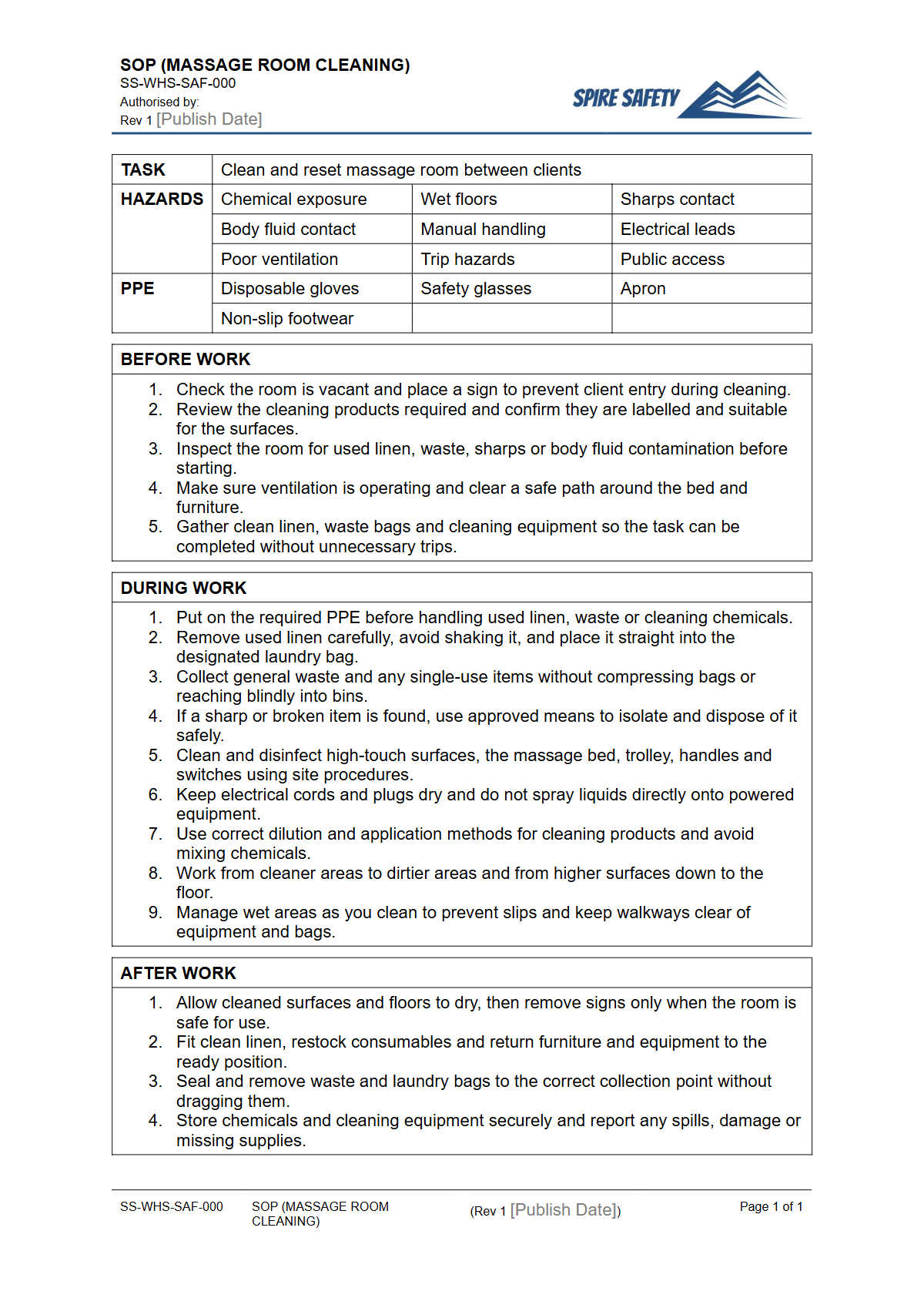
This Safe Operating Procedure for massage room cleaning is available for download as a fully editable DOCX file and a print-ready PDF. Its purpose is to serve as a comprehensive starting point, designed to be adapted to the specific context of your massage clinic or wellness centre.
The document outlines key stages of the cleaning process, from preparation and PPE selection to the final post-cleaning checks.
To get the most value from this template, follow these steps:
- Download the DOCX version.
- Thoroughly review the content with your team, including therapists and any staff responsible for cleaning.
- Customise the document to reflect the specific layout of your rooms, the equipment you use, and the exact cleaning and disinfectant products you have on site.
- Incorporate brand names of chemicals, required dilution ratios, and necessary contact times as specified by the manufacturer's Safety Data Sheet (SDS).
- Schedule and document training for all relevant staff on the finalised procedure.
- Display the SOP in an accessible location and schedule regular reviews to ensure it remains current.
Important: This is a template only and must be customised to your workplace. We strongly recommend that a competent person reviews and validates the document to ensure it aligns with your operational risks, specific equipment, and legal obligations.
If you require assistance, our WHS consulting team can provide expert guidance.
When to use it
This SOP should be the standard reference for all cleaning activities within your treatment rooms. It is designed for use in several scenarios, including routine daily cleaning at the end of the day, wipe-downs between client appointments, and more thorough weekly or periodic deep cleans.
It also serves as a crucial training tool during the induction of new employees, ensuring they understand your clinic's expectations for hygiene and safety from day one. In the event of a health and safety incident or a compliance audit, this documented procedure provides clear evidence of your established safety protocols.
In a medical emergency, having clear procedures for all critical tasks is vital; this includes having a Safe Operating Procedure for Defibrillator Operation readily available if your facility is equipped with one.
Who should use it
This Safe Operating Procedure is intended for all individuals involved in maintaining the cleanliness and safety of the massage room environment. This primarily includes massage therapists, remedial therapists, and myotherapists who are often responsible for cleaning their own treatment spaces.
It is also essential for clinic managers, practice owners, and dedicated cleaning staff or contractors. Supervisors can use the SOP as a benchmark for monitoring performance and conducting workplace inspections.
Ultimately, the Person Conducting a Business or Undertaking (PCBU) is responsible for ensuring a safe work environment, and this SOP is a practical tool to help fulfil that duty of care. If cleaning tasks require accessing high shelves for supplies or maintenance, workers should also be familiar with the correct procedures outlined in a step ladder SOP.
This resource is just one of many documents available to help you build a safer workplace. You can explore our complete free WHS resources library for more templates, checklists, and guides to support your safety management efforts.
Common mistakes
Common mistakes to avoid
- Using incorrect dilution ratios for concentrated cleaning chemicals.
- Neglecting to clean high-touch points like door handles, light switches, and payment terminals.
- Failing to allow for adequate disinfectant contact time ('dwell time') on surfaces.
- Storing cleaning chemicals improperly, such as in unlabelled containers or near incompatible substances.
Legal references
Legal considerations
The following legal requirements may be relevant to this type of work.
- Work Health and Safety Act (Harmonised) — Provides the primary duties for protecting workers and other people from work health and safety risks.
- Work Health and Safety Regulations (Harmonised) — Sets out requirements supporting the management of workplace hazards and risks.
The following codes may be relevant to this type of work.
- Managing WHS Risks Code of Practice — Provides practical guidance on identifying hazards, assessing risks and applying effective controls.
- Work Health and Safety Consultation, Cooperation and Coordination Code of Practice — Provides practical guidance on consulting workers and coordinating with other duty holders.
- Managing the Work Environment and Facilities Code of Practice — Provides practical guidance on safe work environments, workplace facilities and related controls.
Did you know
Chemical Dwell Time
Many disinfectants require a specific 'dwell time' to be effective, meaning the surface must remain visibly wet with the product for several minutes. Simply spraying and wiping immediately can render the disinfectant useless against pathogens.
The Hierarchy of Control
Using a less hazardous, pH-neutral cleaning chemical (Substitution) is a more effective WHS control measure than simply providing gloves and goggles (PPE). SOPs should be developed with this hierarchy in mind, prioritising higher-level controls.
FAQ
Frequently asked questions
01What is a Safe Operating Procedure (SOP) for massage room cleaning?
02Why is a specific SOP for cleaning a massage room necessary?
03Do I need to provide training on this SOP?
04Can I use this template for other wellness or clinical rooms?
Share this resource
Free Safe Operating Procedure (Massage Room Cleaning) Template
Browse Categories
How To Use It
- 1Download and open in Word or PDF.
- 2Replace the placeholders with your business details.
- 3Get it reviewed by a WHS specialist before rollout.
Need it customised?
Our WHS consultants can adapt this template to your site, run a gap analysis, or audit what you already have in place.
Book a Free Consultation WHS consulting servicesor call 1300 156 382
Related templates
- Free Safe Operating Procedure (Massage Table Cleaning) Template
- Free Safe Operating Procedure (Mast Climber) Template
- Free Safe Operating Procedure (Material Cage) Template
- Free Safe Operating Procedure (Material Hoist) Template
- Free Safe Operating Procedure (Material Lift) Template
- Free Safe Operating Procedure (Mattress Handling) Template