
Free Safe Operating Procedure (Material Lift) Template
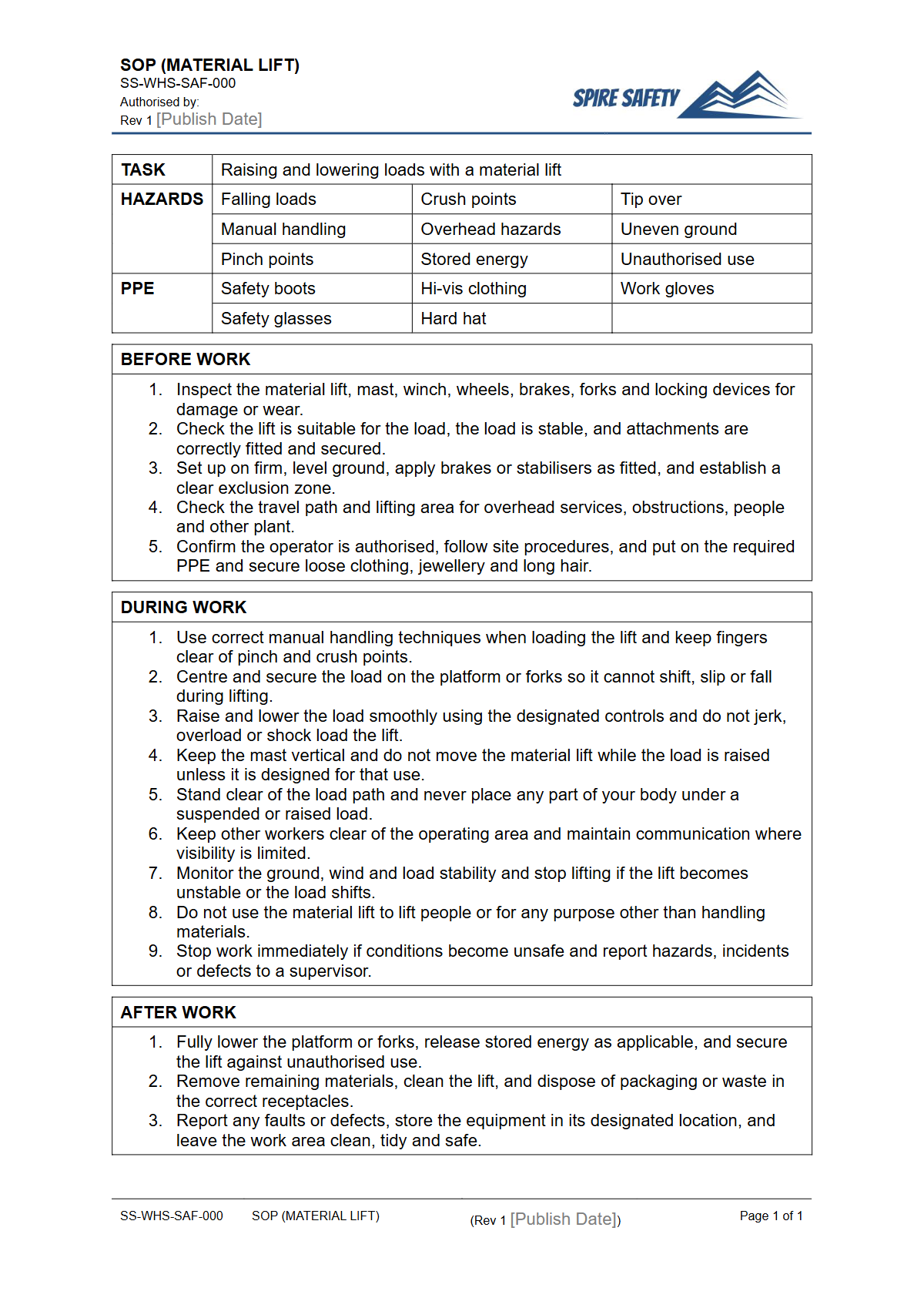
Streamline your WHS processes with our free material lift SOP template. Download this customisable document to define safe work methods and meet your legal duties.
Free Safe Operating Procedure (Material Lift) Template
DOCX • 126 KB + PDF
Updated Oct 2026
No signup required
Purpose of the Free Safe Operating Procedure (Material Lift) Template
Effectively managing workplace risks associated with plant and machinery is a core responsibility for any PCBU. This Free Safe Operating Procedure (Material Lift) Template provides a structured framework for documenting the safe use of material lifts, which are common in warehouses, construction sites, and manufacturing facilities.
Using a Safe Operating Procedure (SOP) helps standardise tasks, ensuring every operator follows a consistent, safe, and efficient method for operating the equipment. It serves as a critical administrative control, breaking down complex tasks into sequential steps, identifying associated hazards, and specifying the required control measures for each step.
This document is a foundational component of a robust safety management system, demonstrating a commitment to providing clear instructions and training for workers.
Implementing documented procedures like this is a practical way to fulfil your duties under WHS legislation. It forms an integral part of your broader WHS management systems, providing tangible evidence that you have considered the risks and communicated safe work methods to your team.
An effective SOP reduces the likelihood of incidents caused by operator error, misunderstanding, or procedural gaps, ultimately protecting both your workers and your business from the consequences of workplace accidents.
Video walkthrough
How to use the Free Safe Operating Procedure (Material Lift) Template
This template is designed as a starting point, available for download in both DOCX for easy editing and PDF for simple distribution. To create a compliant and effective document, you must customise it to reflect the specific circumstances of your workplace.
Generic procedures are insufficient; your SOP needs to detail your exact equipment, environment, and tasks.
- Consultation: Engage with the workers who operate the material lift, their supervisors, and any health and safety representatives. Their direct experience is invaluable for identifying practical hazards and effective controls.
- Risk Assessment: Use the template in conjunction with a specific risk assessment for the material lift. The findings from your risk assessment will inform the hazards and control measures you document in the SOP.
- Customisation: Fill in the sections with details specific to your site. This includes the make and model of the lift, its capacity, site-specific emergency procedures, pre-operational checks, and PPE requirements.
- Training: Once finalised, use the SOP as a training tool for all new and existing operators. Ensure every operator understands and can demonstrate the procedures outlined in the document.
Note: This document must be customised to your specific workplace. We have provided a comprehensive framework, but you are responsible for ensuring the final SOP accurately reflects your equipment, operating environment, and legal obligations. The principles applied here are similar to those in other plant-specific documents, such as our FREE Telehandler SOP Template.
When to use a Safe Operating Procedure
A Safe Operating Procedure for a material lift should be developed and implemented before the equipment is first used in your workplace. It should be a living document, readily accessible to all relevant personnel at the point of use.
You must also establish a schedule for regular review to ensure it remains current and effective. A review is necessary:
- At scheduled intervals (e.g., annually).
- After any incident, accident, or near miss involving the material lift.
- When the material lift itself is modified, replaced, or relocated.
- When the tasks or operating environment change.
- Following recommendations from regular WHS compliance auditing.
Regular reviews ensure the SOP continues to be a relevant and useful tool for managing risk, rather than just a document that sits on a shelf. Just as material moves through a facility, so should the SOP be part of a continuous improvement process, like the systems documented in our FREE Conveyer System SOP.
Who should use this document
The Material Lift SOP is a key resource for several roles within an organisation:
- Operators: As a primary reference guide for performing their tasks safely. It provides step-by-step instructions for pre-start checks, operation, and shutdown.
- Supervisors and Managers: To assist with training, competency assessments, and performance monitoring. It provides a clear benchmark for what constitutes safe operation.
- Health and Safety Personnel: As part of incident investigations, risk assessments, and workplace inspections to verify that established procedures are being followed.
- Maintenance Staff: To understand the operational procedures and requirements, particularly regarding isolation, lockout-tagout, and safe shutdown for servicing.
Properly implemented, an SOP ensures everyone from the operator to the site manager has a shared understanding of how to use equipment safely. This principle applies to all types of workplace plant, as shown in resources like our Free Air Compressor SOP Template. Find more templates for your business in our free WHS resources library.
Common mistakes
Common mistakes to avoid
- Using a generic SOP without customising it for the specific lift model and workplace.
- Failing to consult with operators and supervisors during the development process.
- Not providing practical training on the finalised SOP.
- Forgetting to review and update the procedure after an incident or when work processes change.
Legal references
Legal considerations
The following legal requirements may be relevant to this type of work.
- Work Health and Safety Act (Harmonised) — Provides the primary duties for protecting workers and other people from work health and safety risks.
- Work Health and Safety Regulations (Harmonised) — Sets out requirements supporting the management of workplace hazards and risks.
The following codes may be relevant to this type of work.
- Managing WHS Risks Code of Practice — Provides practical guidance on identifying hazards, assessing risks and applying effective controls.
- Work Health and Safety Consultation, Cooperation and Coordination Code of Practice — Provides practical guidance on consulting workers and coordinating with other duty holders.
- Managing the Work Environment and Facilities Code of Practice — Provides practical guidance on safe work environments, workplace facilities and related controls.
Did you know
Administrative Controls
Safe Operating Procedures (SOPs) are classified as an 'administrative control' in the hierarchy of risk controls. They are used to support higher-level controls like engineering and substitution.
Consultation is a Duty
Under Australian WHS law, PCBUs have a specific duty to consult with workers on matters relating to their health and safety. Developing an SOP for equipment they use is a key part of this consultative process.
FAQ
Frequently asked questions
01Is a Safe Operating Procedure legally required for a material lift in Australia?
02Who should be consulted when writing a material lift SOP?
03What is the difference between a SWMS and an SOP?
04Can this template be used for a personnel lift or hoist?
Share this resource
Free Safe Operating Procedure (Material Lift) Template
Browse Categories
How To Use It
- 1Download and open in Word or PDF.
- 2Replace the placeholders with your business details.
- 3Get it reviewed by a WHS specialist before rollout.
Need it customised?
Our WHS consultants can adapt this template to your site, run a gap analysis, or audit what you already have in place.
Book a Free Consultation WHS consulting servicesor call 1300 156 382
Related templates
- Free Safe Operating Procedure (Mattress Handling) Template
- Free Safe Operating Procedure (Meal Cart Cleaning) Template
- Free Safe Operating Procedure (Meal Cart Handling) Template
- Free Safe Operating Procedure (Meal Delivery Rounds) Template
- Free Safe Operating Procedure (Meal Service Setup) Template
- Free Safe Operating Procedure (Meat Hook Handling) Template