
Free Safe Operating Procedure (Meal Cart Handling) Template
Formalise your workplace safety protocols for handling meal carts with our structured template. Download our free Safe Operating Procedure to get started.
Free Safe Operating Procedure (Meal Cart Handling) Template
DOCX • 126 KB + PDF
Updated Oct 2026
No signup required
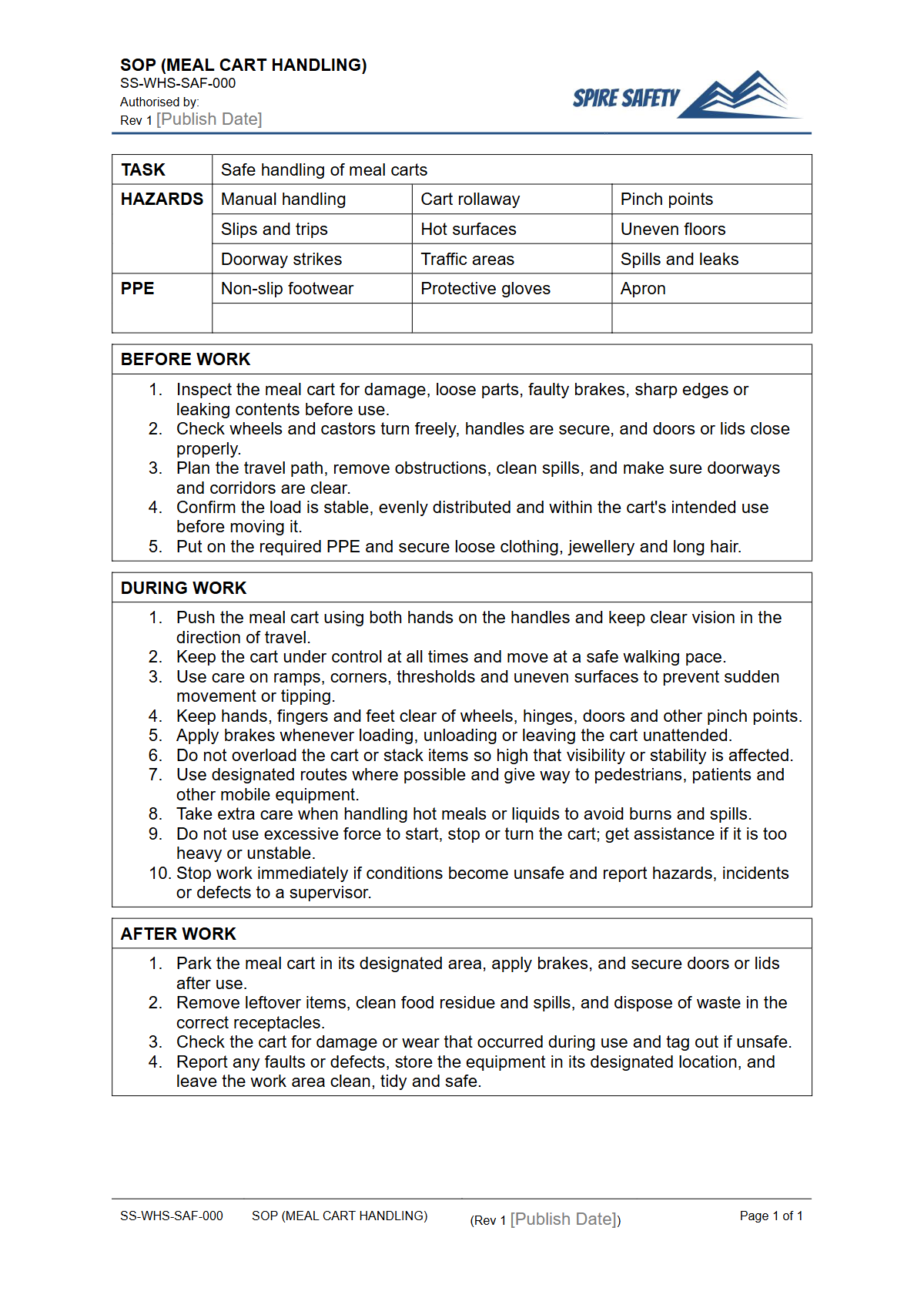
Purpose of the Free Safe Operating Procedure (Meal Cart Handling) Template
Handling meal carts, a common task in healthcare, aged care, and hospitality, presents significant manual handling risks. This Free Safe Operating Procedure (Meal Cart Handling) Template provides a structured framework for documenting a safe system of work to minimise these risks.
The purpose of a Safe Operating Procedure (SOP) is to provide clear, step-by-step instructions that guide workers in performing a task safely and consistently. By implementing a formal SOP, your organisation can reduce the likelihood of musculoskeletal injuries, slips, trips, and other incidents associated with moving loaded carts.
A well-defined SOP serves as a critical training tool for new and existing employees, ensuring everyone understands the expected safe behaviours, required personal protective equipment (PPE), and emergency procedures. It also acts as a key component of your overall safety management system, demonstrating a commitment to proactive risk management.
Integrating this document into your broader WHS management system helps create a holistic approach to workplace safety and operational excellence.
Video walkthrough
How to use the Free Safe Operating Procedure (Meal Cart Handling) Template
This template is provided in both DOCX and PDF formats to serve as a comprehensive starting point. It is designed to be adapted to the specific conditions of your work environment, including the types of carts used, the surfaces they are moved across, and the tasks being performed. To effectively use this resource, follow these steps:
- Download: Choose the DOCX format for easy editing or the PDF for reference.
- Consult: Engage with the workers who actually perform the task. Their firsthand experience is invaluable for identifying all relevant hazards and practical control measures.
- Customise: Conduct a site-specific risk assessment for meal cart handling. Use the findings to populate the template with details specific to your workplace, such as designated pathways, load limits, cleaning procedures, and required PPE.
- Review and Approve: Have the draft SOP reviewed by a supervisor, WHS representative, or manager to ensure it is accurate, comprehensive, and aligns with your organisation's policies.
Important Note: This document is a template and is not a complete safety solution on its own. We have drafted it to be aligned with Australian WHS principles, but you must customise it with your own site-specific information.
The final responsibility for its accuracy and adequacy rests with the Person Conducting a Business or Undertaking (PCBU).
When to use it
A Safe Operating Procedure for meal cart handling should be used as a primary reference document in several key situations. It forms the basis of all training for the task, whether during new employee induction or as part of regular refresher training for existing staff.
Workers should be encouraged to refer back to the SOP if they are ever unsure about the correct procedure.
The SOP should also be reviewed and referenced following any incident or near miss involving a meal cart. This process helps identify any gaps in the procedure that may have contributed to the event. In larger facilities where carts are loaded from automated lines, it's also crucial to have documented procedures for associated equipment, such as our FREE Conveyer System SOP.
Finally, the document should be a central part of periodic procedural reviews. Regular checks, often supported by internal or external WHS compliance auditing, ensure that the SOP remains relevant and effective as equipment, environments, or work practices evolve over time.
Who should use it
This SOP template is designed for a broad range of personnel within any organisation where meal carts are used. Primarily, it is for the workers who perform the task daily, providing them with clear and accessible safety instructions.
Supervisors and team leaders should use it to train their staff, monitor adherence, and conduct pre-start checks.
WHS managers, safety officers, and management personnel will use this template as a foundational document to build and maintain the organisation's safety framework. It provides a defensible, documented system of work that helps meet duty of care obligations.
If you need expert assistance in adapting this template or developing other critical safety documents, our WHS consulting services can provide tailored support. This template and others are available for download from our complete free WHS resources library, covering a wide range of tasks and equipment.
Common mistakes
Common mistakes to avoid
- Overloading carts beyond a safe weight, making them difficult to control.
- Failing to inspect cart wheels and brakes before use, leading to equipment failure.
- Leaving carts unattended in walkways or obstructing emergency exits.
- Pushing carts with poor posture or trying to move them too quickly.
Legal references
Legal considerations
The following legal requirements may be relevant to this type of work.
- Work Health and Safety Act (Harmonised) — Provides the primary duties for protecting workers and other people from work health and safety risks.
- Work Health and Safety Regulations (Harmonised) — Sets out requirements supporting the management of workplace hazards and risks.
The following codes may be relevant to this type of work.
- Managing WHS Risks Code of Practice — Provides practical guidance on identifying hazards, assessing risks and applying effective controls.
- Work Health and Safety Consultation, Cooperation and Coordination Code of Practice — Provides practical guidance on consulting workers and coordinating with other duty holders.
- Managing the Work Environment and Facilities Code of Practice — Provides practical guidance on safe work environments, workplace facilities and related controls.
Did you know
Manual Handling Risks
Musculoskeletal disorders, often resulting from hazardous manual tasks like pushing and pulling carts, are one of the most common types of work-related injuries in Australia.
Load Limits
Many meal carts don't have a manufacturer-specified maximum load capacity. A site-specific risk assessment is crucial to determine a safe weight limit based on the cart, the environment, and the worker.
FAQ
Frequently asked questions
01What hazards are associated with handling meal carts?
02How often should a Safe Operating Procedure for meal carts be reviewed?
03Is a meal cart SOP a legal requirement in Australia?
04Who is responsible for training workers on this SOP?
Share this resource
Free Safe Operating Procedure (Meal Cart Handling) Template
Browse Categories
How To Use It
- 1Download and open in Word or PDF.
- 2Replace the placeholders with your business details.
- 3Get it reviewed by a WHS specialist before rollout.
Need it customised?
Our WHS consultants can adapt this template to your site, run a gap analysis, or audit what you already have in place.
Book a Free Consultation WHS consulting servicesor call 1300 156 382
Related templates
- Free Safe Operating Procedure (Meal Delivery Rounds) Template
- Free Safe Operating Procedure (Meal Service Setup) Template
- Free Safe Operating Procedure (Meat Hook Handling) Template
- Free Safe Operating Procedure (Meat Slicer) Template
- Free Safe Operating Procedure (Meat Tenderiser) Template
- Free Safe Operating Procedure (Meat Tray Handling) Template