
Free Safe Operating Procedure (Meat Hook Handling) Template
Properly handling meat hooks is crucial for preventing serious injuries in food processing and butchery. Download our free template to outline your procedures.
Free Safe Operating Procedure (Meat Hook Handling) Template
DOCX • 126 KB + PDF
Updated Oct 2026
No signup required
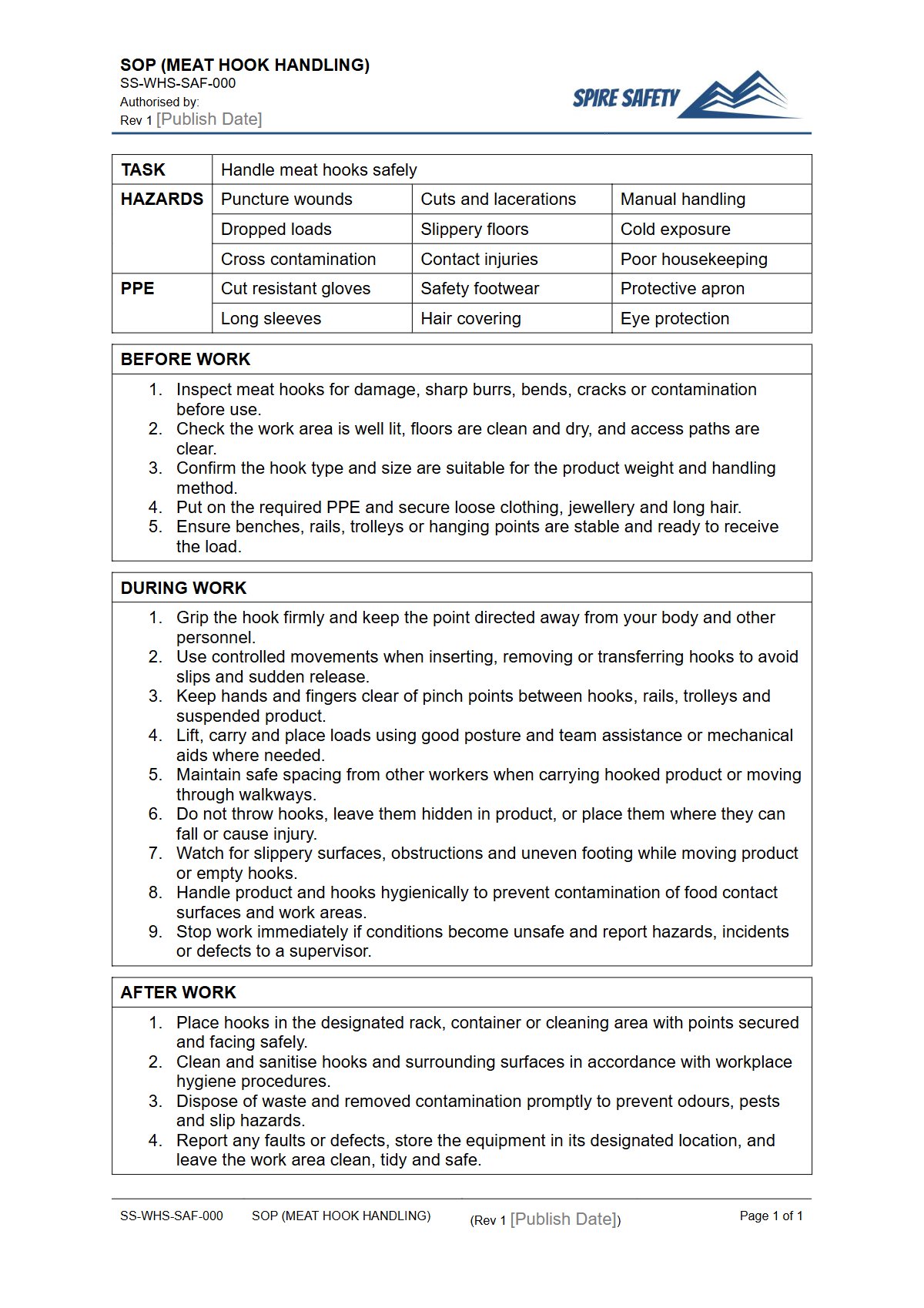
Purpose of the Free Safe Operating Procedure (Meat Hook Handling) Template
A Safe Operating Procedure (SOP) is a fundamental administrative control that formalises a safe method for performing a specific task. The purpose of this template is to guide your business in documenting the critical safety steps for handling meat hooks.
It prompts you to identify potential hazards (e.g., sharp points, heavy loads, slippery conditions), assess the associated risks, and specify the control measures required to eliminate or minimise them. Properly implementing this SOP helps standardise work practices, provides a clear basis for training and induction, and serves as a key document within your overall WHS management systems.
Video walkthrough
How to use the Free Safe Operating Procedure (Meat Hook Handling) Template
This resource is available in both DOCX and PDF formats for your convenience. The DOCX file is fully editable, allowing you to tailor the content to the specific equipment, environment, and tasks at your worksite.
We recommend you work through each section, adding site-specific details, PPE requirements, and emergency procedures.
Important: This is a template only. You must customise it to reflect the unique hazards and control measures relevant to your specific workplace.
We strongly recommend consulting with your workers and a safety professional during this process to ensure the final document is comprehensive and effective. If you need assistance, Spire Safety offers expert WHS consulting services to help you develop site-specific documentation.
When is an SOP for Meat Hooks Needed?
This Safe Operating Procedure should be a core part of your daily operations and training cycle. It is used to train new workers during their induction, ensuring they understand the approved method from day one.
It should also be used for regular refresher training for existing staff to prevent complacency and reinforce safe behaviour. Following an incident or near-miss involving a meat hook, the SOP should be reviewed and updated. It's also critical when introducing new types of hooks, new products, or changing a process, such as updating the workspace or installing a new processing line that interacts with a FREE Conveyer System SOP.
Who Is Responsible for This Safe Operating Procedure?
Responsibility for this SOP is shared across multiple roles. Workers (butchers, meat packers, process workers) must understand and follow the procedure every time they handle meat hooks.
Supervisors and Team Leaders are responsible for providing training, monitoring compliance, and ensuring the procedure is followed correctly. Managers and Persons Conducting a Business or Undertaking (PCBUs) hold the ultimate responsibility for ensuring a safe system of work is developed, implemented, and reviewed regularly.
The effectiveness of this SOP should be verified through workplace observations and periodic WHS compliance auditing to confirm its practical application.
Explore our extensive catalogue of safety documents in our free WHS resources library to find more templates that can support your safety management framework.
Common mistakes
Common mistakes to avoid
- Using damaged, bent, or dull hooks that require excessive force to use.
- Failing to use appropriate Personal Protective Equipment (PPE), such as cut-resistant gloves and aprons.
- Improper lifting and handling techniques, leading to back strains and other musculoskeletal injuries.
- Neglecting regular cleaning and sanitisation of hooks, creating biological hazards and risking product contamination.
Legal references
Legal considerations
The following legal requirements may be relevant to this type of work.
- Work Health and Safety Act (Harmonised) — Provides the primary duties for protecting workers and other people from work health and safety risks.
- Work Health and Safety Regulations (Harmonised) — Sets out requirements supporting the management of workplace hazards and risks.
The following codes may be relevant to this type of work.
- Managing WHS Risks Code of Practice — Provides practical guidance on identifying hazards, assessing risks and applying effective controls.
- Work Health and Safety Consultation, Cooperation and Coordination Code of Practice — Provides practical guidance on consulting workers and coordinating with other duty holders.
- Managing the Work Environment and Facilities Code of Practice — Provides practical guidance on safe work environments, workplace facilities and related controls.
Did you know
Ergonomic Design
Modern meat hooks often feature ergonomic handles to reduce the fatigue and strain associated with repetitive gripping and lifting, lowering the risk of musculoskeletal disorders.
Colour Coding
Some facilities use colour-coded meat hooks to segregate different types of products (e.g., pork, beef, organic) or to distinguish between raw and cooked product lines, helping to prevent cross-contamination.
FAQ
Frequently asked questions
01What are the main hazards associated with handling meat hooks?
02Is a Safe Operating Procedure for meat hook handling a legal requirement in Australia?
03How often should training on this SOP be conducted?
04Can this template be used for different types of meat hooks?
Share this resource
Free Safe Operating Procedure (Meat Hook Handling) Template
Browse Categories
How To Use It
- 1Download and open in Word or PDF.
- 2Replace the placeholders with your business details.
- 3Get it reviewed by a WHS specialist before rollout.
Need it customised?
Our WHS consultants can adapt this template to your site, run a gap analysis, or audit what you already have in place.
Book a Free Consultation WHS consulting servicesor call 1300 156 382
Related templates
- Free Safe Operating Procedure (Meat Slicer) Template
- Free Safe Operating Procedure (Meat Tenderiser) Template
- Free Safe Operating Procedure (Meat Tray Handling) Template
- Free Safe Operating Procedure (Meat Trimming) Template
- Free Safe Operating Procedure (Mechanical Isolation) Template
- Free Safe Operating Procedure (Mechanical Press) Template