
Free Safe Operating Procedure (Mechanical Press) Template
Manage mechanical press hazards with our free Safe Operating Procedure template. Download the customisable DOCX to define safe work steps for your team.
Free Safe Operating Procedure (Mechanical Press) Template
DOCX • 126 KB + PDF
Updated Oct 2026
No signup required
Purpose of the Free Safe Operating Procedure (Mechanical Press) Template
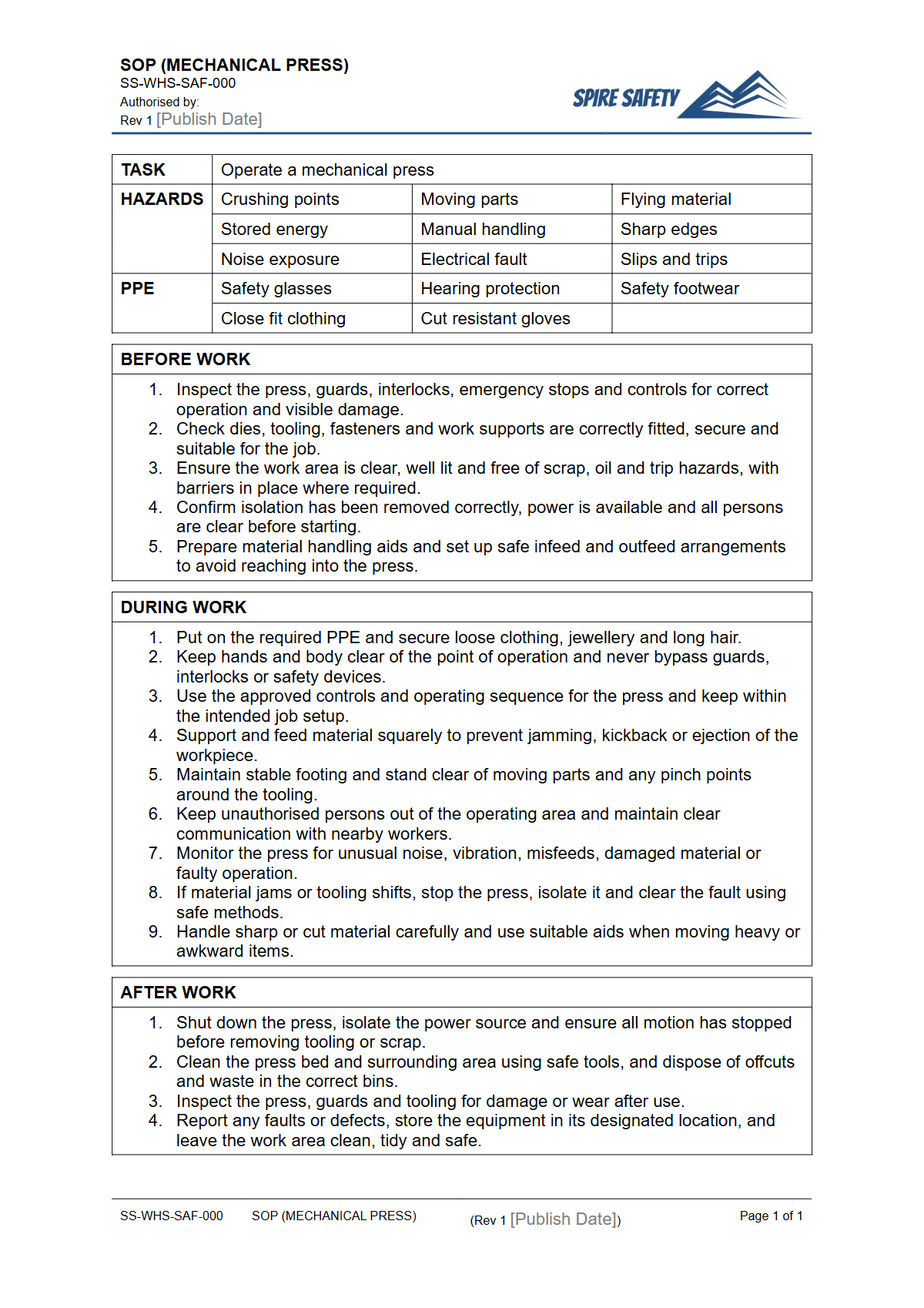
This Free Safe Operating Procedure (Mechanical Press) Template provides a structured framework for documenting the safe use of mechanical power presses in your workplace. Its primary purpose is to help Persons Conducting a Business or Undertaking (PCBUs) control the significant risks associated with this type of plant, including crushing, shearing, entanglement, and impact injuries.
By clearly outlining pre-operational checks, step-by-step instructions, and emergency responses, the SOP serves as a vital tool for operator training, competency verification, and risk management. It forms a key component of a broader safety framework, helping to standardise safe work practices across all shifts and operators.
A well-developed SOP is a practical demonstration of an organisation's commitment to safety and a fundamental element of effective WHS management systems. It helps ensure that everyone who interacts with the equipment understands the hazards and the required control measures, from machine guarding and emergency stops to correct material handling and the use of personal protective equipment (PPE). Formalising these procedures helps minimise human error and promotes a consistent, safety-first approach to machine operation.
Video walkthrough
How to use the Free Safe Operating Procedure (Mechanical Press) Template
To use this template effectively, download the DOCX file and adapt it to the specific make, model, and configuration of the mechanical press in your workplace. Generic procedures are a starting point, not a final solution.
The document includes prompts and sections that you must fill in with details relevant to your machinery, tasks, and environment. This customisation process is critical for ensuring the procedure is practical and effective at managing the actual risks present.
Important: We have created this document as a guide, and it must be customised to your specific workplace, equipment, and processes. You must consult with your workers, supervisors, and health and safety representatives during its development.
Review the manufacturer’s operating manual and any relevant technical standards to ensure all specific safety features and warnings are included. For machinery with different operating principles, you may need a different document, such as our FREE Hydraulic Press SOP (Safe Operating Procedure) Template.
When to use a Safe Operating Procedure
A Safe Operating Procedure for a mechanical press should be used consistently as a reference and training tool. It is not a document to be filed away and forgotten.
It should be readily accessible to operators at or near the machine. Key times to use the SOP include during new worker inductions and task-specific training, before starting a new job or production run, and when conducting refresher training.
Supervisors should use it to observe work practices and verify competency. The SOP is also a critical reference document following an incident or near miss, helping to guide the investigation and identify any procedural gaps.
It should also be reviewed during routine safety inspections and formal WHS compliance auditing to ensure it remains current and effective.
Who should use this Safe Operating Procedure
This SOP should be used by anyone who interacts with or is responsible for the mechanical press. This includes:
- Machine Operators: As their primary guide for performing their work safely.
- Supervisors and Team Leaders: To train workers, enforce safe procedures, and conduct informal safety observations.
- Maintenance and Service Personnel: To understand the required lockout/tagout (LOTO) procedures and operational safety controls before commencing work.
- Health and Safety Representatives (HSRs) and WHS Officers: As a tool for risk assessment, training validation, and workplace inspections.
- Trainees and Apprentices: As a foundational learning document under the direct supervision of a competent person.
For operations involving other common workshop equipment, it's essential to have specific SOPs for each. For instance, procedures for compressed air systems can be detailed using our Free Air Compressor SOP (Safe Operating Procedure) Template to manage associated hazards like high-pressure air and noise.
Key Elements of a Mechanical Press SOP
A robust SOP for a mechanical press should contain several critical sections to provide comprehensive guidance. Our template is structured to cover these areas, ensuring you have a solid foundation for developing your site-specific document.
Pre-Operational Checks
Before any work begins, operators must conduct a series of checks to ensure the machine is in a safe condition. This section of the SOP should list specific items to inspect, such as the physical condition of guards and interlocks, the function of two-hand controls, the clarity and accessibility of emergency stop buttons, and a general inspection for leaks or damage.
This routine helps identify potential faults before the machine is energised, preventing incidents. If your team requires expert guidance in formalising these critical safety steps, consider engaging with professional WHS consulting services.
Step-by-Step Operating Instructions
This is the core of the SOP, detailing the safe sequence of actions for a typical work cycle. It should break down the task into logical steps, from loading the die and workpiece to initiating the press stroke and safely removing the finished part.
Instructions should be clear, unambiguous, and focus on the required safety behaviours at each stage, such as keeping hands clear of the point of operation and using appropriate tools for material handling. For other fabrication tasks, ensure you have equally detailed guides, like a FREE Circular Saw SOP (Safe Operating Procedure) Template, to maintain safety standards across all equipment.
Post-Operational and Shutdown Procedures
The SOP must also define the correct process for shutting down the press at the end of a shift or job. This includes powering down the machine, cleaning the immediate work area of scrap and offcuts, and storing tools and dies correctly.
It should also specify any required lockout procedures if the machine is to be left for maintenance or extended non-use. This ensures the press is left in a safe, neutral state, preventing unauthorised or accidental start-up.
You can find more templates like this in our free WHS resources library to support your other operational needs.
Common mistakes
Common mistakes to avoid
- Failing to customise the template with details specific to the machine's make, model, and installed guarding.
- Neglecting to consult with experienced operators when drafting or reviewing the procedure.
- Treating the SOP as a one-time compliance task instead of a 'living document' that requires regular review and updates.
- Providing the SOP without practical, hands-on training and competency verification for operators.
Legal references
Legal considerations
The following legal requirements may be relevant to this type of work.
- Work Health and Safety Act (Harmonised) — Provides the primary duties for protecting workers and other people from work health and safety risks.
- Work Health and Safety Regulations (Harmonised) — Sets out requirements supporting the management of workplace hazards and risks.
The following codes may be relevant to this type of work.
- Managing WHS Risks Code of Practice — Provides practical guidance on identifying hazards, assessing risks and applying effective controls.
- Work Health and Safety Consultation, Cooperation and Coordination Code of Practice — Provides practical guidance on consulting workers and coordinating with other duty holders.
- Managing the Work Environment and Facilities Code of Practice — Provides practical guidance on safe work environments, workplace facilities and related controls.
Did you know
Point of Operation
The area on a press where work is performed on the material, such as cutting, shaping, or forming, is officially known as the 'point of operation'. It is the most common location for serious injuries to occur.
Force and Energy
Unlike a hydraulic press which applies continuous pressure, a mechanical press derives its force from a flywheel that stores kinetic energy. This energy is released rapidly when the clutch is engaged, resulting in a powerful stamping motion.
FAQ
Frequently asked questions
01Is a Safe Operating Procedure a legal requirement for a mechanical press in Australia?
02What is the most critical part of a mechanical press SOP?
03How often should a mechanical press SOP be reviewed?
04Can I use this template for a hydraulic press?
Share this resource
Free Safe Operating Procedure (Mechanical Press) Template
Browse Categories
How To Use It
- 1Download and open in Word or PDF.
- 2Replace the placeholders with your business details.
- 3Get it reviewed by a WHS specialist before rollout.
Need it customised?
Our WHS consultants can adapt this template to your site, run a gap analysis, or audit what you already have in place.
Book a Free Consultation WHS consulting servicesor call 1300 156 382
Related templates
- Free Safe Operating Procedure (Mechanical Room Clean) Template
- Free Safe Operating Procedure (Medical Gas Cylinder) Template
- Free Safe Operating Procedure (Medication Fridge Clean) Template
- Free Safe Operating Procedure (Mesh Bender) Template
- Free Safe Operating Procedure (Mesh Cutter) Template
- Free Safe Operating Procedure (Metal Detector) Template