
Free Safe Operating Procedure (Mesh Cutter) Template
Download our free Safe Operating Procedure (Mesh Cutter) Template to define safe work practices for your team. Customise our DOCX or PDF to suit your site.
Free Safe Operating Procedure (Mesh Cutter) Template
DOCX • 126 KB + PDF
Updated Oct 2026
No signup required
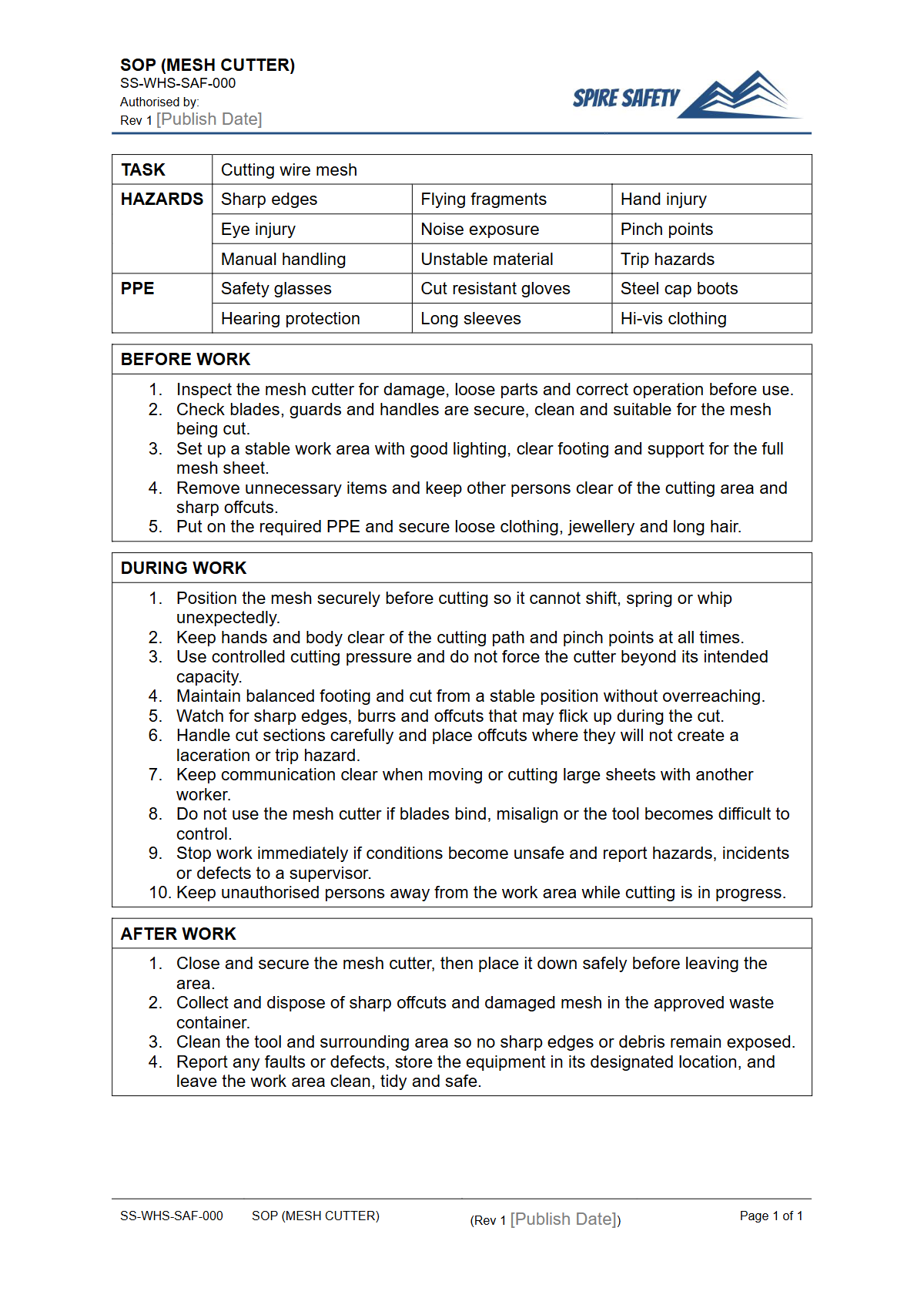
Purpose of the Free Safe Operating Procedure (Mesh Cutter) Template
A well-defined Safe Operating Procedure (SOP) is essential for managing the risks associated with using mesh cutters in construction, manufacturing, and recycling environments. This free Safe Operating Procedure (Mesh Cutter) Template provides a structured framework for your organisation to document the specific steps for safely operating this equipment.
Using this template helps control significant hazards such as lacerations from sharp edges, entanglement with moving parts, high-pressure fluid injection from hydraulic systems, and musculoskeletal injuries from manual handling.
By clearly outlining pre-start checks, operational steps, and emergency protocols, this Safe Operating Procedure helps standardise safe work practices across your team. Implementing documented procedures is a fundamental part of building robust WHS management systems that protect your workers and ensure operational consistency.
What is included in this Safe Operating Procedure?
This template is a comprehensive starting point aligned with Australian WHS principles. It includes sections for:
- Required Personal Protective Equipment (PPE)
- Pre-operational safety and equipment checks
- Step-by-step instructions for the cutting task
- Post-operational procedures (shutdown and clean-up)
- Emergency response actions
- Associated risks and control measures
Video walkthrough
How to use the Free Safe Operating Procedure (Mesh Cutter) Template
To get started, simply download the template in your preferred format (DOCX for easy editing or PDF for straightforward printing) and begin adapting it to your operational context. The document is designed to be user-friendly, allowing you to insert site-specific information, machinery details, and company branding.
Important Note: This document is a template and must be customised to reflect your specific workplace. You need to incorporate details about the make and model of your mesh cutters, the types of materials being cut, the work environment, and your organisation's specific safety protocols.
We have provided a comprehensive starting point, but its effectiveness depends on your input and commitment to its implementation.
The principles of pre-start checks and hazard identification are similar for other cutting equipment. For example, the need to inspect blades and guards is also a critical step in our FREE Circular Saw SOP Template.
When to use it
A Safe Operating Procedure for a mesh cutter should be a core part of your daily operations and safety management system. It is a live document that should be used during:
- Operator Training and Induction: To ensure all new and existing workers understand the correct and safe way to use the equipment.
- Pre-start Inspections: As a checklist to verify the machine is in safe working order before each use.
- Task Planning: To review the steps and required controls before commencing a specific cutting job.
- Incident Investigations: To help identify if procedural deviations contributed to an incident or near-miss.
- Audits and Reviews: As evidence of your organisation's commitment to safe work practices.
When conducting a formal review of your safety processes, an effective SOP is a key piece of evidence that can be assessed during a WHS compliance auditing process to verify that documented procedures are in place and being followed.
Who should use it
This procedure is designed for several key roles within a workplace to ensure a shared understanding of safety requirements:
- Machine Operators: To follow as their primary guide for safe operation.
- Supervisors and Managers: To use for training, monitoring performance, and enforcing safety standards.
- WHS Personnel: To integrate into the broader workplace health and safety management system and use as a basis for risk assessments.
- Maintenance Staff: To understand operational hazards and safety lockouts before commencing maintenance or repair work.
The SOP should also be familiar to those operating other machinery in the vicinity, particularly when equipment interaction is possible. For instance, when materials are being moved into the cutting area, operators of other plant should be aware of the mesh cutter's operational zone. Similar principles of spatial awareness are detailed in our FREE Telehandler SOP Template.
Just as pneumatic tools require specific checks before use, your mesh cutter SOP should detail maintenance schedules and daily inspections. For related procedures on ancillary workshop equipment, you might find our Free Air Compressor SOP Template a useful reference.
You can find more templates like this one in our complete free WHS resources library, which offers a wide range of documents to support your safety goals.
Common mistakes
Common mistakes to avoid
- Using a cutter with dull, chipped, or incorrect blades, leading to kickback or failed cuts.
- Failing to properly secure the workpiece, allowing it to move unexpectedly during cutting.
- Neglecting to inspect hydraulic hoses for leaks, bulges, or abrasion before operation.
- Positioning hands or other body parts too close to the cutting jaws during operation.
Legal references
Legal considerations
The following legal requirements may be relevant to this type of work.
- Work Health and Safety Act (Harmonised) — Provides the primary duties for protecting workers and other people from work health and safety risks.
- Work Health and Safety Regulations (Harmonised) — Sets out requirements supporting the management of workplace hazards and risks.
The following codes may be relevant to this type of work.
- Managing WHS Risks Code of Practice — Provides practical guidance on identifying hazards, assessing risks and applying effective controls.
- Work Health and Safety Consultation, Cooperation and Coordination Code of Practice — Provides practical guidance on consulting workers and coordinating with other duty holders.
- Managing the Work Environment and Facilities Code of Practice — Provides practical guidance on safe work environments, workplace facilities and related controls.
Did you know
Hydraulic Force
Hydraulic mesh cutters can generate immense cutting forces, often exceeding 100 tonnes. This power easily severs reinforced steel but also presents a significant risk of high-pressure fluid injection if a hydraulic line is damaged.
Hand Injuries
According to Safe Work Australia, hands are one of the most frequently injured body parts in Australian workplaces, with machinery operation being a leading cause of serious incidents. Clear procedures and correct PPE are critical controls.
FAQ
Frequently asked questions
01What should be included in a Safe Operating Procedure for a mesh cutter?
02Is a SWMS required for using a mesh cutter?
03How often should mesh cutter SOPs be reviewed?
04Who is responsible for training workers on the mesh cutter SOP?
Share this resource
Free Safe Operating Procedure (Mesh Cutter) Template
Browse Categories
How To Use It
- 1Download and open in Word or PDF.
- 2Replace the placeholders with your business details.
- 3Get it reviewed by a WHS specialist before rollout.
Need it customised?
Our WHS consultants can adapt this template to your site, run a gap analysis, or audit what you already have in place.
Book a Free Consultation WHS consulting servicesor call 1300 156 382
Related templates
- Free Safe Operating Procedure (Metal Detector) Template
- Free Safe Operating Procedure (Metal Locator) Template
- Free Safe Operating Procedure (Metal Pickling) Template
- Free Safe Operating Procedure (Meter Installation) Template
- Free Safe Operating Procedure (Meter Room Cleaning) Template
- Free Safe Operating Procedure (Metering Pump) Template